
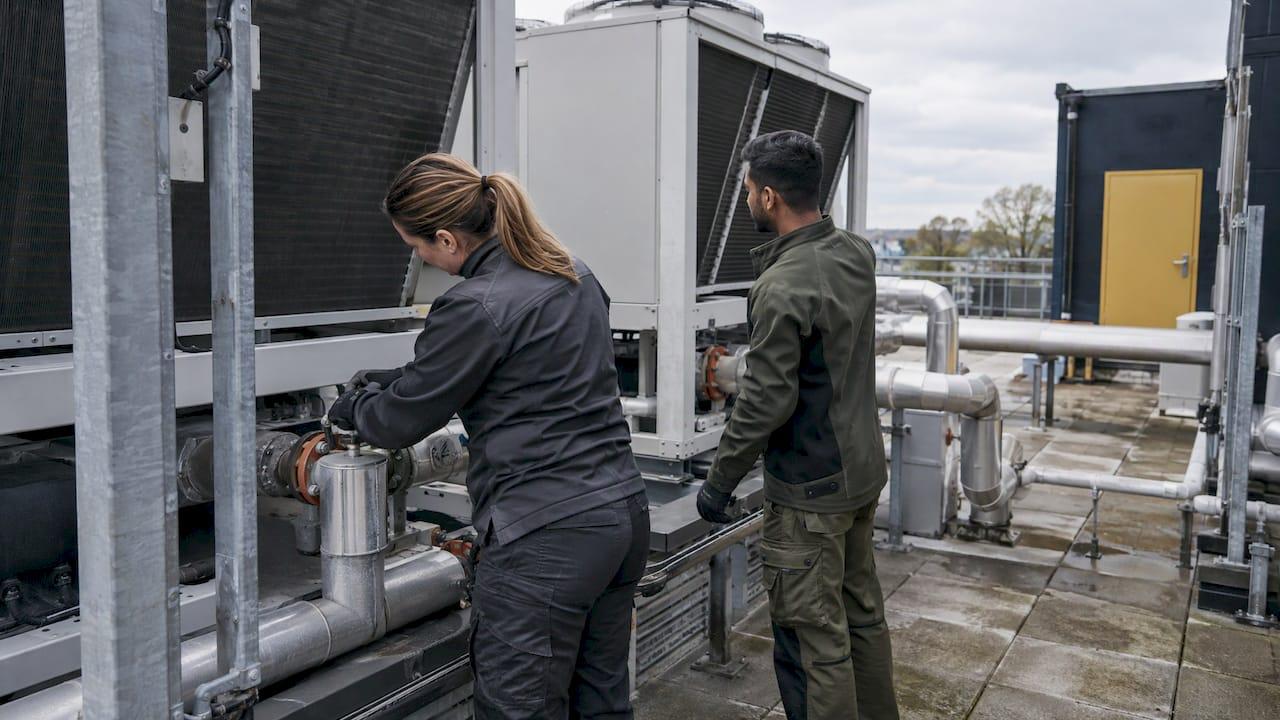
A multi-engineer job is any job that needs two or more engineers, on the same site, at the same time or across several visits. It goes well when one shared record holds the scope, the skills required, who is going and what each person has to evidence. It goes badly when that information sits in a diary, a spreadsheet and three phone calls. This guide sets out how to plan, dispatch and close these jobs in a UK service or engineering business, and where a connected platform takes the admin off your office team.
A note on the search itself: if you are an engineer looking for multi-skilled vacancies, you want a job board. This article is for the person who runs the work: the owner, operations lead or office manager who has to put several engineers on one job and get paid for it.
TL;DR
- A multi-engineer job needs a single job record that every engineer and the office can see, not a message thread.
- Decide crew size from the task and the risk (lone working, lifting, height), then match people by skill and certificate, not by who is free.
- Brief each engineer on their part of the job, and have each one capture their own evidence, photos and sign-off.
- Close the job once: combined paperwork, one invoice, one audit trail.
- Our platform brings scheduling, dispatch, certificates, the mobile app and invoicing into one system, from £99 per month.
Table of Contents
- What counts as a multi-engineer job
- Why multi-engineer jobs go wrong
- How to plan a multi-engineer job, step by step
- Safety rules that should shape your crew size
- One record for every engineer on the job
- A worked example: a two-trade plant room job
- Our perspective
- Put multi-engineer jobs on one platform
- FAQ
- Sources
What counts as a multi-engineer job
The phrase covers more than one situation, and each one needs slightly different planning:
- Same-time crews. Two or more engineers on site together, for example a lift of heavy plant, a switchgear changeover or a boiler house replacement.
- Mixed-trade jobs. An electrician and a mechanical or HVAC engineer, each doing the part that needs their qualification, on one scope of work.
- Sequenced visits. One engineer isolates and makes safe, a second returns to repair, a third commissions and certifies.
- Multi-site programmes. A planned preventive maintenance (PPM) contract split across a portfolio of buildings, with several engineers each covering part of it.
- Support pairs. A senior engineer with an apprentice or assistant, where the second person is there to supervise, assist or provide cover for safety reasons.
In job adverts, "multi-skilled engineer" means something related but different: one person who covers both mechanical and electrical maintenance. Employers often use the label for flexibility, and the real role can lean towards one discipline. When you are the employer sending out crews, that distinction matters for a different reason: a multi-skilled engineer can reduce how many people you need on a job, but only if their actual competence and certificates cover every task you are asking of them.
Why multi-engineer jobs go wrong
A single-engineer job has one owner. A multi-engineer job has several, and the problems appear in the gaps between them.
Nobody holds the whole scope. The office knows the customer's request, engineer A knows what they found on the first visit, and engineer B turns up having heard only half of it. The result is a wasted trip, a second visit and an unhappy customer.
The wrong mix of skills. The job is booked as "two engineers, Tuesday". On the day, both are electrically qualified and the task also needs someone with a gas, refrigerant or lifting competence. Booking by availability instead of by capability is the most common cause.
Evidence scattered across people. Each engineer photographs something on their own phone, completes their own paperwork and sends it to the office in their own way. When a client or auditor asks for the complete job file months later, someone spends an afternoon assembling it.
Billing delays. Invoicing waits until every engineer's timesheet, parts list and certificate has arrived. One missing item holds up the whole invoice, which is a cash-flow cost as well as an admin one.
Hidden compliance risk. If one of the engineers' certifications has lapsed, you may not find out until after the visit. Our guide on audit-ready engineer certification tracking covers how to keep that from happening.
All four are information problems, not engineering problems. That is why they are solved by how you structure the job record and the dispatch, rather than by hiring more coordinators.
How to plan a multi-engineer job, step by step
1. Write the scope once, in one place
Start with a job record that states the site, the access arrangements, the work to be done, the equipment involved and the customer's contact. Everything else hangs off this. If the scope is in an email and the schedule is in a diary, you already have two versions.
Where it goes wrong: scope changes by phone after the job has been booked, and only one engineer hears about it. Any change should be made on the record, so everyone sees it.
In our platform, jobs, customers, engineers, assets and compliance sit in one connected system, so the scope, the site's asset register and the people assigned are viewed from the same place.
2. Decide how many engineers the task really needs
Crew size comes from the task and the risk, not from habit. Ask three questions:
- Does the task physically need two people, such as a heavy or awkward lift?
- Does the risk assessment say the work should not be done alone?
- Do you need different qualifications in the same visit?
The safety rules in the next section should shape this answer. If none of the three applies, a single engineer with a second visit may be cheaper than two on site.
3. List the skills and certificates the job requires
Break the scope into tasks and write down the competence each one needs: Gas Safe registration, an electrical qualification, F-Gas certification, lifting competence, water hygiene training, site-specific inductions. This list is what you match people against.
The common mistake is to describe the job by trade ("HVAC job") and not by task. A refrigeration repair, an electrical isolation and a controls adjustment are three different competences, and one "HVAC engineer" may not hold all three.
4. Match engineers by capability, then by availability
With the requirements list in hand, filter the people who qualify first, then look at who is free, who is nearest and who knows the site. Doing it the other way round gets you a full diary and a job nobody can legally finish.
Our article on skills-based scheduling for UK field service teams walks through this approach in more detail, and the piece on an engineer competency matrix with 90 and 30 day alerts shows how to see expiring competence before it blocks a job. If your engineers also work shifts or on-call patterns, rota scheduling for engineers covers that side.
Our platform's scheduling and engineer dispatch are built to sit alongside its compliance tracking, so qualifications and bookings live in the same system rather than in separate spreadsheets.
5. Brief each engineer on their own part
Each engineer should know what they are responsible for, what they hand over to the next person and what evidence they must capture. A short written brief on the job record beats a conversation in the van park. Name a lead engineer for the visit, the person who talks to the customer, signs the site in and decides if the plan has to change.
6. Capture evidence as the work happens
Photos, readings, parts used and test results should be recorded on the job, by the engineer who did the task, at the time. Retyping from memory at the end of the week produces gaps and disputes. Engineers working in plant rooms, basements or rural sites often lose signal, so an app that works offline matters here. Our mobile engineer app is offline capable and supports document and photo capture, so the record builds up on site.

7. Close the job once
When all engineers have finished, the office should see one complete job: every visit, every certificate, every photo, the time and parts used. Review it against a checklist before it goes to the customer. Our job audit checklist for UK field service managers sets out six groups of checks that suit this review.

Then invoice from the job, not from a pile of separate timesheets. Because jobs, certificates and invoicing sit in the same platform, the figures that go to the customer come from the same record the engineers wrote to.
Safety rules that should shape your crew size
Sending two engineers instead of one is sometimes a commercial choice and sometimes a legal necessity. Two areas of UK health and safety guidance come up most often.
Lone working. The Health and Safety Executive (HSE) defines a lone worker as someone who works by themselves without close or direct supervision, and says employers should provide training, supervision, monitoring and support for lone workers. Lone workers face the same hazards as anyone else, but may have nobody to help if something goes wrong. For each job, your risk assessment should tell you whether one engineer can safely do the work alone or whether a second person is needed. Lone working is not banned, but where the assessment says the work needs a second person, the job is a two-engineer job whatever the diary looks like.
Lifting operations. Under LOLER, the Lifting Operations and Lifting Equipment Regulations 1998, all lifting operations involving lifting equipment must be properly planned by a competent person, appropriately supervised and carried out safely. For a multi-engineer job that includes a lift, that means the plan, the competent person and the supervision are decided before the crew arrives, and written down on the job.
If you are unsure how these apply to a specific task, your safety adviser or the HSE guidance is the right place to confirm it, because the answer depends on the work, the site and the equipment.
One record for every engineer on the job
The most valuable thing you can do for multi-engineer work is stop thinking of it as several jobs that happen to be related. It is one job with several contributors. In practice that means:
- One job number that every visit, certificate and photo attaches to.
- One site and asset history, so the next crew can see what the last crew found.
- One status view for the office, so nobody has to ring round to ask who is where.
- One audit trail, showing who did what and when.
- One route to the invoice, built from what was recorded.
Our platform is designed around this idea of a single source of truth: field teams and office teams work from the same information, and managers get visibility of jobs, customers, assets, compliance and performance through role-based dashboards. It also generates certificates and reports for the standards UK service firms work to, including Gas Safe, EICR, PAT, LOLER, F-Gas, fire safety and water hygiene, so the paperwork a mixed-trade crew produces ends up in one place.
If your multi-engineer work is delivered under maintenance contracts, the same record helps protect your margin. Our piece on maintenance contract management for service businesses explains how to tie visits and costs back to the contract they belong to.
A worked example: a two-trade plant room job
Take a facilities management firm asked to replace a pump and its control panel in a commercial building's plant room, with one engineer's electrical isolation needed before the mechanical engineer can work.
- Scope. The office records the site, the asset, the work and the access conditions on one job.
- Crew. The task list shows two competences: electrical isolation and mechanical pump replacement. The risk assessment also calls for a second person present during isolation. Two engineers are booked, with one named as lead.
- Matching. Only engineers whose records show the right qualifications are offered for each task. Of those, the two closest to the site and free that morning are assigned.
- Briefing. The electrical engineer's brief covers isolation, lock-off and a test photo. The mechanical engineer's covers removal, installation and a commissioning reading.
- On site. Each captures photos and readings in the app against their own task. The signal in the plant room is poor, but the work is saved on the device.
- Close. The office sees both sets of evidence on one job, checks it against the audit checklist, issues the paperwork and raises one invoice.
No one phoned a colleague for a photo, no one rebuilt the file, and no one invoiced a job that was missing a certificate.
Our perspective
We built Curcle inside a real UK service and engineering business, and the multi-engineer job is where disconnected information hurts most. One engineer knows one half of the job, the office knows the other, and the customer is left holding the gap.
Our view is that a job with several engineers should still be one job. Scheduling, dispatch, compliance, evidence and invoicing should read from the same record, so field and office teams are never working from different versions of the truth.
That is why compliance sits at the backbone of the platform instead of being bolted on, and why we say every click should earn its place. If an engineer has to type something twice to keep the office informed, the software is working against the team. Our aim is operational software that shows you what needs attention, rather than only recording what has already happened.
Luke Herridge
Put multi-engineer jobs on one platform
If your crews, certificates and invoices still live in separate tools, Curcle brings scheduling, engineer dispatch, certificate and report generation, asset and site registers, compliance tracking and invoicing into one connected system, with an offline-capable mobile app for the engineers on site. Plans start from £99 per month for Starter, from £249 per month for Professional and from £499 per month for Business, with Enterprise available on request. You can see what each includes on our pricing page.

We build for UK field service, engineering, maintenance, facilities management, commercial catering, electrical and HVAC businesses. If yours is one of them, our features overview shows how the pieces fit, and the pages for facilities management, HVAC and electrical contractors show how that looks in your trade.
FAQ
What is the difference between a multi-engineer job and a multi-skilled engineer?
A multi-engineer job needs two or more people on the same piece of work. A multi-skilled engineer is one person qualified across more than one discipline, usually mechanical and electrical. A multi-skilled engineer may reduce the number of people a job needs, but only if their certificates cover every task in the scope.
How do I decide whether a job needs two engineers?
Look at the task, the risk assessment and the competences required. If the work is physically a two-person task, if the assessment says it should not be done alone, or if it needs qualifications one person does not hold, book two. Record the reasoning on the job so it is clear later.
Who should be in charge when several engineers are on site?
Name one lead engineer on the job record before the visit. They are the customer's point of contact, they confirm the site arrangements and they decide if the plan has to change. The others know what they own and what they hand over.
How do I keep one invoice for a job with several engineers?
Record time, parts and certificates against a single job number as the work happens, then invoice from that record. Waiting for separate timesheets and emails is what delays billing. In our platform, invoicing sits in the same system as jobs and compliance, so the invoice draws on what was recorded.
Does every engineer on a multi-engineer job need their own evidence?
Yes. Each engineer should capture the photos, readings and sign-off for the task they performed, on the shared job. That gives you an audit trail showing who did what, and it avoids reconstructing the file from memory afterwards.
Sources
- Protecting lone workers: how to manage the risks of working alone (HSE, INDG73)
- Lifting Operations and Lifting Equipment Regulations 1998 (LOLER) overview (HSE)