

Maintenance contract management is the discipline of recording every service agreement in one place, setting the SLAs and pricing that govern each job, and tracking renewals before they lapse. The immediate action, if none of that exists yet, is simple: build a contract register today and set automated renewal alerts. Bodies like the JCT and platforms like Curcle both exist because that single step prevents most of the disputes and lost revenue that follow.
TL;DR:
- Most maintenance contracts should be based on a clear asset register, defined scope, and precise exclusions to avoid billing disputes and ensure clarity.
- Pricing should be built around fixed fees, rates, retainer, or per-call models, with costs including labor, parts, travel, and response time premiums for emergencies.
- Automated renewal alerts, a central contract system, and SLA dashboards are essential features to prevent missed renewals and monitor performance effectively.
- Regular contract audits and performance tracking, including response times and compliance certificates, help maintain profitability and avoid scope creep.
- Using a unified platform like Curcle streamlines contract management, improves data visibility, and reduces dispute risk through integrated asset, SLA, and renewal tracking features.
Table of Contents
- What types of maintenance contracts should you offer?
- How should you price a maintenance contract?
- How do you set up and run a maintenance contract?
- What features matter most in contract management software?
- How does a platform built inside a real service business help?
- How do you monitor contract performance and prove it's working?
- How do you protect profitability on maintenance contracts?
- How do you handle disputes and breach of contract?
- What should a contract review or audit checklist cover?
- Three mistakes that quietly wreck maintenance contracts
- Get your contracts into one system with Curcle
- Useful templates and guidance for contract setup
- Sources
- FAQ
What types of maintenance contracts should you offer?
The contract type you choose should match the asset's criticality, not your default template. Four structures cover most of the work UK service businesses take on.
- Preventive (PPM/AMC): scheduled inspections and servicing at fixed intervals, used for statutory safety work such as gas, electrical or fire systems where lapses carry legal exposure.
- Corrective: reactive repair only, triggered by a fault report, suited to low-value or non-critical assets where scheduled visits would waste budget.
- Condition-based: servicing triggered by sensor data or inspection findings rather than a calendar, common on plant where wear varies by usage.
- Risk-based: contract intensity scaled to consequence of failure, often layered onto critical plant such as lifts, boilers or standby generators.
Most businesses run a blend. A facilities client might sit on a preventive contract for fire alarms, corrective cover for minor joinery, and a risk-based tier for the boiler room. Whatever the mix, state exclusions clearly. Vandalism, third-party damage and consumables (filters, belts, refrigerant top-ups) are the exclusions that cause the most billing arguments if left ambiguous.
How should you price a maintenance contract?
Pricing decides whether a contract makes money or quietly drains it. Four models dominate the sector.
- Fixed fee: one price for defined, predictable scope. Works well for straightforward PPM with a stable asset count.
- Schedule of rates: labour and materials billed against a published rate card, ideal where job volume or asset mix varies. The JCT Repair and Maintenance Contract is built around exactly this structure for programmed jobbing work.
- Retainer or subscription: a recurring fee covering a bundle of visits or hours, popular for smaller commercial clients who want budget certainty.
- Per-call: no standing fee, billed only when work happens, best reserved for low-frequency, low-risk assets.
Build your cost model before you quote, not after you win the job. Add labour, parts, travel time, admin overhead, a contingency margin and, where response times are tight, an SLA premium. A four-hour emergency response costs more to staff than a next-business-day slot, and the price should reflect that difference honestly.
Flexible pricing, combining a schedule of rates with clearly defined call-out fees, tends to work best across multi-site contracts where asset mix varies from site to site.
Pro Tip: Build a price-review clause into every contract over 12 months. Without one, rising parts and labour costs erode margin quietly until the renewal conversation forces an uncomfortable jump.
Minimum term length matters as much as the rate. A 12-month minimum with a 90-day notice period protects revenue predictability without locking clients into terms they resent.
How do you set up and run a maintenance contract?
Setting up a contract properly the first time saves months of chasing paperwork later. Follow this sequence for every new agreement.
- Build or update the asset register, listing every item covered, its location and any statutory inspection requirement.
- Define scope precisely, including inclusions, exclusions and response time bands.
- Agree pricing and get written client sign-off before the first job is scheduled.
- Load the contract into a central system and link it to the relevant assets and site.
- Set automated renewal and expiry alerts, ideally 60 and 30 days out.
Once live, three operational tasks keep the contract running smoothly:
- Schedule PPM visits against the contract calendar so nothing relies on memory.
- Raise every job from the contract record itself, so completed work links directly to invoicing.
- Track SLA performance (response time, first-time fix rate) against the agreed matrix, not against gut feel.
Amendments happen constantly, additional assets, revised pricing, a change of site contact, and each one needs a dated record. Effective contract management for operations and maintenance work depends on defining rules and performance measures at the outset, because retrofitting governance after a dispute starts is far harder than agreeing it up front. Keep a full audit trail: who signed what, when a variation was agreed, and what evidence supports every completed visit.
What features matter most in contract management software?
The right software removes the two failure points that cost service businesses the most: missed renewals and billing that doesn't match what was actually agreed. Look for these capabilities before signing up to anything.
- A central contract register that holds every agreement, its terms and its pricing in one searchable place.
- Asset linkage, so each contract connects directly to the specific equipment, site and job history it covers.
- Automated renewal and expiry alerts, removing the reliance on someone remembering a date in a spreadsheet.
- SLA dashboards that flag a breach risk before it becomes a missed response, not after.
- Document storage and audit trails covering signed agreements, variations and compliance evidence.
- Mobile or offline engineer apps, so field data feeds the contract record without a second data-entry step back at the office.
Centralising contracts in a single system also automates approvals and links agreements directly to invoicing and purchasing, which closes the gap between work done and work billed. That gap, more than any single missed renewal, is usually where profitability leaks fastest on multi-site accounts.
How does a platform built inside a real service business help?
Some platforms solve the common admin problems service businesses face: disconnected spreadsheets, missed renewals and lack of a single view of at-risk SLAs. It can bring jobs, customers, assets, compliance and contracts into one register rather than treating each as a separate system.
- A unified contract and asset register, so every PPM schedule and SLA sits against the equipment it covers.
- Automated renewal alerts that flag expiring agreements before they lapse.
- Templates can help get a contract register running without building one from scratch.
Pro Tip: When evaluating any platform, ask three questions: how long does migration actually take, what onboarding support is included, and can you see evidence of live customers using it day to day, not just a features list.
Start with a free trial before committing, and time how long it takes to get your existing contracts loaded.
How do you monitor contract performance and prove it's working?
Numbers, not impressions, tell you whether a contract is delivering. Track response time against the agreed SLA band, first-time fix rate, number of reactive call-outs on a preventive contract (a rising count usually signals under-scoped PPM), and missed or late visits.
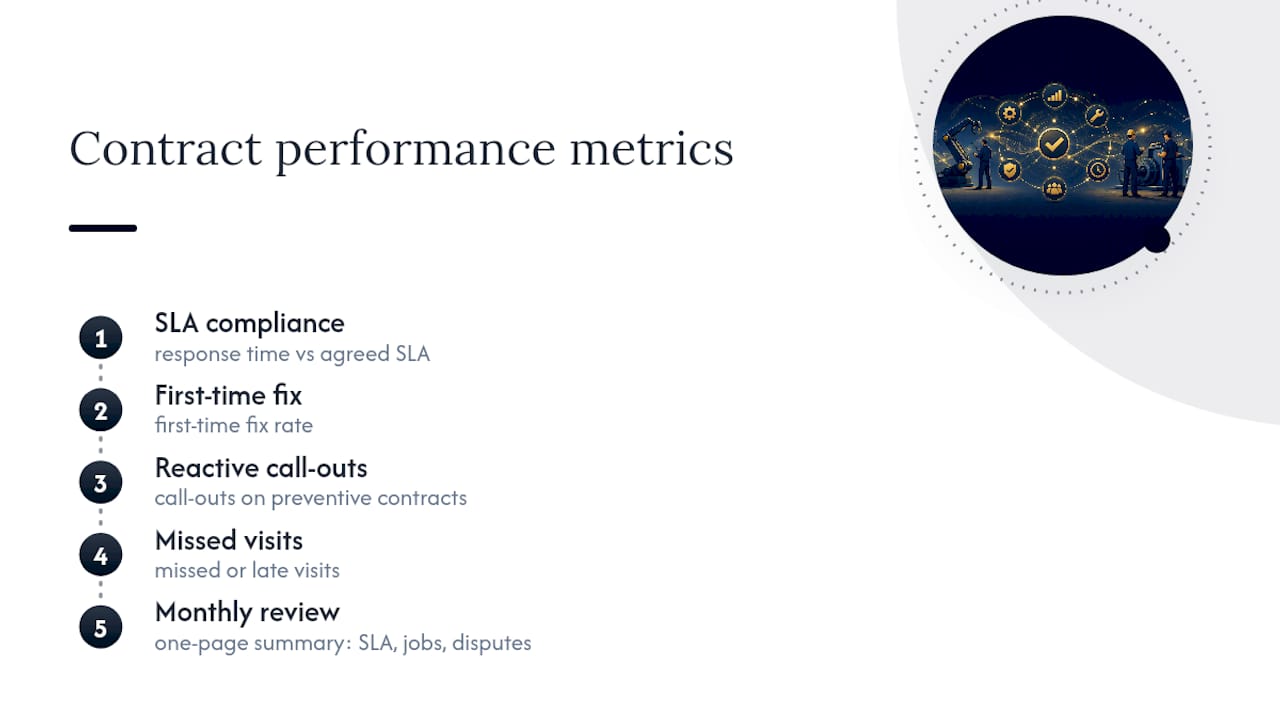
Report these monthly for larger accounts and quarterly for smaller ones. A one-page summary showing SLA compliance percentage, jobs completed against the schedule, and any open disputes gives clients confidence and gives you an early warning system. If response times are consistently missed on one contract type, that's a resourcing problem, not a client problem, and it's cheaper to fix before renewal than to discover it during a dispute.
Compliance evidence deserves its own reporting line. For statutory work, a client should be able to see, at any point, when the last inspection happened and where the certificate lives. That single piece of visibility does more to justify a contract's price at renewal time than any sales conversation.
Set a simple reporting cadence and stick to it. Contracts reviewed quarterly against real performance data renew more smoothly than contracts revisited only when something goes wrong.
How do you protect profitability on maintenance contracts?
Profitability erodes in small increments, one under-priced call-out, one missed price review, one contract that quietly outgrew its original scope without a corresponding price change. Protecting margin means watching those increments, not just the headline contract value.
Start by tracking actual cost against quoted price per contract, not just across the book as a whole. A contract that looked profitable at signing can slide into loss once fuel costs rise or an asset ages and needs more frequent attention. Review this at each renewal point, not annually in bulk.
Scope creep is the second drain. When a client adds assets or requests extra visits informally, capture it as a written variation with a price attached, even a small one. Left unrecorded, these additions accumulate until a contract that should be profitable is barely breaking even.
Bundling helps where it's genuine. Combining PPM across several asset types on one site, rather than running separate agreements for HVAC, electrical, and fire systems, cuts your travel and admin overhead per visit. That saving can either widen your margin or become the discount that wins the renewal, your choice, but it should be a deliberate decision rather than an accident of how the contracts happened to get signed.
How do you handle disputes and breach of contract?
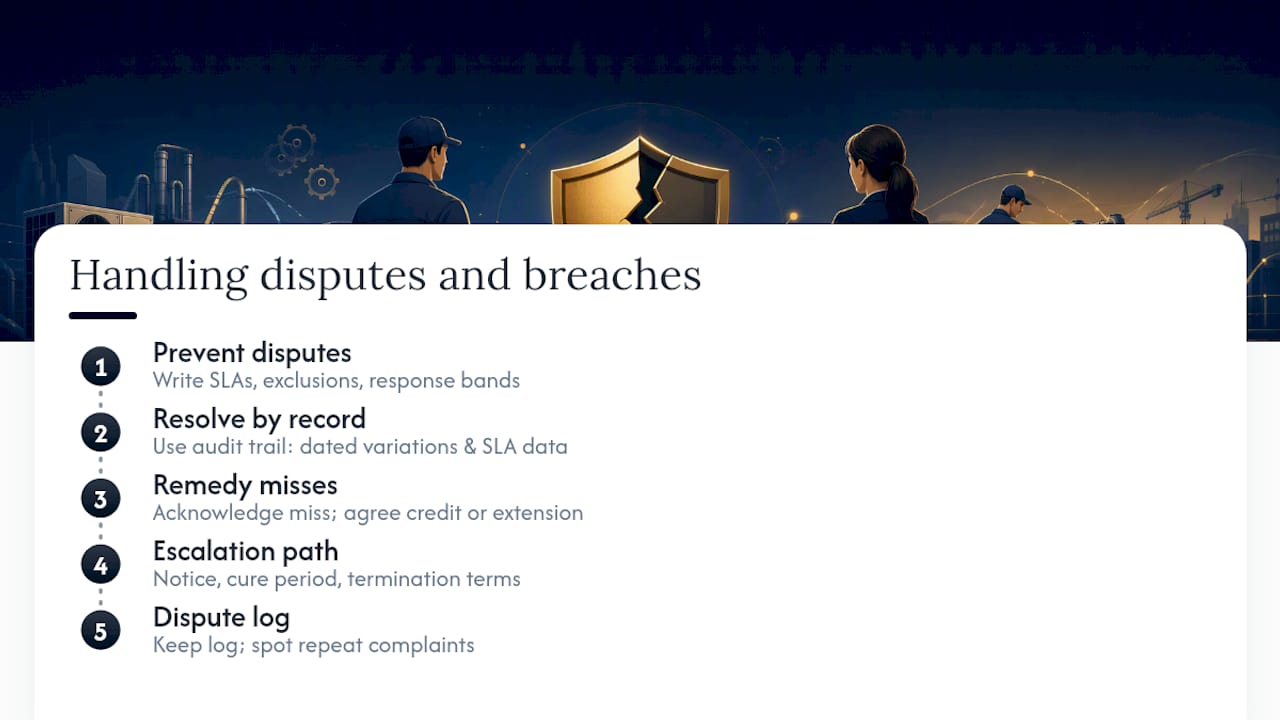
Most contract disputes trace back to one thing: a term that was ambiguous at signing. The fix starts before any disagreement, by writing SLA definitions, exclusions and response bands in specific, measurable language rather than general reassurance.
When a dispute does arise, resolve it against the written record, not memory. This is why an audit trail matters so much: dated variation agreements, timestamped job records and stored SLA performance data settle most disagreements in minutes rather than weeks. If the record shows the response time was met, say so and show the evidence. If it shows a genuine miss, acknowledge it and agree a remedy quickly, a service credit or an extended term, rather than letting it fester into a renewal-time argument.
Serious breaches, non-payment, repeated SLA failure, unauthorised subcontracting, need an escalation path defined in the contract itself: a written notice period, a cure period to put things right, and a termination clause that specifies what happens to outstanding work and equipment. Without that written path, both sides end up negotiating the exit terms from scratch under pressure, which rarely goes well for either party.
Keep a dispute log even for minor complaints. A client who raises the same issue three times in a year is telling you something about the contract's scope or pricing, not just about that particular job.
What should a contract review or audit checklist cover?
A structured review, done at least annually and always before renewal, catches problems long before they become disputes. Run through the same checklist every time so nothing gets skipped under time pressure.
- Confirm the asset register still matches what's on site, additions and removals happen more often than paperwork tracks.
- Check SLA performance data against the agreed matrix for the full contract period, not just the last quarter.
- Review pricing against actual delivered cost, including any variations agreed since the last renewal.
- Verify compliance certificates and inspection records are current and correctly filed.
- Confirm contact details, site access arrangements and emergency escalation contacts are accurate.
- Read the exclusions clause aloud with fresh eyes. Does it still reflect what actually happens on site?
Treat the annual audit as a client-facing document, not an internal formality. A short written summary handed to the client at renewal, showing SLA compliance, work completed and any recommended scope changes, does more for retention than a discount ever will.
Three mistakes that quietly wreck maintenance contracts
The businesses that lose money on contracts usually make the same three errors: no central register, so nobody can say what's actually live; manual renewal tracking, so agreements lapse unnoticed; and vague SLA wording that means everyone argues about what "prompt" actually meant.
The fix is one governance habit, not three separate ones: a central register, automated alerts, and a written SLA matrix, applied consistently. Get that right and disputes fall, renewals stop leaking, and contract revenue becomes something you can actually forecast.
— Luke Herridge
Get your contracts into one system with Curcle
Curcle is the alternative to running contracts across spreadsheets, paper files and someone's memory for renewal dates. It maps directly onto the needs this guide has covered: a central contract register, PPM scheduling tied to your asset list, SLA tracking that flags a breach risk early, and compliance templates ready to use rather than built from a blank page.
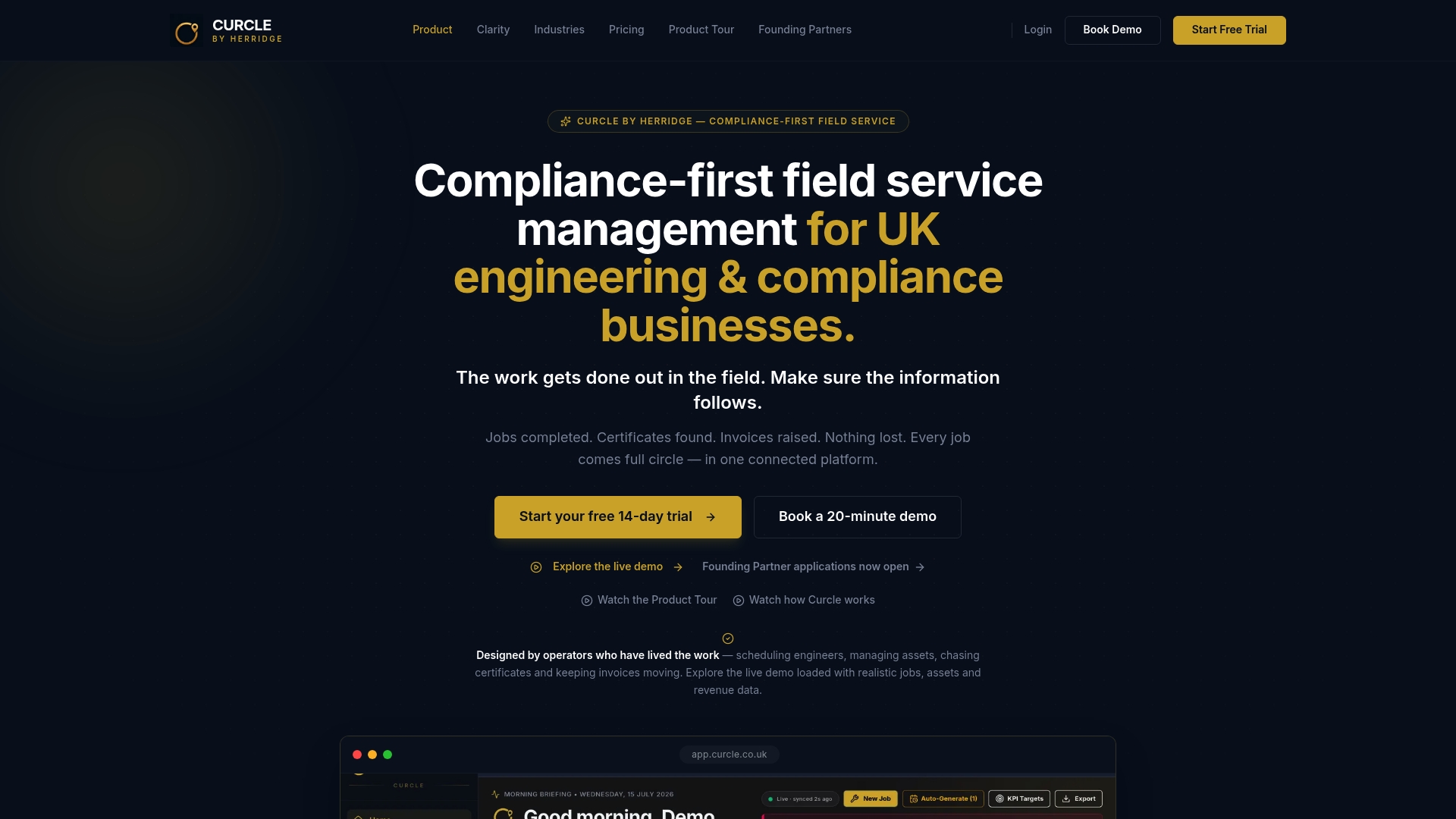
Two ways to see whether it fits your business. Book a walkthrough on the Curcle product tour to see contract workflows in action, or start with the free compliance templates if you'd rather test the paperwork side first. If you want a rough sense of what centralising contract admin could save your business, the savings calculator gives a starting estimate before you commit to anything. From there, the field service management platform is where the full contract, PPM and SLA workflow lives day to day.
Useful templates and guidance for contract setup
- The JCT Repair and Maintenance Contract offers sample clauses and pricing structures for programmed repair work.
- Curcle's free compliance templates cover CP12, EICR and LOLER documentation for immediate use.
- Businesses in Scotland should check the Scottish Building Contracts Committee suite for jurisdictional variants before adopting a standard template.
Sources
FAQ
What should be included in a maintenance contract?
A maintenance contract needs defined scope, covered assets, explicit exclusions, pricing structure, SLA response times, contract length, renewal terms and a dispute or termination clause.
What are the five steps of contract management?
A practical version covers: build the asset register and scope, agree pricing and get sign-off, load the contract into a central system with alerts, run and monitor delivery against SLAs, then review and renew based on performance data.
How do I set up a maintenance contract?
Start by recording the asset list and scope, agree pricing using a fixed-fee, schedule of rates, or retainer model, get written sign-off, then load the contract into a system such as Curcle that links it to assets and sets renewal alerts.
What is the salary of a contract manager?
Salary varies widely by sector, seniority and region, and no single UK-wide figure applies consistently, so check current listings on a recruitment site for your specific trade and location.
How often should a maintenance contract be reviewed?
Review performance quarterly where possible and always run a full audit before renewal, checking SLA compliance, pricing against actual cost, and whether the asset register still matches what's on site.