

Engineer certification tracking means keeping every licence, statutory certificate and job authorisation your field staff hold in one place, checked against expiry dates automatically. The right move is to stop managing this through spreadsheets or shared drives and centralise it into an auditable system with built-in expiry alerts. UKAS guidance based on ISO/IEC 17020 sets the bar for how personnel competence should be assessed and recorded, and platforms like Curcle exist to make that standard practical for day-to-day operations rather than a once-a-year scramble.
TL;DR:
- Centralising engineer certificates and licenses into a single system with role-based access reduces manual errors and ensures audit readiness.
- Automated expiry alerts should give warnings weeks before certificates lapse, supporting primary-source verification where possible.
- Mobile, offline data capture and enforced input fields improve record accuracy and ease on-site evidence collection.
- Linking certificates directly to assets and jobs allows quick verification of compliance for specific equipment and sites.
- Regular reassessment, supervision, and documented audits are essential to maintain competence and meet UKAS standards.
Table of Contents
- What engineer certification tracking must cover
- What to require when you buy or spec a system
- How to implement engineer certification tracking in 6 steps
- Maintaining competence: training, assessment and reassessment
- Preparing for audits and client evidence requests
- Where manual systems break down
- Why a purpose-built platform closes the gap
- Priorities for this quarter
- Get audit-ready faster with Curcle
- Sources
What engineer certification tracking must cover
A tracking system is only as good as the records inside it. Miss a field and you lose the evidence an auditor or client will ask for the moment something goes wrong on site.
At minimum, each engineer record needs to hold:
- Registration and licence numbers for schemes such as Gas Safe, along with the issuing body and scope of registration.
- Certificate files themselves (PDFs, scanned originals) rather than just a note that one exists.
- Condition codes and outcomes for documents like an EICR, which under BS 7671 format needs coded findings, not free text.
- Authorised activity scope, meaning exactly which tasks and equipment types the certificate or authorisation covers.
- Timestamped evidence, so every photo, signature, or PDF upload is logged with a date and device, not just filed loosely.
- Links to jobs and assets, tying each certificate to the specific site, boiler, lift, or appliance it relates to.
Each field earns its place because a regulator or client rarely asks "do you have a certificate?" They ask "show me the certificate for this asset, on this date, done by this engineer, and prove it hasn't lapsed." Without asset and job linking, that question takes hours to answer instead of seconds.
What to require when you buy or spec a system
Procurement conversations for compliance software tend to drift into feature lists. Cut through that by requiring five things, in this order of priority.
- A single source of truth with role-based access. Every licence and certificate lives in one place, and exportable audit logs show who viewed or edited what, and when.
- Automated expiry and renewal workflows. The system should flag lapsing certificates weeks ahead, not the day after they expire, and support primary-source verification where the issuing body allows it.
- Mobile, offline-capable capture. Engineers need to photograph, sign, and upload evidence on site, even without signal, with fields enforced so incomplete records can't be submitted.
- Authorisation registers mapped to competencies. Each engineer's record should show exactly which tasks they're cleared for and at what supervision level, matching the structure UKAS recommends.
- Integration with job scheduling and asset registers. Certification data needs to sit next to the job it was generated for, feeding into reporting dashboards rather than a separate silo.
Pro Tip: When shortlisting systems, ask each vendor to show you an exported audit pack for a single engineer, live, in the demo. If it takes more than two minutes to produce, that's the adoption problem waiting to happen once your team is under real pressure.
Lower-friction capture tends to beat feature-heavy tools that engineers quietly avoid, according to Quickler's field compliance research, which is worth remembering before you pick the system with the longest feature list.
How to implement engineer certification tracking in 6 steps
Moving off spreadsheets doesn't need a six-month project. It needs a clear order of operations.
- Audit existing records. Pull together every certificate and licence you currently hold, however scattered, and classify each by expiry date and regulatory risk.
- Choose your single source of truth. Specify the exact fields and evidence types (registration number, PDF, condition code, photo) before you migrate anything.
- Migrate and assign owners. Move records across, name a responsible person for each engineer's file, and configure renewal reminders.
- Map competencies to tasks. Set authorisation rules so the system enforces who can be assigned to which job type.
- Pilot with a small team. Train engineers on mobile capture and offline submission before rolling out wider, since adoption failures usually surface in week one.
- Set a review cadence. Schedule reassessment dates, live witnessing, and periodic audit drills so the system stays current rather than becoming another stale record.
Maintaining competence: training, assessment and reassessment
ISO/IEC 17020's competence guidance, as interpreted by UKAS, runs on a lifecycle: train, assess, authorise, monitor, reassess. Skip the monitoring step and the whole chain becomes a paper exercise.
In practice this means:
- Running written tests or supervised on-site witnessing before granting authorisation, not just accepting a training certificate at face value.
- Issuing an internal authorisation certificate that states supervision level and any restrictions on the work an engineer can do unsupervised.
- Scheduling reassessment at fixed intervals, with live witnessing at least every two years for many inspection roles.
- Keeping documented monitoring activity, meaning report reviews, spot audits and supervisor meetings logged against each engineer's record, not held in someone's memory.
Preparing for audits and client evidence requests
Auditors and clients tend to ask for the same things: registers of authorised engineers, the certificates themselves, evidence that witnessing and training actually happened, and proof that renewals are current.
Prepare these exports before you're asked for them:
- Individual competence dossiers per engineer, showing training, authorisation and reassessment history.
- Asset-linked certificate histories, so every boiler, appliance or lift shows its full compliance record in one view.
- Renewal logs with clear red, amber and green status against expiry dates.
- Corrective-action histories for any certificate that flagged a fault or condition code requiring follow-up.
Retention matters as much as content. CP12 records, for instance, need holding for at least two years, and a defensible timestamp on every document is what turns a claim into evidence.
Where manual systems break down
Spreadsheets and shared inboxes fail in predictable ways: version conflicts, inconsistent file naming, missed expiry dates, and no way to verify a certificate against the issuing body. Certemy's research on licence tracking found that centralised systems with automated reminders and clear owner accountability are what close this gap, not stricter spreadsheet discipline.
Fixes are straightforward:
- Enforce required fields so incomplete records can't be saved.
- Give one person ownership of each engineer's file.
- Measure adoption directly, tracking active users and first-month completion rates rather than assuming the rollout worked.
It's usually a field that's too fiddly to fill in on a phone screen in the rain.*
Why a purpose-built platform closes the gap
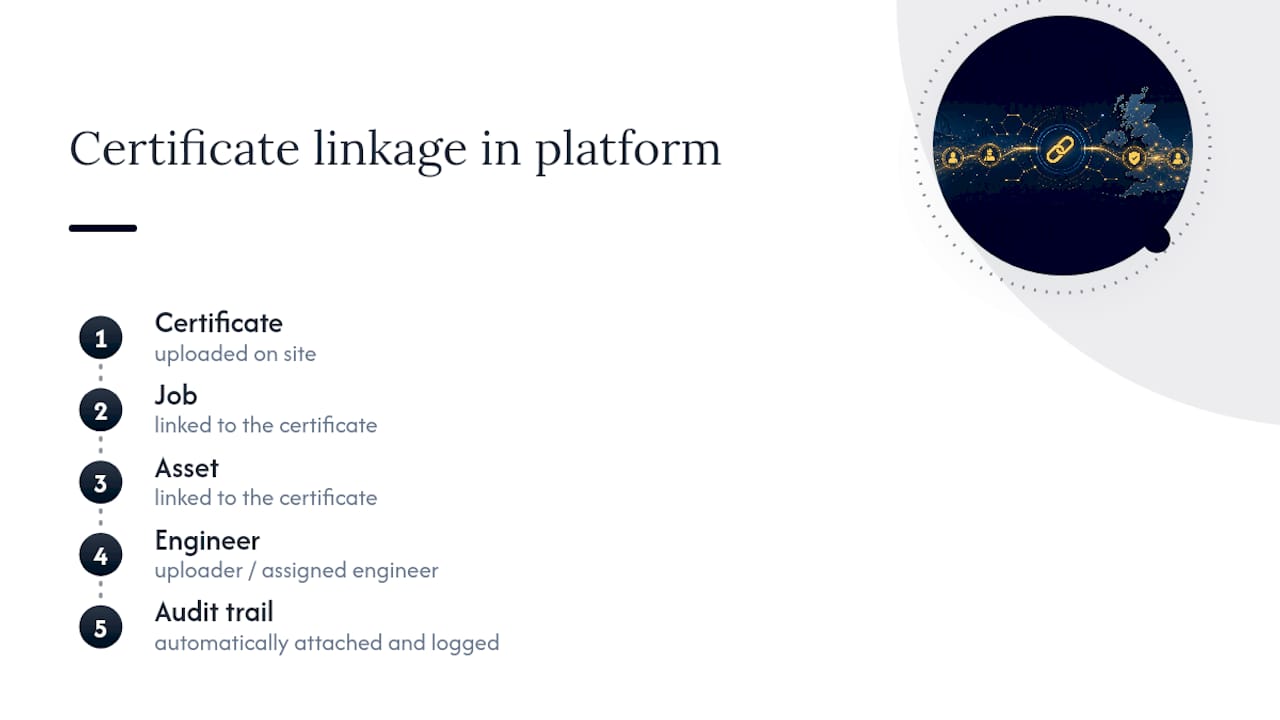
A real UK service and engineering business shaped how it handles compliance rather than treating it as a bolt-on feature. It consolidates jobs, engineers, assets and compliance records into one system, so a certificate uploaded on site links straight back to the job and asset it belongs to, with an audit trail attached automatically.
For teams that want to start before committing to a full system, Curcle offers a free PAT testing register template and an EICR inspection checklist to standardise how evidence gets captured across a team. Security matters here too: audit-sensitive certification data needs role-based access controls and export logs that hold up under client or regulator scrutiny, not just a shared folder with everyone's login.
Priorities for this quarter
Get central records and expiry automation working before touching anything else. Track three numbers: time to produce an audit pack, percentage of engineers with current authorisations, and renewal compliance rate. Pilot on one team for 30 days first.
— Luke Herridge
Get audit-ready faster with Curcle
Curcle is the practical alternative to stitching together spreadsheets, shared drives and reminder emails for engineer compliance. Where manual tracking leaves gaps at renewal time, Curcle centralises licences, certificates and job authorisations into one auditable record, with expiry workflows that flag lapsing certificates before they become a client-facing problem.

The features covered throughout this guide map directly onto what Curcle offers: audit logs, mobile capture for on-site evidence, and certificate templates for EICR and PAT testing built into the platform's features. If you'd rather see it working than read about it, the product tour walks through exactly how a certificate uploaded on site connects to a job and an asset automatically. When you're ready to move off manual tracking, the field service management platform is the place to start, and downloading the free EICR inspection checklist is a low-effort way to see the standard before you commit to anything.
Sources
- UKAS — Guidelines on the competence of personnel undertaking engineering inspections
- Why manual license tracking fails field service teams (Certemy)
- Field compliance reporting for UK SMEs (Quickler)