

An engineer competency matrix is a live record that ties every technician to the job types, tickets and proficiency levels they're cleared for, with expiry dates that gate dispatch automatically. The immediate move: block dispatch on any expired ticket and switch on 90 and 30-day renewal alerts before you do anything else. Get that right and you protect first-time fix rates and give auditors evidence in seconds, not days.
TL;DR:
- Dispatch should automatically block engineers with expired tickets and activate renewal alerts 90 and 30 days before expiry to prevent compliance breaches.
- The skills matrix must include specific job types, qualifications with issuing bodies, proficiency levels, and timestamps for issue and expiry dates to remain accurate.
- Ownership of the matrix needs to be assigned to a single role responsible for updates, renewals, and escalation, ensuring continuous compliance and audit readiness.
- Automated alerts and linking certifications directly to jobs help maintain certification currency and streamline proof collection during audits.
- Focusing on high-risk, single-engineer job types and expiring credentials in the next 30 days prevents bottlenecks and reinforces operational resilience.
Table of Contents
- What is an engineer competency matrix and why do operations teams need one?
- What fields belong in an engineer skills matrix?
- How do you build or migrate a practical competency matrix?
- Who owns the matrix and how do you keep the evidence audit-ready?
- How should dispatchers use the matrix day to day?
- What tools and records keep the matrix accurate?
- What matters most when your diary's full and renewals are looming?
- See how Curcle handles certification tracking and dispatch gating
- Sources
- FAQ
What is an engineer competency matrix and why do operations teams need one?
Confusion happens fast here, so it's worth being blunt: this is a dispatch and compliance tool, not a career-ladder document. If you've seen "competency matrix" used to map software engineers onto seniority tiers, forget it. In field service, the matrix exists to answer one question instantly. Can this person legally and competently do this job, right now?
A skills matrix in field service works by turning scattered certificates and training records into a single queryable dataset. This way, a dispatcher isn't ringing round asking who's still in-date on F-Gas. Done properly, it delivers several concrete gains:
- Correct dispatch first time, because the system won't offer an engineer who isn't qualified for the job type.
- Fewer return visits caused by sending someone under-skilled for the fault in hand.
- Audit-ready evidence pulled in minutes rather than assembled after the auditor calls.
- Training spend aimed at genuine gaps instead of generic refreshers nobody needed.
The Mandatory Technical Competence Framework reinforces why this can't stay informal: businesses on Competent Person Schemes must keep documented records of each individual's skills, qualifications, experience and CPD, and revalidate on a defined cycle. A spreadsheet nobody updates won't survive that scrutiny.
What fields belong in an engineer skills matrix?
The structure matters more than the software you eventually put it in. Get the columns wrong and every dispatch decision downstream inherits the error. A technician skill matrix needs to connect people, credentials and work orders, which means the following fields as a baseline:
- Job type or asset category (e.g. domestic gas boiler, three-phase HVAC unit, LOLER-rated lifting equipment).
- Required certificate or qualification, with issuing body named explicitly (Gas Safe, NICEIC, F-Gas, CITB).
- Proficiency level on a defined scale.
- Issue date and expiry date for every time-limited credential.
- Evidence link to the scanned certificate or assessment record.
- Assessor name and last-assessed date.
On proficiency, field-service templates commonly use a 0 to 5 grid: 0 for no exposure, 3 as the dispatchable floor for unsupervised work, 5 for someone who could train others. Treat Level 3 as the typical minimum dispatch level.
Time-limited credentials need a grace-period rule too. Some businesses allow a short window after expiry while renewal paperwork clears, but that window should be visible in the matrix, not a verbal understanding between the engineer and their manager.
Pro Tip: Add a one-line evidence note to each matrix cell, capturing the assessor, the job number, and the date. When a dispute lands months later, you resolve it from the matrix instead of digging through old emails.
How do you build or migrate a practical competency matrix?
Building this from scratch, or rescuing one from an ageing spreadsheet, follows roughly the same sequence whether you're a five-engineer HVAC contractor or a fifty-strong multi-trade operation.
- Audit what exists. Pull every certificate currently held, noting issuing body, format, renewal cycle and who's supposed to be tracking it. This step alone usually surfaces gaps nobody knew about.
- Define your job-type columns. List the actual work orders you dispatch against, then map the gating certificate or ticket each one requires. A commercial catering job and a domestic gas service need entirely different credentials.
- Score each technician with an assessor attached, evidence linked, and a date stamped. Undated scores drift out of relevance within months and become a liability rather than an asset.
- Set dispatch rules. Decide the minimum proficiency level for solo dispatch, what happens automatically when a ticket expires, and whether buddy-pairing a junior with a senior counts as coverage for a job type.
- Flag single-engineer risk immediately. If only one person on the roster can legally do LOLER inspections, that's a business continuity problem today, not a training plan for next quarter. Prioritise cross-training or recruitment against that gap before anything cosmetic.
Start small. A compact matrix covering the job types that actually drive SLA risk beats a sprawling one that's three months out of date.
Who owns the matrix and how do you keep the evidence audit-ready?
Ownership is where most competency systems quietly fail. Certification tracking commonly breaks down at the ownership gap: HR assumes line managers chase renewals, managers assume HR is on it, and nobody actually is. Name one role, not a department, as the owner of matrix updates, renewals and escalation.

Build the lapse protocol before you need it, not after an engineer turns up to a job with an expired ticket. Decide in advance: does dispatch pull that person from the roster automatically, and is a temporary reassignment allowed with supervision, or not at all?
Evidence requirements should be non-negotiable:
- Every credential document stored against the matrix cell, not filed separately.
- Timestamps on uploads and assessor notes recorded at the point of assessment.
- A retention policy that keeps historical records available for audit, not just the current version.
On cadence, the MTC framework specifies revalidation on a defined cycle, often five years, where sector annexes require it, and separate provider guidance calls for documented competency reviews at least annually. Layer automated alerts at 90 and 30 days ahead of any expiry so renewals get scheduled without disrupting live jobs.
How should dispatchers use the matrix day to day?
The matrix earns its keep the moment a dispatcher opens a job and the system, not a phone call, tells them who's actually eligible to go. That means a few checks running in the background on every job:
- Automatic gating that removes anyone with an expired ticket from the assignable list for that job type.
- Quick filters combining job type, location and current availability, so dispatchers aren't cross-referencing three separate systems.
- Coverage targets tracked as a KPI, not just checked when someone's off sick.
On coverage, aim for at least two dispatchable engineers per critical job type. A single point of qualification is a single point of failure, and it tends to surface at the worst possible moment, usually when that engineer is on holiday and a compliance-critical job comes in.
Track these KPIs on a rolling basis: skill coverage by shift, upcoming expiries in the next 90 days, single-person dependencies by job type, and any correlation between under-skilled dispatch and repeat visits. That last one is where the real cost sits. A weak match between engineer and job doesn't just risk compliance, it drives up the callback rate you're already trying to reduce.
What tools and records keep the matrix accurate?
A matrix that lives in a spreadsheet works for a handful of engineers. Beyond that, you need a system built for the job, and the minimum bar is fairly clear:
- One single source of truth for every credential, not duplicate copies across HR, ops and individual managers' inboxes.
- Document upload attached directly to the matrix cell, so evidence and record sit together.
- Automated expiry alerts with staged lead times, rather than a manual calendar someone forgets to check.
- Role-based access so engineers see their own records while managers see the roster, and every change leaves an audit log.
Digital training matrix tools that export calendar reminders and colour-code expiry status are a reasonable stopgap, but the bigger win comes from linking the matrix to the jobs themselves, so a certificate like an EICR or a CP12 is tied directly to the technician's dispatch eligibility rather than sitting in a separate compliance folder.
Curcle was built inside a real UK service business rather than designed on a whiteboard, which is why it treats NICEIC and EICR workflows as part of the same record as the job, the engineer and the dispatch decision.
Pro Tip: When preparing capability evidence for tenders or audits, keep a running export of current certifications by job type. Guidance on preparing capability statements for engineering tenders is worth a look if you're regularly bidding for compliance-heavy contracts.
What matters most when your diary's full and renewals are looming?
Every operations manager eventually hits the same wall: too many jobs, not enough qualified hands, and a compliance deadline that doesn't move. When that happens, prioritise ruthlessly. Sort by single-engineer job types first, then by anything expiring in the next 30 days. Everything else waits.
The biggest mistake is letting the matrix sit with HR as a paperwork exercise. It only earns its value when it's wired directly into dispatch and SLA management, where a dispatcher actually sees it before assigning a job. A small, accurate, evidence-backed matrix covering your real risk areas beats an exhaustive one nobody trusts enough to use.
— Luke Herridge
See how Curcle handles certification tracking and dispatch gating
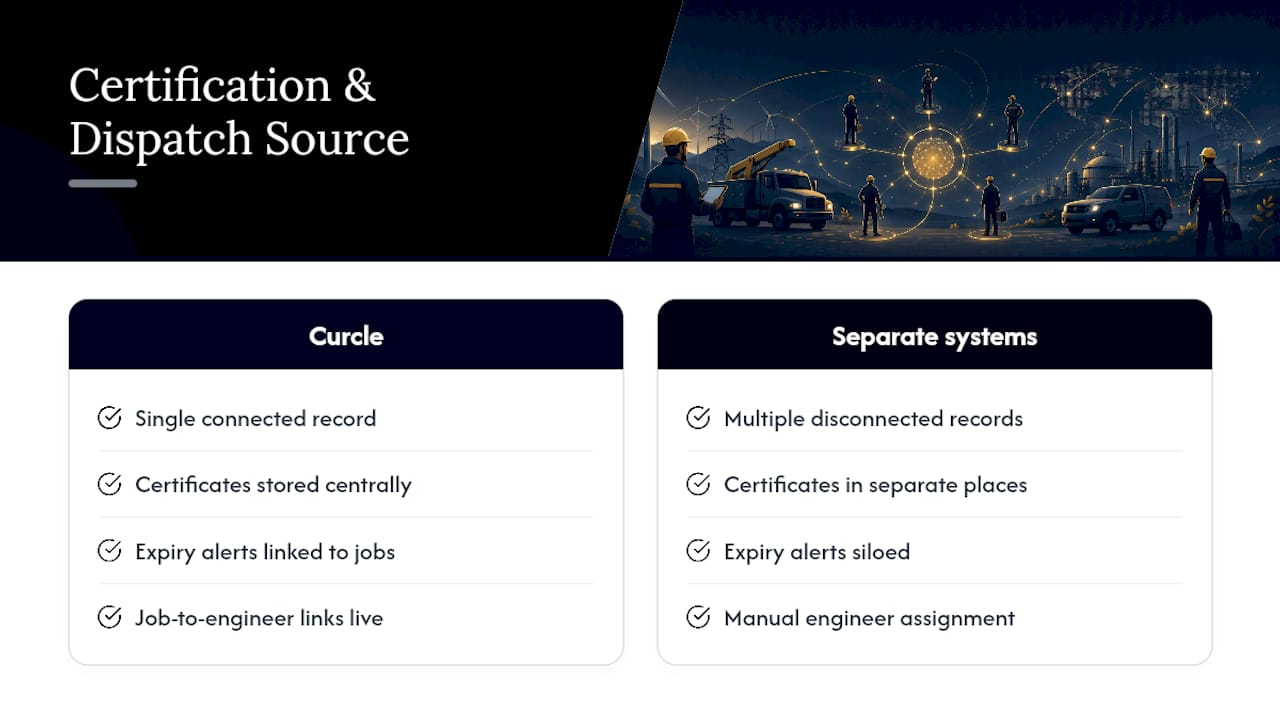
Some platforms offer operations teams one connected record where certificate storage, expiry alerts, job-to-engineer links and audit logs all sit together, so dispatch decisions and compliance evidence come from the same source rather than three different systems that quietly drift apart.

That matters most when an auditor asks for proof or a job needs assigning in the next ten minutes. Curcle's feature set covers exactly the fields this guide has walked through, and its field service management tools are built around dispatch and compliance working from the same data, not two teams reconciling separate spreadsheets at month end.
If you want to see it before committing to anything, take the product tour or book a demo to walk through how your own job types and certificates would map onto the platform.
Sources
For the rules themselves, read the MTC Framework Document, which sets out assessment and revalidation requirements in full. For structure, the field-service skills matrix template offers a practical starting grid. For evidence handling, certification tracking best practice covers ownership and audit-trail design in more depth than any single article can. Curcle's own free compliance templates are worth downloading alongside these.
- Mandatory Technical Competence (MTC) Framework Document
- How to Track Employee Certification Compliance - Gauge
- Technician skill matrix in CMMS: match the right technician to the right work order
- Skills matrix for field service teams (template)
FAQ
What is an engineer competency matrix used for?
It records which certifications, proficiency levels and expiry dates each technician holds against specific job types, so dispatchers can assign qualified people and produce audit evidence on demand.
What proficiency scale should a competency matrix use?
Most field-service matrices use a 0 to 5 scale, with Level 3 typically set as the minimum for unsupervised dispatch.
How often should credentials be revalidated?
The MTC Framework specifies revalidation cycles, often every five years where sector annexes require it, alongside annual competency reviews recommended by sector guidance.
How far ahead should expiry alerts be set?
A staged approach at 90 and 30 days before expiry gives enough lead time to schedule renewals without disrupting live jobs.
Does Curcle support certificate types like EICR and Gas Safe?
Yes, Curcle links NICEIC and electrical compliance certificates directly to engineer records and job dispatch, keeping evidence and eligibility in one place.
Who should own updates to the competency matrix?
One named role should own renewals and escalation. Splitting responsibility between HR and line managers is a common cause of lapsed credentials going unnoticed.