
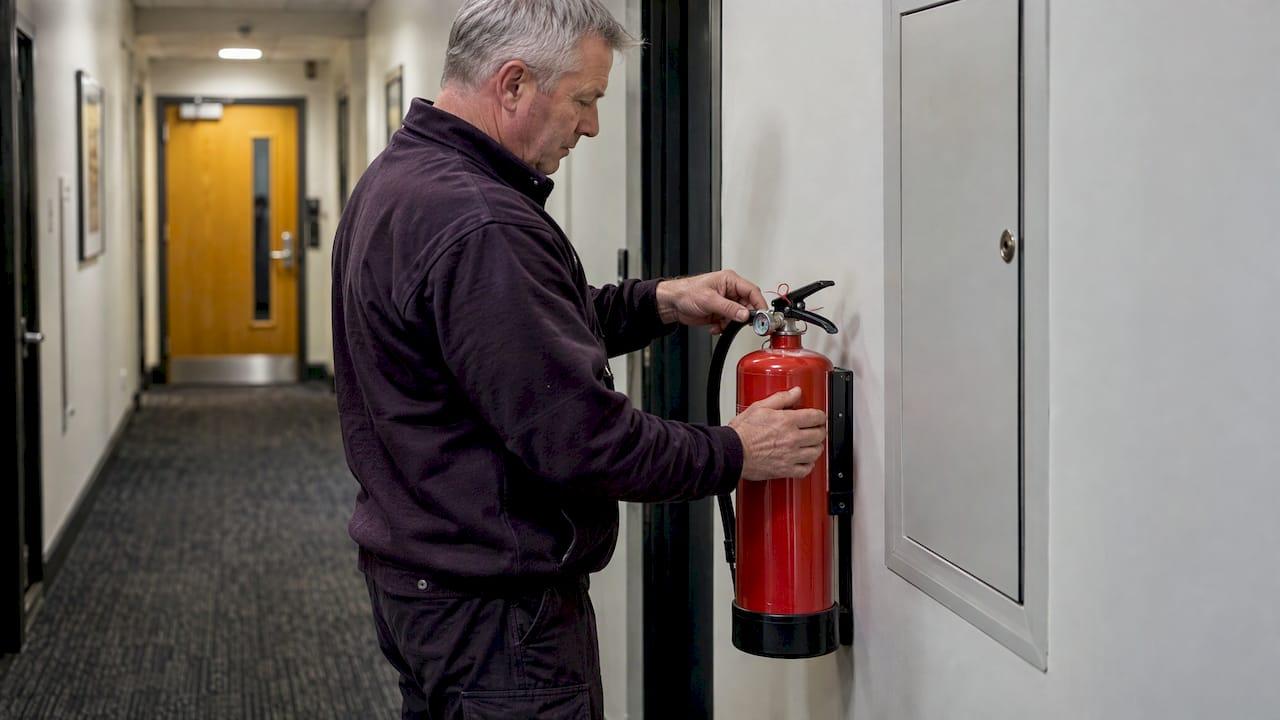
For a UK workplace, every fire extinguisher needs a visual check at least monthly and a basic service by a competent person at least once a year. Beyond that, an extended service or overhaul falls due every five or ten years, depending on the extinguisher type. The law asks you to keep equipment in efficient working order. BS 5306-3 is the standard that tells you what that looks like in practice.
This guide sets out each interval, who is allowed to carry out the work, what the visit covers and how to keep records that stand up when an inspector, insurer or client asks for them.
TL;DR
- Check every extinguisher visually at least monthly, and more often where the environment or risk demands it.
- Arrange a basic service by a competent person every 12 months, for every extinguisher type.
- Extended service is due every five years for water-based and conventional powder units, and every ten years for primary-sealed powder. CO2, clean agent and halon units get a ten-year overhaul.
- Use a technician from a BAFE SP101 registered organisation and keep a record that ties each check to a specific extinguisher.
- The law sets the duty to maintain, not a fixed interval. The standard supplies the intervals.
Table of Contents
- What the law requires, and where the intervals come from
- The three layers of extinguisher upkeep
- Monthly checks by the responsible person
- The annual basic service
- Extended service and overhaul by extinguisher type
- Who counts as competent
- What the service report and labels should show
- Keeping records that stand up to scrutiny
- Why extinguishers are one of several compliance cycles
- Our perspective
- Keeping the cycle under control with Curcle
- FAQ
- Sources
What the law requires, and where the intervals come from
In England and Wales, the Regulatory Reform (Fire Safety) Order 2005 puts the duty on the responsible person. Article 17 requires them to maintain fire-safety equipment in an efficient state, in efficient working order and in good repair, where necessary to safeguard relevant persons. The Order does not state a universal number of months between extinguisher services.
That is why the British Standard matters. BS 5306-3:2017 is the principal UK standard for maintaining portable extinguishers, and BAFE points to Clause 6, Table 1 of the standard as the place where the maintenance intervals by extinguisher type are set. If you follow the standard, you have a clear, defensible answer to the question of what efficient working order means for your extinguishers.
The responsible person is usually the employer, the owner or the person in control of the premises. They can appoint others to do the work, but the duty stays with them. Scotland and Northern Ireland have their own fire-safety legislation, so check the rules that apply to your premises if you are outside England and Wales.
The three layers of extinguisher upkeep
There are three separate activities, and confusing them is the most common mistake we see in site compliance routines.
- The user inspection: a quick visual check by someone on site, at least monthly.
- The basic service: a more thorough annual visit by a competent technician.
- Extended service or overhaul: a deeper intervention at five or ten years, depending on type.
Each layer has a different purpose, a different person and a different record.
Monthly checks by the responsible person
BS 5306-3 recommends visual inspections at least monthly, with more frequent checks where circumstances require. BAFE identifies this as Clause 11.2 guidance. A kitchen, a workshop, a loading bay or a site where vehicles are likely to knock equipment will justify weekly checks rather than monthly ones.
The London Fire Brigade's guidance on portable firefighting equipment sets out what a regular user inspection should confirm:
- the extinguisher is in its designated place;
- the instructions are clean and legible;
- it has not been operated or obviously damaged;
- any pressure gauge is within its operational and safety limits;
- seals and tamper indicators are intact.
This check needs no special tools and takes seconds per unit. It does need to happen on a schedule and be written down. A monthly check that nobody can evidence is, in an audit, a monthly check that did not happen.
What to do when a check fails
If an extinguisher is missing, discharged, damaged or showing a gauge reading outside limits, take it out of use and replace it or have it assessed by your servicing company. Log the defect and the action taken. Do not wait for the next annual visit.
The annual basic service
Every extinguisher, whatever its type, needs a basic service every 12 months. Several of the pages ranking for this topic say the same: the annual service is the minimum professional intervention.
A basic service is not a longer version of the monthly check. According to the maintenance guidelines in BS 5306-3, it checks continuing safety and suitability. That includes whether the hazard in that location has changed, whether the extinguisher has been tampered with or used, whether media and propellant are within their allowances, and whether the unit should work when required.
The tolerance on timing
The standard gives basic and extended service intervals a practical tolerance of plus or minus one month. It also allows intervals to be shortened for environmental or special hazards, known or likely faults, or manufacturer instructions. Treat the tolerance as a safety margin for scheduling, not a reason to drift. Planning each service for the same month each year keeps the pattern simple.

Extended service and overhaul by extinguisher type
The annual basic service applies to all types. What changes is the deeper intervention.
| Extinguisher type | Basic service | Extended service | Overhaul |
|---|---|---|---|
| Water-based (water, foam, water additive) | Every 12 months | Every 5 years | Not listed |
| Powder (conventional) | Every 12 months | Every 5 years | Not listed |
| Powder, primary sealed | Every 12 months | Every 10 years | Not listed |
| Clean agent, halon and CO2 | Every 12 months | Not listed | Every 10 years |
The table follows BAFE's summary of the BS 5306-3 interval table. Check the exact wording in the current standard with your servicing company, because model-specific instructions from the manufacturer can alter what is done.
A related table appears in the Maritime and Coastguard Agency's guidance, and it gives similar intervals. That document covers ships and includes harsh marine environment qualifications and international references that do not automatically apply to ordinary premises, so use it only as supporting context.
What an extended service involves
For low-pressure extinguishers, an extended service is the basic service plus a discharge to check operation, which also gives the technician a chance to replace the media. The maintenance guidelines are clear that it is a separate service from the annual basic service, not a replacement for it. In the year an extended service falls due, you still get one visit, but the work done is the larger of the two.
What an overhaul involves
For high-pressure units such as CO2, an overhaul involves a detailed inspection and hydraulic pressure testing. That is why it sits on a ten-year cycle and why it is carried out by specialist technicians rather than as part of a routine round.

Who counts as competent
The law and the standard both talk about a competent person. GOV.UK guidance, following BS 5306-3, describes this as someone with the necessary training and experience and access to the relevant tools, equipment, information, manuals and manufacturer-recommended special procedures.
In practice, the simplest route to demonstrating competence is third-party certification. BAFE says SP101 sets the competency criteria for portable fire-extinguisher organisations and the technicians they employ, and it recommends using an SP101 registered organisation.
Technician registration works through the employer. BAFE states that technicians cannot register independently: they must be employed by an SP101 registered organisation, pass a recognised servicing examination covering BS 5306 Parts 3 and 8, and keep up refresher training every three years. When you appoint a servicing company, ask for their registration details and confirm them against the BAFE register before the first visit.
What the service report and labels should show
After the visit you should receive more than an invoice. BS 5306-3 expects a written report that states the status of the extinguishers and identifies any that are unsuitable for the hazard they cover. Maintenance details should also be recorded on a durable label attached to the extinguisher.
Read the report for three things:
- units that passed, with their location and type;
- units that failed, were removed or were replaced;
- extinguishers that are the wrong type or size for the risk where they hang.
The third point is the one that catches businesses out. A kitchen that has changed its fryers, a workshop that now stores flammable liquids and an office that has become a server room can all outgrow the extinguishers on the wall.
Keeping records that stand up to scrutiny
A fire-safety logbook is not itself a statutory requirement, according to East Sussex Fire and Rescue's logbook guidance. The same guidance says an up-to-date logbook is an effective way to show that required maintenance, testing and training have been carried out. If an enforcing officer, insurer or client auditor asks how you know your extinguishers are in order, the record is your answer.
Bedfordshire Fire and Rescue's logbook sets out what a good entry contains. Records should link each inspection or service to the particular extinguisher and capture:
- the date;
- whether it was a visual check or a full test;
- who carried it out;
- the findings and any defects;
- the remedial action, with the log completed once corrective work is finished.
The weak point in most paper systems is the link between an entry and a specific unit. "Checked all extinguishers, fine" tells an auditor very little. A register where each extinguisher has its own identity, location and history tells them everything.
A simple annual rhythm
| When | Action | Who |
|---|---|---|
| Monthly (weekly in higher-risk areas) | Visual check, log result | Responsible person or delegate |
| Every 12 months | Basic service, report and labels | SP101 registered technician |
| Every 5 years | Extended service for water-based and powder units | SP101 registered technician |
| Every 10 years | Extended service for primary-sealed powder, overhaul for CO2, clean agent and halon | SP101 registered technician |
| After any use, damage or defect | Remove from use, assess, replace or repair, log it | Responsible person and servicing company |
Because five and ten year work lands in different years for different units, a site with a mixed stock needs a register that shows each extinguisher's own next due date. Buying everything on the same day makes the cycle tidier, but any later replacement will break the pattern.
Why extinguishers are one of several compliance cycles
Extinguishers rarely sit alone. The same site probably has emergency lighting, electrical equipment, gas appliances and water systems, each with its own interval and evidence. Our guides on emergency lighting test records, PAT testing frequency and a job audit checklist for field service managers cover the neighbouring cycles. The pattern is the same each time: an interval from a standard or regulation, a competent person, and a record tied to a specific asset.
Our perspective
We built Curcle inside a real UK service and engineering business, so we know how extinguisher compliance usually goes wrong. The interval is rarely the problem. The problem is that the dates live in one person's diary, the certificates in a folder, and the defect notes in a text message.
Our view is that every extinguisher should be an asset with its own record: where it is, what type it is, when it was last serviced, when the next basic service and extended service fall due, and what happened the last time something failed. That is how we design compliance into the platform backbone rather than bolting it on afterwards.
We also believe software should tell you what needs attention, not just record what has already happened. A due-date list that surfaces next month's services, and an audit trail you can export quickly when a client or officer asks, beat a year-end scramble every time. Every click should earn its place, and that matters most for the engineer on site with a phone and ten minutes.
AI can help by spotting gaps, but the judgement about whether an extinguisher suits a hazard stays with a competent person.
Luke Herridge
Keeping the cycle under control with Curcle
If you manage extinguisher servicing for several sites, or you are a service business that carries it out for clients, a spreadsheet stops being enough quickly. Curcle brings jobs, assets, site registers, compliance tracking, document and photo capture and invoicing into one connected system, with a mobile engineer app that works offline.

Plans start from £99 per month on Starter, from £249 per month on Professional and from £499 per month on Business, and Enterprise is priced on request. See Curcle pricing for what each plan includes, or look at how multi-site facilities teams use the platform to hold SLAs and compliance in one place. You can also browse the full feature list first.
FAQ
How often should fire extinguishers be serviced in the UK?
Every extinguisher needs a basic service by a competent person at least every 12 months under BS 5306-3, with a visual check by the responsible person at least monthly. Extended service or overhaul then follows at five or ten years depending on type. The Fire Safety Order itself requires equipment to be maintained in efficient working order and leaves the detail to the standard.
Is annual extinguisher servicing a legal requirement?
The law requires you to maintain fire-safety equipment in efficient working order and good repair. It does not itself prescribe a universal interval. BS 5306-3 is the standard that sets the annual basic service, and following it is the usual way to show you have met the duty.
Can a member of staff service our extinguishers?
Staff can and should carry out the monthly visual checks. The basic service and any extended service or overhaul need a competent person with the right training, tools and manufacturer procedures. BAFE recommends using an SP101 registered organisation, whose technicians must pass a recognised examination and refresh their training every three years.
What records do I need to keep?
Keep a register of each extinguisher and log every check and service against the specific unit. Record the date, whether it was a visual check or full test, who did it, the findings, any defects and the remedial action. Keep the technician's written report too. A logbook is not a statutory requirement, but fire and rescue services treat it as the practical evidence that maintenance happened.
What happens if an extinguisher fails its monthly check?
Take it out of use, replace it or have it assessed by your servicing company, and log the defect and the action. Do not leave it until the next annual service. Make sure the replacement is the right type for the hazard in that location.
Sources
- The Regulatory Reform (Fire Safety) Order 2005, Article 17
- BAFE: How often should I be servicing my fire extinguishers?
- BAFE: Fire extinguisher guidance
- BAFE: How do I become a BAFE SP101 registered fire extinguisher technician?
- London Fire Brigade: Hand held portable firefighting equipment
- Maintenance guidelines for BS 5306-3:2017
- GOV.UK: MGN 276 (M+F) Amendment 1, maintenance of portable fire extinguishers
- Bedfordshire Fire and Rescue Service: Fire safety log book
- East Sussex Fire and Rescue Service: Fire safety log book