

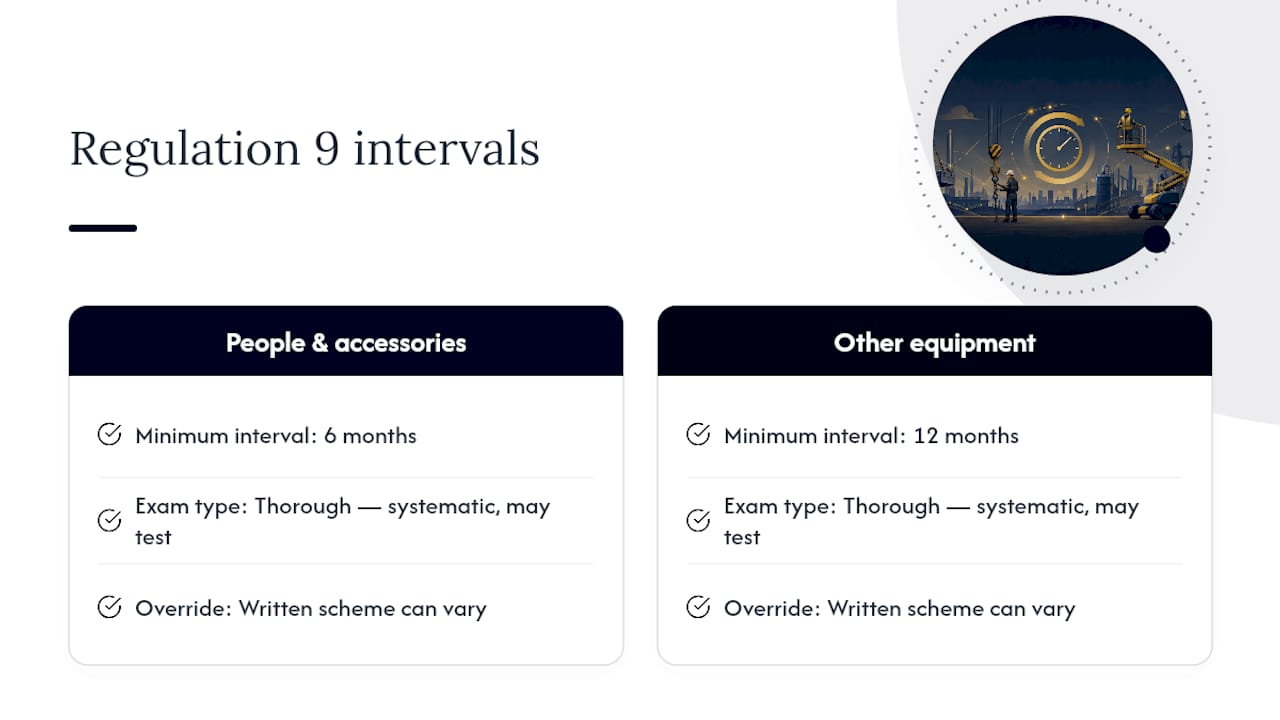
Under LOLER, lifting accessories and any equipment used to lift people must undergo a thorough examination at least every 6 months. Other lifting equipment used purely to lift loads needs one at least every 12 months. Both are legal maximums, not targets, and a written examination scheme can shorten or extend them where the evidence supports it. Certain events, such as first use on site or storm damage, trigger an extra examination regardless of the calendar.
TL;DR:
- Equipment used to lift people and lifting accessories must be thoroughly examined every six months, while load-only lifting equipment requires annual inspections.
- Events such as first use on site, reinstallation, or storm damage trigger additional examinations outside the regular schedule.
- An examination scheme, based on risk assessment, can extend or shorten intervals but must be documented and reviewed periodically.
- A Report of Thorough Examination must include specific details like inspection scope, defects, examiner’s credentials, and must be stored centrally.
- Compliance management benefits from a structured system that tracks due dates, separates assets, and escalates defects, rather than relying on spreadsheets or manual reminders.
Table of Contents
- LOLER inspection frequency at a glance: which assets need which interval
- The legal basis: Regulation 9 and what "thorough examination" actually means
- What counts as a lifting accessory (and why they sit on the 6-month clock)
- When you need an examination outside the normal schedule
- Examination schemes: justifying a different interval and proving it's sound
- The competent person and the Report of Thorough Examination
- A practical checklist for scheduling LOLER thorough examinations
- Where LOLER compliance goes wrong (and how inspectors catch it)
- Why treating LOLER frequency as a workflow beats treating it as a deadline
- Managing LOLER schedules without the spreadsheet chaos
- Primary sources to keep in your compliance pack
- Sources
- FAQ
LOLER inspection frequency at a glance: which assets need which interval
The 6 and 12-month split under Regulation 9 covers almost every piece of lifting kit you'll find on a UK site, but which bucket an item falls into isn't always obvious. The table below covers the common cases.
| Equipment type | Statutory interval | Notes |
|---|---|---|
| Passenger lifts, platform lifts | 6 months | Classed as equipment for lifting people |
| MEWPs (mobile elevating work platforms) | 6 months | Applies whenever used to lift a person |
| Lifting accessories (slings, chains, shackles, hooks, eyebolts, spreader beams) | 6 months | High wear, high handling risk |
| Cranes (mobile, tower, overhead) | 12 months | Provided not used to lift people |
| Forklifts and lift trucks | 12 months | Goods-only use |
| Goods lifts and hoists | 12 months | No passenger use |
| Jib cranes, davits | 12 months | Goods-only default |
These figures are statutory maxima, according to HSE guidance on thorough examinations. Equipment working in abrasive, corrosive or high-cycle environments often needs shorter intervals in practice, whatever the default says on paper.
The legal basis: Regulation 9 and what "thorough examination" actually means
The 6 and 12-month defaults come from Regulation 9 of the Lifting Operations and Lifting Equipment Regulations 1998. Regulation 9(3) sets the intervals directly: at least every 6 months for equipment used to lift people and for lifting accessories, at least every 12 months for everything else, unless a written examination scheme drawn up by a competent person specifies different periods.
A "thorough examination" is not a visual once-over. HSE defines it as a systematic and detailed assessment carried out by a competent person, with the scope to include testing where necessary, aimed at identifying whether the equipment is safe to continue in use and spotting defects before they become dangerous. That distinction matters for procurement: if a contractor is only walking round with a torch and a clipboard, that's an inspection, not the statutory examination LOLER demands.
For the full regulatory detail, including exemptions and worked scenarios, L113: Safe use of lifting equipment is the HSE's expanded reference guide and worth keeping in your compliance pack alongside the primary legislation.
What counts as a lifting accessory (and why they sit on the 6-month clock)
Accessories default to 6 months because they're handled constantly, moved between jobs, and rarely get the attention a fixed crane does. Typical items include:
- Chains and chain slings
- Wire rope and webbing slings
- Shackles and hooks
- Eyebolts and lifting eyes
- Spreader beams and lifting beams
- Clamps and grabs
These items fail through wear, misuse, and improper storage far more often than through age alone, which is why HSE treats them the same as equipment used to lift people. Where you run large numbers of similar accessories of the same type, age and use pattern, an examination scheme can group them under a single set of intervals rather than tracking each one separately, according to HSE's INDG422 leaflet. Tagging each accessory with a unique ID and logging it against that scheme from day one saves considerable admin further down the line.
When you need an examination outside the normal schedule
Calendar intervals aren't the only trigger. LOLER also requires a thorough examination whenever certain events occur, regardless of when the last one happened.
Before first use, if equipment was assembled on site rather than delivered ready to go, a fresh examination is required. That applies to tower cranes, platform lifts and anything else built up on location, since a valid conformity declaration from the manufacturer doesn't cover risks introduced during assembly. An examination is also needed after installation or re-siting at a new location, and again after exceptional circumstances likely to jeopardise safety, such as an impact, storm damage, an extended idle period, or major repair work.
Examination schemes: justifying a different interval and proving it's sound
An examination scheme is a written document, prepared by a competent person, that sets out intervals other than the default 6 or 12 months for specific equipment. It has to be based on genuine risk assessment, not convenience. A competent person deciding to lengthen an interval will typically want to see usage hours, environmental exposure records, manufacturer durability data, and any condition monitoring already logged for that asset.
Shortening an interval is often the more defensible move for equipment under heavy use, but either direction needs a documented rationale. The scheme itself must be in writing, available for inspection on request, and reviewed periodically as conditions change. A scheme that hasn't been revisited in years, while the equipment's usage pattern has clearly changed, is exactly the kind of gap an HSE inspector will flag.
The competent person and the Report of Thorough Examination
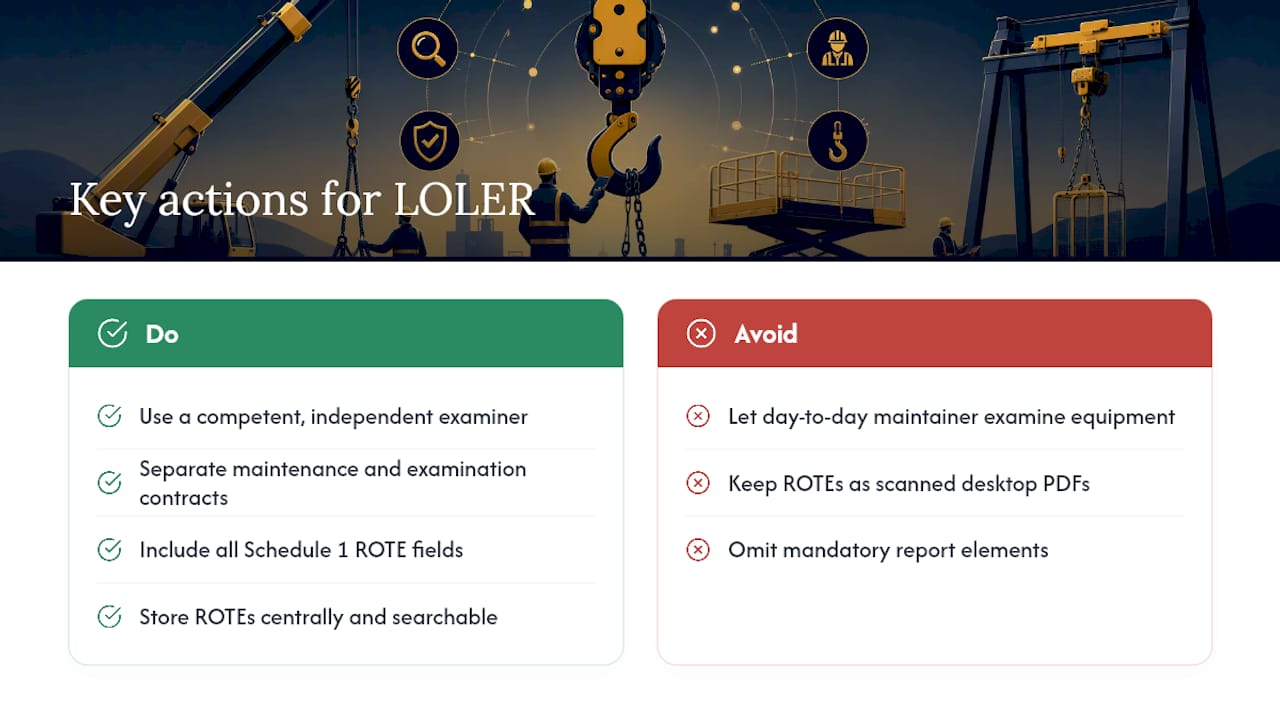
HSE guidance is explicit that a competent person needs the technical knowledge and practical experience to identify defects, plus genuine independence. Someone who maintains or repairs the equipment day to day may not be sufficiently impartial to examine it objectively, which is why many duty-holders separate the maintenance contract from the examination contract.
Every examination produces a Report of Thorough Examination (ROTE), and Schedule 1 of the Regulations sets out what it must contain: equipment identification, the date, the scope of the examination, any defects found and their urgency, the examiner's name and qualification, and a signature, among other mandatory fields. There's no single mandated format, but missing any of those elements makes the report legally deficient. Store ROTEs centrally and searchably; a folder of scanned PDFs on someone's desktop is a liability the moment that person leaves the business.
A practical checklist for scheduling LOLER thorough examinations
Turning the regulation into a working system comes down to a handful of steps:
- Tag every asset and separate accessories from fixed equipment in your register.
- Build a statutory schedule against each item's correct 6 or 12-month default.
- Assign a duty-holder and appoint a competent, independent examiner.
- Put any extended-interval decisions into a written examination scheme.
- Track due dates, store every ROTE centrally, and escalate defects the moment they're logged.
Pro Tip: Don't wait for the due date to appear on a spreadsheet. Set the reminder 4 to 6 weeks out, so there's time to book a competent examiner without rushing the job or running equipment past its legal deadline.
Curcle's free LOLER thorough examination checklist template maps these steps against the Schedule 1 fields, so nothing gets missed when you're setting the process up from scratch.
Where LOLER compliance goes wrong (and how inspectors catch it)
The failures HSE sees repeatedly are dull rather than dramatic: overdue or missing ROTEs, no named duty-holder, in-house maintenance staff signing off their own work as an "examination," and reports missing mandatory fields. Contracting the work-out doesn't remove your liability either, since duty-holders remain responsible for verifying contractor competence and holding valid reports. Spot-checking a sample of contractor reports each quarter catches most of these issues before an inspector does.
Why treating LOLER frequency as a workflow beats treating it as a deadline
The 6 and 12-month intervals are minimums, not a finish line. A report that flags a hairline defect and then sits in an inbox for three weeks is a bigger risk than a slightly early examination. The businesses that manage this well treat findings as work orders, not paperwork, and get operations, maintenance and compliance teams looking at the same asset register rather than three separate spreadsheets.
— Luke Herridge
Managing LOLER schedules without the spreadsheet chaos
Curcle replaces the spreadsheet-and-reminder approach to LOLER compliance with a system built around the real workflow: recurring scheduling against 6 and 12-month defaults, an asset register that separates accessories from fixed equipment, and audit-ready ROTE storage your team can pull up in seconds during an HSE visit.

Because Curcle was built inside a working UK service and engineering business, the scheduling logic reflects how examinations actually get missed in practice, not how a generic tickbox app assumes they should be tracked. You can start with the free LOLER thorough examination checklist template to see how the mandatory Schedule 1 fields map onto a working process, then look at the LOLER inspection features to see how scheduling, records and defect escalation sit together in one register. Plans start from £99 a month on the Starter tier, with Professional and Business tiers available for larger asset registers and teams running multiple examination schemes at once. Book a look at the product tour to see the compliance module in action before committing to anything.
Primary sources to keep in your compliance pack
- HSE: Thorough examinations and inspections of lifting equipment
- Legislation
- INDG422: Thorough examination of lifting equipment
- L113: Safe use of lifting equipment
- Leanscape: grey fleet audit-readiness checks
Keep these five bookmarked. Inspectors reference the same documents, so citing them accurately in your own paperwork carries real weight.
This article is general information, not a substitute for advice from a qualified lawyer. Consult a qualified legal professional about your own circumstances before acting on anything here.
Sources
- Thorough examinations and inspections of lifting equipment — HSE
- Legislation
- INDG422 - Thorough examination of lifting equipment (HSE leaflet)
- L113: Safe use of lifting equipment (HSE publication)
FAQ
Is LOLER inspection every 6 months or 12 months?
Both, depending on the equipment. Lifting accessories and anything used to lift people need a thorough examination at least every 6 months, while other lifting equipment used only for loads needs one at least every 12 months.
How often is a LOLER inspection legally required?
At minimum every 6 or 12 months depending on the equipment type, plus additional examinations triggered by first use, installation at a new site, or exceptional circumstances such as damage. A written examination scheme by a competent person can set different intervals where the risk evidence supports it.
What do the LOLER regulations actually require of UK employers?
LOLER requires that lifting equipment is strong and stable enough for its use, positioned to minimise risk, and thoroughly examined at the statutory intervals by a competent, independent person. Every examination must produce a report containing the fields set out in Schedule 1, and duty-holders remain responsible for compliance even when the work is contracted out.
Does scaffolding need inspecting every 7 days?
Scaffolding inspections fall under the Work at Height Regulations, not LOLER, and yes, they generally need frequent checking plus after any event that could affect stability. It's a separate regime from the lifting equipment intervals covered here, so don't conflate the two schedules in a single compliance calendar.
Can Curcle help track LOLER thorough examination due dates?
Yes. Curcle's compliance inspection tools schedule recurring examinations against the 6 and 12-month defaults, store completed ROTEs centrally, and flag overdue items before they become an enforcement risk.