
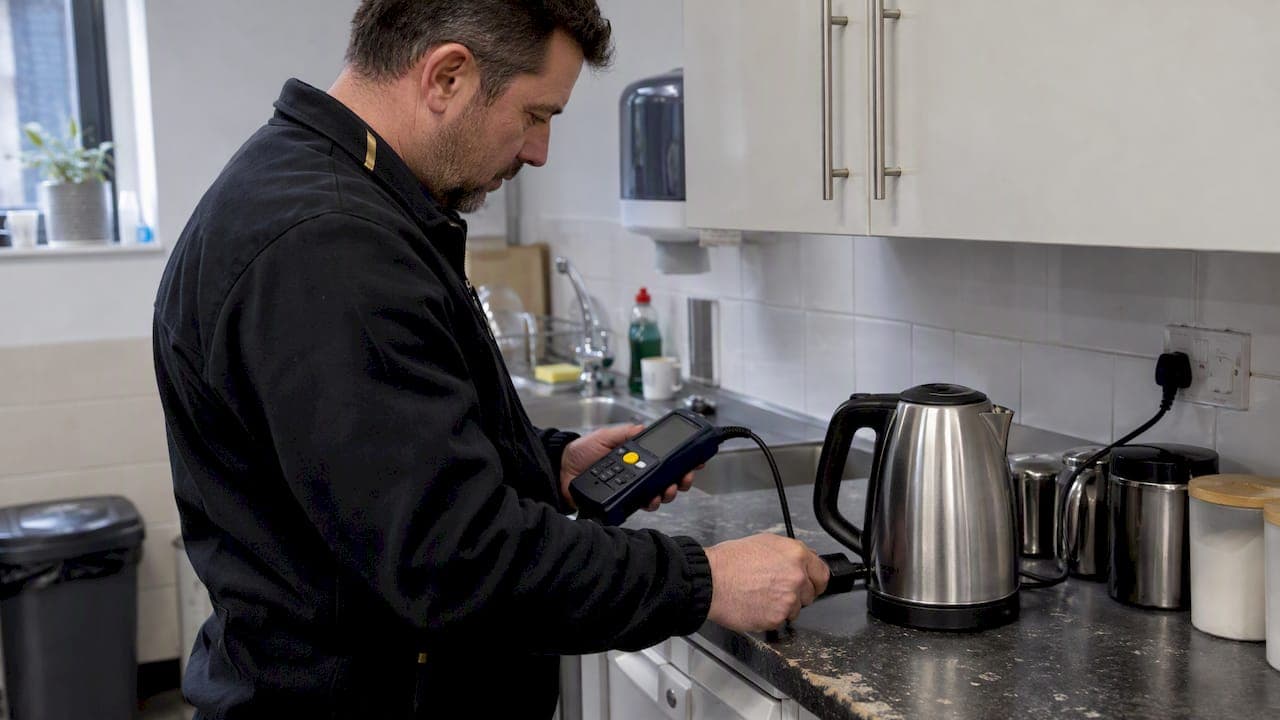
There is no single legal PAT testing interval. Frequency must be set by a risk assessment that weighs equipment type, environment and usage, not a fixed calendar rule. A typical office laptop might only need a visual check every one to five years, while a construction tool on a hire site could need checking every shift. Below, we cover the HSE starting intervals, the legal duties behind them, and the 5-year check now required for social housing.
TL;DR:
- Office IT needs combined testing every four to five years; hired equipment needs checks before each hire and combined tests every three to four months.
- In England, social landlords must have supplied equipment checked by a qualified person at least every five years, with records available to tenants.
- For social housing in England, providers must complete flagged remedial work within 28 days and retain inspection records until the next check is due.
- Staff should check equipment before use, schedule visual inspections alongside electrical tests, and test damaged or faulty items immediately, regardless of their normal interval.
- Review fault rates by equipment category after each cycle: consistently low rates can justify longer intervals, while rising faults call for shorter ones.
Table of Contents
- Quick recommended intervals: starter schedule by premise and appliance
- The UK legal position and recent regulatory change for social housing
- How to set and justify PAT testing frequency: a practical method
- Records, labelling and ISIT/EICR evidence: what to keep and how long
- Typical inspection and test intervals by equipment and environment
- Putting a programme into practice: templates, registers and automation
- Author perspective: operational benefits of a risk-based approach
- Curcle resources: free templates and PAT testing software
- FAQ
- Sources
- Primary sources and guidance
Quick recommended intervals: starter schedule by premise and appliance
Before diving into the full HSE table, it helps to know roughly where your business sits. Most premises fall into one of a handful of risk categories, and each comes with a sensible starting point for inspection and testing.
- Offices and low-risk workplaces: user checks ongoing, formal visual inspection every two to four years, combined inspection and test every four to five years.
- Light industrial sites: user checks ongoing, formal visual inspection every six months to a year, combined test every one to two years.
- Heavy industrial or high-use environments: formal visual inspection every six months, combined test annually or more often depending on fault history.
- Construction and equipment hire: user checks before every use, formal visual inspection every month, combined test every three months for 110V kit used on site.
- Public-use premises (hotels, retail, leisure): formal visual inspection annually, combined test every one to two years given the higher number of untrained users.
- Rented residential property: landlords should follow the same risk logic as above, with the added statutory duty covered in the next section.
Double-insulated appliances such as many kettles and vacuum cleaners often only need a visual check rather than a full electrical test, since there's no earth connection to verify. Earthed Class I equipment, extension leads and anything that moves between sites or gets dragged across floors wear out faster and deserve shorter intervals. Hire equipment is a particular risk because it changes hands constantly and its history is rarely visible to the next user, so it's worth treating it as high-risk by default until your own records say otherwise.
The UK legal position and recent regulatory change for social housing
The core legal duty sits in the Electricity at Work Regulations 1989, which require that electrical equipment be maintained in a way that prevents danger. The regulations don't specify a testing method or a time interval, and HSE's own guidance confirms there is no law mandating PAT testing at fixed intervals. Instead, the duty holder has to assess the risk and decide what's reasonable for their equipment and environment.
That general principle changed shape for one sector. Under the Electrical Safety Standards in the Private and Social Rented Sectors guidance, social landlords in England must ensure that electrical equipment they provide under a tenancy is checked by a qualified person at intervals of no more than five years, with records supplied to tenants. The 2025 Electrical Safety Standards regulations define "at regular intervals" for an Installation and/or Supply Item Test (ISIT) as no more than five years, unless the most recent ISIT record specifies an earlier date.
In practice, this means:
- Registered providers must complete a check before a new tenancy starts where equipment is provided.
- ISIT records must be retained and made available to tenants and, where applicable, to local authorities.
- Remedial work flagged by an inspection has a defined 28-day window for completion under the regulations.
- Linking ISIT records to the EICR for the same property makes tenant disclosure simpler and shows at a glance whether checks are current.
For everyone outside social housing, the Electricity at Work Regulations still apply, but the frequency remains yours to justify through a documented risk assessment.
How to set and justify PAT testing frequency: a practical method
Setting a defensible interval isn't guesswork if you follow a consistent process. The goal is a schedule you could explain to an inspector or insurer without hesitation.
- Build an appliance inventory. Record each item's class (Class I earthed or Class II double insulated), its mobility, and how exposed it is to damage or moisture.
- Assign a starting interval. Use the HSE table in the next section as your baseline for each equipment type and environment.
- Run user checks continuously. Staff should look for obvious damage, loose plugs or scorch marks before use, and report faults immediately.
- Carry out formal visual inspections on schedule. These catch problems a test alone won't, such as cracked casings or frayed cables.
- Record every result. Log pass, fail and remedial action for each appliance, including the inspector's name and the date.
- Review the fault rate after each cycle. Low fault rates across a consistent group of appliances support lengthening the interval; rising faults mean shortening it.
- Adjust one category at a time. Changing intervals across your entire estate at once makes it hard to tell which change caused which outcome.
HSE's maintenance guidance frames this as a hierarchy: user checks first, then formal visual inspection, then combined inspection and testing, each catching faults the previous step might miss. Fault history is what turns a generic starting interval into a defensible one specific to your business.
Pro Tip: Track fault rates by equipment category rather than by individual appliance. A pattern across twenty identical kettles tells you far more about appropriate frequency than one isolated failure.

Records, labelling and ISIT/EICR evidence: what to keep and how long
A risk-based schedule only holds up if the paperwork behind it does too. Whether you're running a PAT programme for an office or an ISIT regime for rented housing, the records need to answer the same basic questions.
- Appliance ID and location: so each record maps to a physical item without ambiguity.
- Tester name and competence: confirming who carried out the check and that they were suitably trained.
- Date of test and result: pass, fail, or remedial action required.
- Next test date: calculated from your agreed interval, not left to memory.
- Remedial works completed: with the date they were closed out.
For social housing, the 2025 regulations require that ISIT records be retained until the next check is due and that remedial work flagged by an inspection be completed within 28 days. Registered providers must also be able to supply these records to tenants and, where requested, to the relevant local authority.
Physical labels on each appliance, showing the last inspection date, next due date and tester initials, cut down on administrative errors when an audit arrives. A digital register that lets you search by location, appliance type or due date turns what used to be a filing cabinet exercise into a five-minute check, and it's the difference between scrambling before an audit and already knowing you're covered.
Typical inspection and test intervals by equipment and environment
The table below reflects HSE's suggested starting intervals for the maintenance hierarchy: user checks, formal visual inspection, and combined inspection and testing. These are starting points for your risk assessment, not fixed rules.
| Equipment / environment | User checks | Formal visual inspection | Combined inspection and test |
|---|---|---|---|
| Equipment hire | Before each hire | Before each hire | Before hire, then every 3-4 months |
| Construction (110V) | Before use | Monthly | Every 3 months |
| Light industrial | Weekly | 6 months to 1 year | 1 to 2 years |
| Heavy industrial | Daily | 6 months | 1 year |
| Office IT equipment | Occasional | 2 to 4 years | 4 to 5 years |
| Double-insulated appliances | Occasional | 2 to 4 years | Visual check often sufficient |
| Public-use items (hotels, retail) | Weekly | 1 year | 1 to 2 years |
| Cables and extension leads | Before use | Annually | Every 2 years |
Read this as a starting hierarchy rather than a lookup table you follow blindly: an office laptop that never leaves its desk sits at the lower-risk end, while an extension lead crossing a warehouse floor daily belongs at the higher-risk end regardless of what category it's filed under. Any appliance with visible damage, a reported fault, or a history of tripping a circuit should be tested immediately, irrespective of where it sits in the schedule. High-use items in public spaces, where untrained members of the public interact with sockets and leads, also warrant moving towards the shorter end of their bracket.
Putting a programme into practice: templates, registers and automation
Running this well across more than a handful of appliances means moving away from spreadsheets that nobody updates. An appliance register that tracks class, location, last test date and next due date gives you the fault history that makes longer intervals defensible, and it gives an auditor a single place to look.
For facilities teams managing office refurbishments or new fit-outs alongside their PAT programme, a practical installation checklist from ALXR Workspace is a useful complement when new equipment is going into service and needs baselining.
A straightforward rollout looks like this:
- Start with your highest-risk category, such as hired tools or extension leads, and establish a clean baseline.
- Capture every result from day one, even passes, so you have a fault history to work from within a year.
- Automate the reminders so retests trigger themselves rather than relying on someone remembering a spreadsheet.
- Review intervals quarterly against the fault data you're accumulating, adjusting one category at a time.
There is a free PAT testing register template available for teams who want to start capturing this data immediately, and PAT testing software that extends that into automated scheduling and certificate generation once the volume of appliances makes a spreadsheet unworkable.
Pro Tip: Review trend data every quarter rather than waiting for the next scheduled test. A category with a consistently clean record for two full cycles is usually your strongest candidate for a longer interval.
Author perspective: operational benefits of a risk-based approach
Blanket annual testing feels safe, but it misdirects effort: it tests low-risk kettles as often as high-risk hire tools, and it rarely gets revisited once set. A records-driven schedule does the opposite. Good fault history lets you stretch intervals on equipment that's proven itself and concentrate resources where faults actually happen. That's better safety and better budgeting, not a trade-off between the two.
— Luke Herridge
Curcle resources: free templates and PAT testing software
We built our PAT testing tools around the same risk-based logic covered in this piece: registers that hold the full history an auditor wants, reminders that trigger themselves, and certificates that export in seconds rather than being rebuilt from scratch each time.

- Start with the free PAT testing register template if you're setting up your first schedule.
- Browse the wider free compliance templates if you're also managing EICR or LOLER alongside PAT.
- Check pricing for current details on plans and fees.
This article is general information, not a substitute for advice from a qualified lawyer. Consult a qualified legal professional about your own circumstances before acting on anything here.
FAQ
How often should I PAT test in the UK?
There's no fixed legal interval. HSE guidance confirms frequency should come from a risk assessment based on equipment type, environment, usage and past fault history, with office equipment often needing combined tests only every four to five years and construction tools far more often.
How often should a PAT test happen?
It depends on the appliance and where it's used: HSE's suggested starting intervals range from every three to four months for hired equipment on construction sites to every four to five years for static office IT equipment. Social landlords in England have an added statutory duty to check equipment they provide at least every five years under the 2025 Electrical Safety Standards regulations.
Is there a shortage of PAT testers in the UK?
This isn't something covered by the guidance we've referenced here, and claims about tester availability vary by region and season. If you're struggling to book a qualified tester, building your own risk-based schedule in advance gives you more flexibility in when you need to book one.
Is PAT testing still a legal requirement?
PAT testing itself isn't named in law, but the underlying duty is: the Electricity at Work Regulations 1989 require that equipment be maintained to prevent danger, and HSE guidance treats a risk-based inspection and testing regime as the practical way to meet that duty. Social landlords face a more specific five-year check requirement under the 2025 regulations.
Sources
Primary sources and guidance
These are the regulator and government pages behind the intervals and duties covered above, worth bookmarking if you need to check a detail or justify a decision to an inspector.