
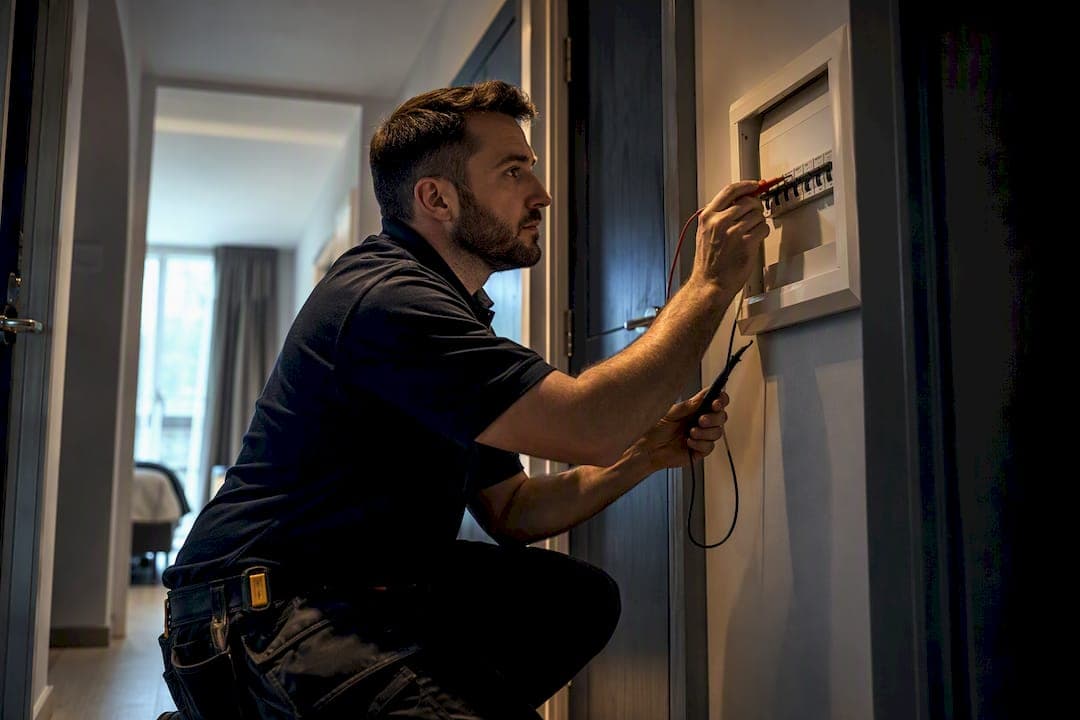
Industry guidance commonly recommends inspection intervals varying by property type, such as around 10 years for owner-occupied homes, up to 5 years as a legal maximum for rented homes in England, and shorter intervals for HMOs, commercial units, and higher-risk installations. The actual interval depends on the inspector's judgment based on risk and usage. The precise figure for any specific property isn't a fixed rule — it's a judgement call the qualified inspector must make and justify in writing under BS 7671.
TL;DR:
- The actual inspection interval depends on property use, condition, and environment, and varies from 3 years for caravans to 10 years for owner-occupied homes.
- Landlords in England must conduct an EICR at least every 5 years, and are required to provide the report to tenants within 28 days, but can reuse a recent report if it shows no issues.
- The inspector's recommended interval is a case-by-case judgment based on factors like usage, age, maintenance history, and the environment, with explicit reasons recorded on the report.
- Urgent issues such as flooding, fire damage, or visible wiring defects must trigger immediate reinspection, with dangerous codes requiring prompt remedial work.
- Centralized record management and routine visual checks help ensure compliance and prevent missed renewal deadlines, especially in larger property portfolios.
Table of Contents
- What are the recommended EICR inspection intervals by property type?
- What are landlords legally required to do about EICRs?
- How does an inspector decide the next inspection interval?
- When do you need an EICR sooner than scheduled?
- How should landlords and facilities managers manage EICR compliance day to day?
- The gap between the regulation and the reality
- Where Curcle fits alongside your EICR inspections
- Sources
- FAQ
What are the recommended EICR inspection intervals by property type?
There's no single number that covers every building, and that catches a lot of landlords out. The interval depends on how a property is used, how hard its electrics are worked, and what condition they're in.
Industry guidance from Electrical Safety First sets out the frequencies most inspectors work from as a starting point. These aren't statutory numbers for every category. They're the accepted baseline that a competent person adjusts up or down based on what they find on site.
- Owner-occupied homes: typically every 10 years
- Rented domestic properties: recommended every 5 years (and legally capped at 5 years in England, covered below)
- HMOs: maximum 5 years where local licensing requires it, sometimes shorter
- Caravans: around every 3 years, given exposure to damp and vibration
- Swimming pools and other special locations: commonly every 1 year, because water and electricity together carry higher risk
- Construction sites: typically every 3 months, reflecting temporary wiring and heavy wear
- Commercial and industrial premises: usually every 1 to 5 years depending on the nature of the work
A small accountancy office with a handful of desks, some lighting circuits and a kettle is a very different risk profile to a metal fabrication unit running three-phase machinery on a factory floor. Both might sit in the "commercial" bracket, but the inspector will almost certainly recommend a much tighter interval for the fabrication unit. Heat, vibration, dust and heavier current draw all accelerate wear on cables, connections and protective devices.
The table below provides commonly referenced typical inspection intervals used in UK electrical installation practice, though actual intervals may vary by property use and condition.
| Property or installation type | Typical recommended interval |
|---|---|
| Owner-occupied domestic | 10 years |
| Rented domestic (England, statutory maximum interval) | subject to a legal maximum of 5 years |
| HMO (licensing dependent) | Up to 5 years |
| Caravan | 3 years |
| Swimming pool or special location | 1 year |
| Construction site | 3 months |
| Commercial/industrial | 1 to 5 years |
Use, intensity, and environment do most of the work in setting the actual figure. A rarely-used holiday let with light domestic loads behaves differently to a busy retail unit with constant footfall, air conditioning, and till systems running all day. Age matters too. An installation rewired within the last decade to current standards will usually earn a longer recommended interval than one still running on older cabling with a patchwork of past alterations.
What are landlords legally required to do about EICRs?
Landlords in England have a fixed statutory duty, separate from BS 7671's guidance on individual judgement. As of November 2025, private and social landlords must have electrical installations inspected and tested by a qualified person at least every 5 years, regardless of what an inspector might otherwise suggest for a similar owner-occupied property.
The 5-year interval is a maximum statutory limit, not a prescribed target. Alongside the inspection and test, landlords must supply a copy of the report to the existing tenant promptly, provide a copy to the local housing authority within a reasonable time if requested, and retain the report until the next inspection is due, keeping records as evidence.
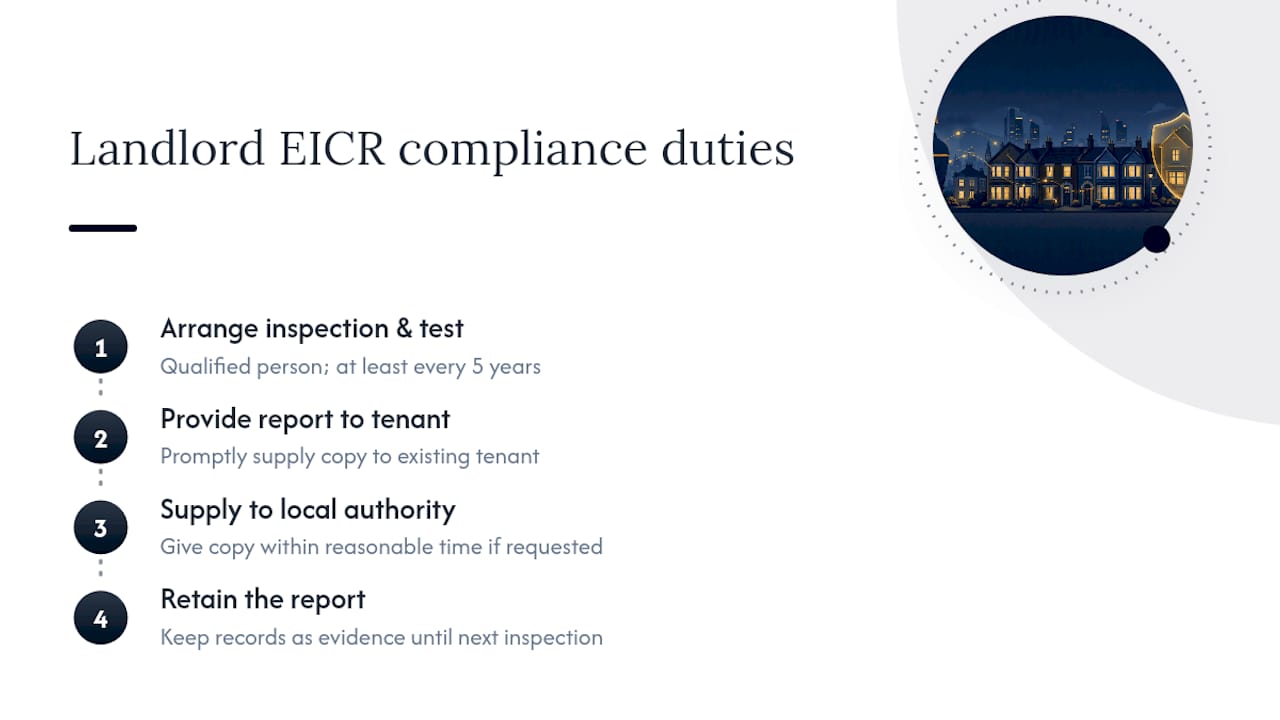
One detail trips up a surprising number of landlords managing a portfolio: you don't automatically need a fresh EICR every time a tenancy changes. If the existing report is less than 5 years old and doesn't flag outstanding remedial or investigative work, you can supply that same valid report to a new tenant rather than commissioning a new inspection. It's a straightforward way to avoid unnecessary costs, provided the paperwork is genuinely current and clean.
Scotland runs its own regime under the Repairing Standard, and Wales and Northern Ireland have their own frameworks too, so don't assume England's specific 5 year rule and 28 day window transfer directly across the border. Where licensing conditions apply, such as HMO licences set by a local authority, those conditions can impose their own maximum interval. Crucially, an inspector must never recommend an interval longer than a statutory maximum where one exists, even if the installation's condition might otherwise justify a longer gap.
How does an inspector decide the next inspection interval?
This is where a lot of confusion sets in, because people assume EICR intervals work like an MOT: fixed number, same for everyone. They don't. BS 7671, the UK wiring standard maintained by the IET, treats the interval as something the competent person determines on a case-by-case basis. Initial recommended frequencies are design decisions. Every inspection after that is an engineering judgement, not a fixed statutory clock.
The inspector weighs several factors together:
- The type of installation and how it's constructed
- How intensively it's used and by how many people
- The quality and frequency of past maintenance
- Environmental conditions, such as damp, heat, dust or corrosive atmospheres
- The age of the installation and any history of alterations
Regulation 653.4 of BS 7671 makes this explicit: the EICR must state the recommended interval to the next inspection, and it must include a brief explanation supporting that figure. It's not optional small print. Guidance from NICEIC confirms that a short, clear rationale is usually sufficient, but it does need to be there, and it needs to be legible enough to survive an audit years later.
In practice, the reasons written on a report tend to fall into recognisable categories: "installation in frequent public use," "damp or corrosive environment," "recent remedial works carried out, reduced interval recommended pending confirmation of standards," or simply "domestic installation, low usage, no adverse findings." A well-maintained, single-family owner-occupied home can legitimately earn a longer recommended interval than a rented flat with a rotating cast of tenants, provided the inspector documents why.
Pro Tip: If your EICR gives a vague or missing reason for its recommended interval, ask the inspector to amend it before filing it away. A one-line justification protects you if the report is ever challenged during a tenancy dispute or a local authority audit.
When do you need an EICR sooner than scheduled?
A satisfactory EICR only covers you up to the date written on it. Beyond that, or before it if circumstances change, you're operating on borrowed time whether the paperwork says so or not.
Certain events should trigger an unscheduled inspection regardless of where you sit in your normal cycle:
- Flooding or water ingress — even brief exposure can corrode connections invisibly behind walls
- Fire damage, even where the fire didn't directly touch the electrical circuits
- Rodent infestation, since gnawed insulation is a common and hard-to-spot fire risk
- Visible damage to sockets, switches, cabling or the consumer unit
- Significant electrical work, such as a rewire, extension, or new circuit addition
- Recurring tripping, buzzing or arcing, which usually signals a fault developing rather than a one-off nuisance
If a fresh or unscheduled EICR comes back with an urgent code, the response isn't optional. A C1 (danger present) finding means immediate risk of injury and requires urgent remedial action, sometimes before the inspector even leaves site. A C2 (potentially dangerous) finding needs remedial work without delay, though not necessarily on the spot. An FI (further investigation) code means the inspector couldn't confirm safety within the scope of the visit and a follow-up examination is required before the installation can be signed off as satisfactory. None of these should sit in an inbox waiting for the next scheduled EICR.
How should landlords and facilities managers manage EICR compliance day to day?
Getting the interval right on paper means nothing if the report itself gets lost in an inbox or forgotten about until a tenant complains. A short operational routine solves most of the problem.
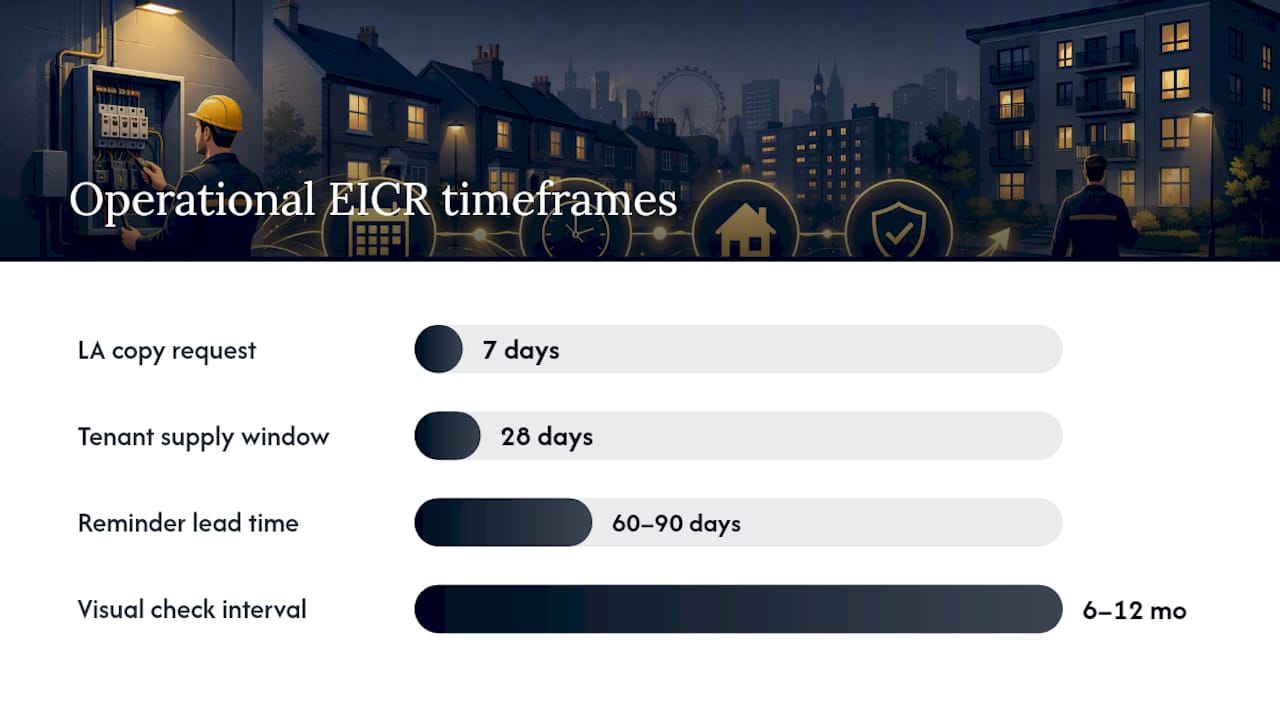
Keep the report until the next inspection is due, or until a replacement report supersedes it, and store it somewhere retrievable at short notice. Local authorities can request a copy within 7 days, and scrambling through old emails at that point is a bad place to be. Agree the next inspection date with your inspector in writing at the point the current report is issued, rather than waiting for a reminder that may never come.
Between formal inspections, a simple visual check every 6 to 12 months, looking for scorch marks, loose fittings, or warm sockets, catches problems long before they become C1 findings. It's not a substitute for a full EICR, but it buys early warning.
- Log the inspection date, next-due date, and inspector's reason for the interval in one place
- Confirm the report has been supplied to the tenant within the 28-day window
- Store the report alongside other statutory certificates for the same property
- Set a reminder at least 60 to 90 days before the recommended reinspection date, not on it
Pro Tip: Don't rely on a spreadsheet across more than a handful of properties. Once you're managing several EICR renewal dates alongside gas safety checks and other certificates, a missed date is a matter of when, not if.
There are free EICR inspection checklists available that landlords can use as a practical starting point for structured records to hand to their inspector or keep for their own files.
If you're preparing documentation for letting a new property or facing a portfolio audit, having every EICR, its reinspection date, and its stated reason for that date in one consistent format saves hours you don't get back once a deadline is looming.
The gap between the regulation and the reality
Most articles on this topic stop at the numbers: 10 years here, 5 years there. The regulation is the easy part. What actually causes non-compliance in the real world is far more mundane, and it has almost nothing to do with anyone misunderstanding BS 7671.
It's missed reminders. A property manager juggling forty tenancies on a wall calendar or a shared spreadsheet, where one renewal date gets buried under the next urgent job. It's certificates sitting in someone's email folder from three roles ago, unreachable when a council actually asks for one within that 7 day window. It's a landlord who genuinely intends to book the next inspection and simply forgets, because nothing flagged it until a tenant asked.
Centralised tracking doesn't change the legal interval. What it changes is the certainty that the deadline gets acted on, not just known about. When every certificate, its issue date, and its recommended reinspection date sit in one system rather than scattered across inboxes and paper files, the interval stops being a number you hope someone remembers and becomes something the business actually manages.
— Luke Herridge
Where Curcle fits alongside your EICR inspections
Curcle doesn't carry out electrical inspections, and it isn't a substitute for a qualified inspector's judgement on BS 7671 intervals. What it does is take the operational side, the part that actually causes missed deadlines, off your plate.

For landlords and facilities managers juggling EICRs alongside gas safety checks, LOLER examinations and other statutory certificates, Curcle centralises recurring audit scheduling so a 5-year renewal date doesn't quietly slip past. Certificates get stored against the property or asset they belong to, not buried in an inbox, so producing one for a tenant or local authority within the required window takes minutes rather than a search. Curcle also hosts a growing library of free compliance templates, including the EICR checklist referenced above, alongside its dedicated compliance inspection tools for recurring renewals and reporting. If you're managing more than a couple of properties or sites, it's worth seeing how the scheduling and storage side works before your next EICR renewal date creeps up on you.
Sources
- Electrical safety standards in the private and social rented sectors: guidance
- Inspection and testing FAQs – IET BS 7671 guidance
- Periodic inspection and testing - Electrical Safety First
- NICEIC guidance on EICR intervals and reporting (excerpt)
FAQ
Is an EICR required every 3 years or every 5 years?
Neither figure applies universally. Rented homes in England face a 5-year statutory ceiling, while caravans commonly get inspected around every 3 years and special locations like swimming pools, often need annual checks.
Have EICR regulations changed since 2020?
The core statutory duty for landlords in England, inspection at least every 5 years with the report supplied to tenants within 28 days, has remained the framework since it took effect, with GOV.UK guidance reaffirmed through 2025. BS 7671 itself has seen amendments over that period affecting reporting detail, including the requirement to record a clear reason for the recommended interval.
What changes are expected in electrical regulation going into 2026?
No confirmed change to the 5-year statutory landlord interval has been announced; the current GOV.UK guidance remains in force. Property owners should still check GOV.UK directly before assuming any figure quoted elsewhere is current.
How often is an EICR actually required for my property?
It depends on use: typically 10 years for an owner-occupied home, up to 5 years for a rented property in England, and as little as 1 year for higher-risk locations like pools. The precise figure for your property is set by the inspector and recorded on the report itself, so check that document rather than relying on general guidance alone.
Can I reuse an existing EICR for a new tenant instead of booking a new inspection?
Yes, provided the existing report is less than 5 years old and shows no outstanding investigative or remedial work, you can supply it to a new tenant rather than commissioning a fresh inspection.