
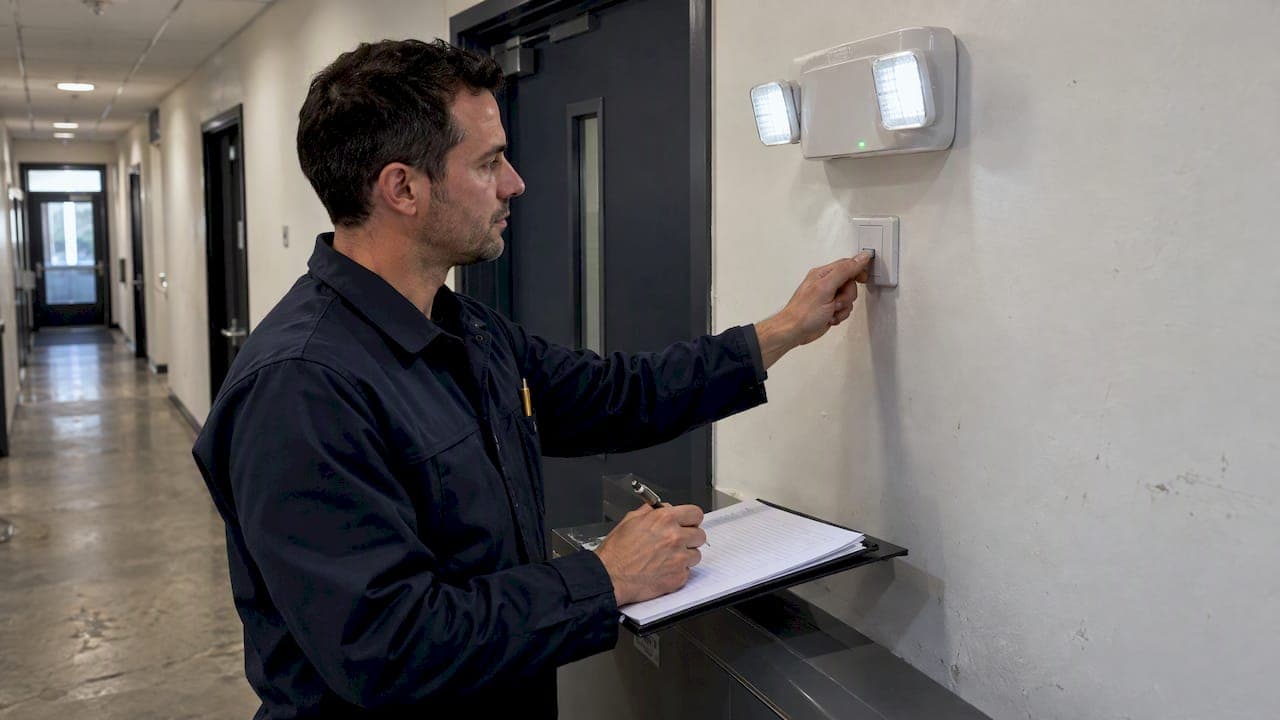
Your emergency lighting test records are the evidence that the system worked when you said it did. In the UK that means a logbook, kept on site, showing every monthly test, the annual full-duration test, any faults found and what was done about them. This guide sets out exactly what to record, who can do which test, and how to keep the whole trail in one place so an inspector can follow it without phoning anyone.
TL;DR
- Record the date, the type of test, each luminaire tested, the result, the remedial action and who carried it out. 'All passed' on its own is not a record.
- The 2025 edition of BS 5266-1 describes daily visual checks, monthly functional tests, an annual full-duration test and a photometric check at intervals of up to five years. Each needs its own entry.
- The standard is not law, but the Fire Safety Order requires the system to be kept in efficient working order, and your logbook is how you show it.
- Keep the logbook on the premises, and tie every entry to a unique luminaire reference such as EL-01.
- Paper works for a small site. Once you have several sites, contractors and certificates, a connected system stops records going missing.
Table of Contents
- Why the logbook matters more than the test itself
- What your emergency lighting test records must contain
- The test cycle and what to log at each stage
- A worked example of a useful entry
- Who can do which test
- Paper logbook or digital records?
- Where records tend to fall down
- Our view: the record should tell you what needs attention
- Keeping emergency lighting records in Curcle
- Setting up your records in five steps
- FAQ
- Sources
Why the logbook matters more than the test itself
A test that nobody wrote down is, for practical purposes, a test that did not happen. The Regulatory Reform (Fire Safety) Order 2005, as amended by the Fire Safety Act 2021, places legal responsibility on a 'responsible person', usually the employer, owner, landlord or managing agent who controls the premises. That person has to keep safety systems maintained, and when a fire risk assessor or fire and rescue officer visits, the logbook is usually the first thing they ask to see.
BS 5266 itself is guidance rather than statute. In practice, though, it is the benchmark inspectors use. Guidance from Warwickshire County Council notes that BS 5266 and its European equivalent expect written declarations of compliance, such as the commissioning certificate and logbook, to be available on site for inspection. Fire and Rescue Scotland's fire precautions logbook makes the same point more simply: the logbook should remain on the premises and helps you prove you have met your legal duties.
The practical consequence is that incomplete records tend to be judged harshly. An emergency system with gaps in its paperwork is hard to defend, however good the hardware is.
What your emergency lighting test records must contain
There is no single mandatory form. There is, however, a consistent set of fields that a third party would need to reconstruct what happened. At a minimum, each entry should carry:
- Date and time of the test, and the person who carried it out.
- Type of test: daily check, monthly functional, annual full-duration or photometric verification.
- Luminaire reference and location, for example EL-14, first-floor corridor, north stairwell door.
- Result for each luminaire, not for the building as a whole.
- Fault description and remedial action, with the date it was fixed and who fixed it.
- Retest result after any repair.
- Signature or digital sign-off from the person responsible.
The point of unique references is traceability. Recording that 'all lights passed' tells an inspector very little. Recording that EL-07 failed at 40 minutes, the battery was replaced on a named date and the retest passed tells them the system is being managed.
Your logbook should also hold the documents that sit around the tests: the commissioning certificate, the as-fitted drawings showing luminaire positions, service certificates from contractors and any record of changes to the layout or the system.
The test cycle and what to log at each stage
The RiskFire guide to BS 5266-1:2025 describes four intervals. Two of them will be familiar from any maintenance contract; the other two are less commonly diarised.
| Test | Frequency | What it proves | What to record |
|---|---|---|---|
| Visual check | Daily, where applicable | Indicator lamps show the unit is healthy | Date, any units with a missing or faulty indicator |
| Functional ('flick') test | Monthly | Every luminaire switches to battery and lights | Date, each luminaire's result, faults, who tested |
| Full-duration test | Annually | Batteries last the rated duration, typically 3 hours | Date, start and end times, result per luminaire, failures |
| Photometric verification | At intervals not exceeding five years | Light on the escape route floor still meets design levels | Date, meter readings, comparison to design, specialist's report |
Treat the table as a starting point and confirm the detail against the current edition of the standard and your own fire risk assessment, which may set a different regime for your premises.
Monthly functional tests
This is a short test that confirms each luminaire activates when the mains supply is removed. It can be done by trained in-house staff. The record should show the date, each luminaire tested and any that did not light. A monthly test with no named luminaires is the single most common weak spot in a logbook.
The annual full-duration test
The annual test runs for the system's full rated duration, typically 3 hours in most commercial premises. A one-hour rating is permitted only in specific cases, such as laboratories where evacuation is immediate and re-entry is restricted until batteries have recovered. The same guide says mains should be isolated with key switches rather than by unplugging or tripping breakers, so every luminaire can be watched across the whole period.
Log the start and finish times, and each luminaire's state at the end. A battery that survives a short flick test can still fail under load, which is exactly why this test exists.
Because batteries can take up to 24 hours to recharge, schedule the test for a low-occupancy window such as an evening or weekend, and record when the system was confirmed fully charged again. That small entry shows you thought about the risk during the recharge period.

Photometric verification
This is the one most people miss. Photometric verification means a specialist measures the light on the escape route floor with a calibrated meter, to confirm it still meets the design criteria in BS EN 1838. It catches problems that functional tests cannot: ageing luminaires, discoloured lenses, a changed layout or new décor. Keep the specialist's report and readings alongside the logbook, and diarise the next one.
A worked example of a useful entry
Take a two-storey office with 18 luminaires. A monthly test entry might read:
- Date: first working Monday of the month, 07:45
- Tester: named facilities coordinator, trained in-house
- Test: monthly functional
- Result: EL-01 to EL-17 lit on battery; EL-12 (ground floor, rear fire door) failed to light
- Action: lamp replaced the same day, retest passed, entry signed
That is a few lines, yet it tells an inspector who tested, what failed, how fast you reacted and that you checked the fix. Compare it with a tick in a box for the building.
Who can do which test
Monthly tests can be carried out by trained in-house staff. The annual full-duration test is better handled by a competent person, typically a qualified electrical engineer or emergency lighting specialist, who can certify the result and leave the system compliant. Photometric verification needs a specialist with the right equipment.
If you outsource any of this, make sure the contractor's certificate lands in your logbook, not just in an email inbox. Records scattered between a contractor's portal, a site manager's desk and a shared drive are the most common reason an inspector cannot see a complete picture.
Paper logbook or digital records?
A printed logbook is perfectly acceptable for a single small building, and many businesses start there. A bound book is cheap, and it sits on site as the guidance expects. Its weaknesses are predictable:
- Pages get lost, damaged or filled in weeks later from memory.
- Nothing reminds you the monthly test is due, or that the five-year photometric check is coming.
- Remedial work and contractor certificates live somewhere else.
- With several sites, nobody can see at a glance which building has overdue tests.
Digital records fix those, provided they keep the same rigour: time-stamped entries, a unique reference per luminaire, photos of defects, a visible audit trail and an export you can hand over on the day. Whichever you choose, the test is the same: could a stranger rebuild the story of the system from your records alone?
Where records tend to fall down
These are the gaps we see most often described in industry guidance and in the paperwork of growing service businesses:
- No luminaire-level detail. One tick for the whole site.
- Failures with no follow-up. A fault noted in March, with no sign it was repaired.
- Missing annual or photometric evidence. Only the monthly tests are filed.
- Fragmented documents. Logs in one place, certificates in another, drawings in a third.
- Layout changes not reflected. New partitions or a refit that were never reviewed against the emergency lighting design.
- Tests with no named, trained person.
Each is easy to prevent with a repeatable process rather than good intentions.
Our view: the record should tell you what needs attention
Curcle was born inside a real UK service and engineering business, and the problem we kept running into was not that engineers failed to test. It was that the evidence ended up in four different places. A test sheet in the van, a certificate in someone's inbox, a defect in a text message, and a customer asking for proof on a Friday afternoon.
Our approach is that compliance should be built into the backbone of the system, not bolted on afterwards. For emergency lighting, that means every luminaire is an asset with its own reference and location, every test is a job linked to that asset, every failure creates remedial work that stays open until it is closed, and the certificate and photos sit on the same record. The logbook then becomes something you can export rather than something you assemble in a panic.
We also believe records should look forward. A logbook that only shows what has already happened is a filing cabinet. The more useful question is which sites have a test due, which defects are still open and which contracts are about to breach their SLA. Software should surface that, and leave the judgement to the people who know the buildings.
— Luke Herridge
Keeping emergency lighting records in Curcle
If you maintain emergency lighting for clients, or look after multiple sites yourself, Curcle brings jobs, assets, compliance, certificates and reporting into one system, with an offline-capable mobile app so engineers can record results on site. You can see how it works across fire safety inspection and remedial tracking, or look at the wider product.
Plans are published on the pricing page: Starter from £99 per month, Professional from £249 per month and Business from £499 per month, with Enterprise available on request and no published price. For managers looking after several buildings, our facilities management software covers multi-site SLA and compliance tracking.

The same principle applies to other regulated records. If you also handle gas, electrical or water hygiene paperwork, our guides on Legionella logbook requirements and PAT testing frequency follow the same audit-trail logic.
Setting up your records in five steps
- Survey and number every luminaire. Give each a unique reference and mark it on the floor plan.
- Gather the paperwork. Commissioning certificate, drawings, previous service certificates.
- Fix the calendar. Monthly test dates, an annual full-duration date in a quiet period, and the next photometric date.
- Decide who does what. Name the trained in-house tester and the competent person or contractor for the annual and five-yearly work.
- Close the loop. Every failure gets a remedial entry and a retest, and someone reviews open items monthly.
FAQ
Do I legally need an emergency lighting logbook?
No single law names the logbook, but the Fire Safety Order requires the responsible person to keep fire safety equipment maintained. BS 5266 and the guidance from fire authorities expect written records and certificates to be available on site. In practice, the logbook is how you show an inspector that duty has been met.
How often must emergency lighting be tested and recorded?
Under the current guidance, you carry out a monthly functional test and an annual full-duration test, usually 3 hours. The 2025 edition of BS 5266-1 also describes daily visual checks where applicable and photometric verification at intervals not exceeding five years. Each of these should have its own dated entry.
Who can carry out the tests?
Trained in-house staff can do monthly functional tests. The annual full-duration test should be done by a competent person, such as a qualified electrical engineer or emergency lighting specialist, who can certify the result. Photometric verification needs a specialist with a calibrated meter.
Can I keep emergency lighting records digitally?
Yes, as long as the records are complete, time-stamped, tied to specific luminaires and available when an inspector asks. The guidance is about the evidence on site, not the format. Check with your fire risk assessor if your premises have specific requirements.
What should I do if a luminaire fails a test?
Record the failure against that luminaire, arrange the repair promptly, and log the date, the work done and a passing retest. Faults should be rectified without delay, and an open failure with no follow-up is one of the weakest things a logbook can show.
Sources
- Residents' guide to fire safety in blocks of flats, GOV.UK
- Fire safety emergency lighting, Warwickshire County Council
- Fire precautions log book, Scottish Fire and Rescue Service
- How often to test emergency lighting, RiskFire
- A compliance guide to emergency lighting testing, Hawkesworth