
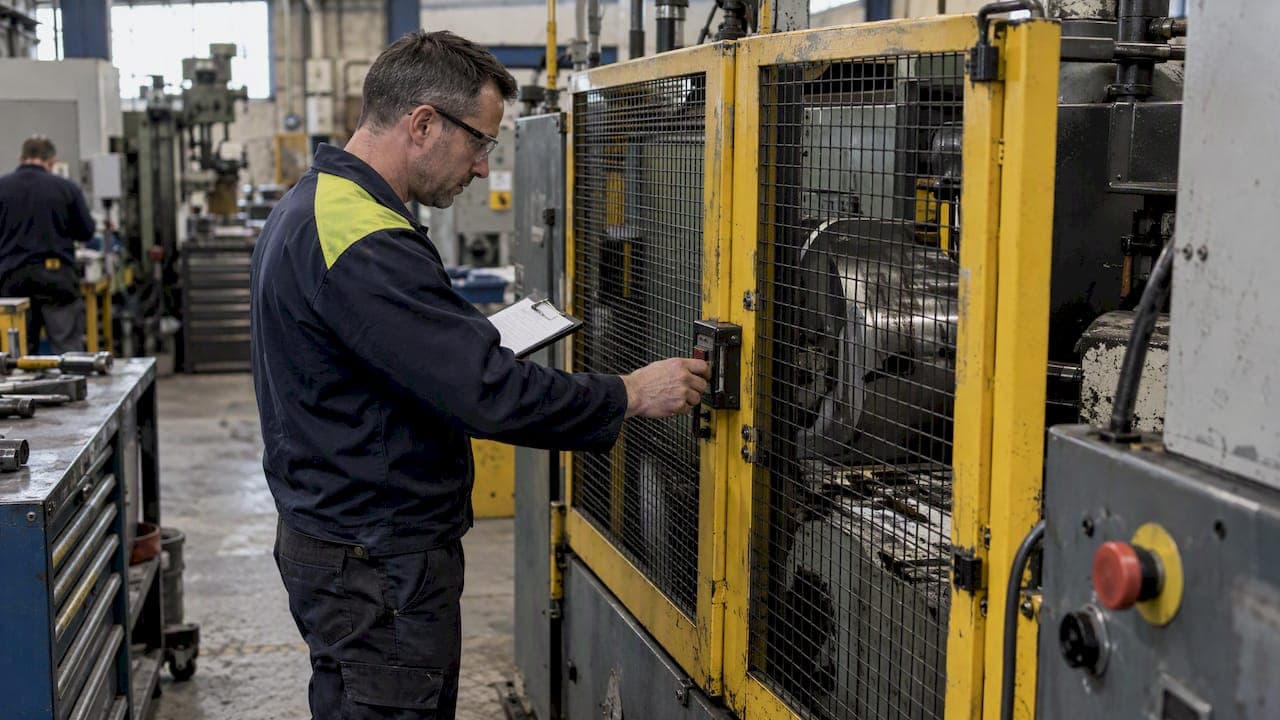
A PUWER inspection record is the written result of an inspection of work equipment, kept until the next inspection is recorded. The law sets no fixed form, so a handwritten log, a spreadsheet or a software record are all acceptable. What matters is that the record ties one identifiable piece of equipment to what was checked, what was found and what was done about it. This guide covers what to put in the record, how long to keep it, how to set inspection frequency, and where records usually fall down in engineering and maintenance businesses.
TL;DR
- Regulation 6 of PUWER 1998 requires you to record the result of each required inspection and keep it until the next one is recorded.
- There is no prescribed template. HSE's L22 guidance lists what a useful record should hold: equipment identity, date, inspector, faults, action taken and completion date.
- Frequency is risk-based. There is no universal six- or twelve-month rule in HSE's inspection guidance.
- Lifting equipment, power presses and work at height sit under their own regimes, so one generic PUWER record does not cover them.
- Equipment that needs inspection must not be used unless you know the inspection has happened.
Table of Contents
- What the law actually says about records
- What a good PUWER inspection record contains
- Records, pre-use checks and maintenance logs are different things
- What falls outside a standard PUWER record
- How often should you inspect?
- Who can carry out the inspection
- Traceability: the part field teams get wrong
- Paper, spreadsheet or software
- Our view: a record should drive action
- Putting it into practice
- How Curcle helps
- FAQ
- Sources
What the law actually says about records
Regulation 6 sets out when work equipment must be inspected. Inspection applies where safety depends on installation conditions: after installation and before first use, and after assembly at a new site or location. It also applies where equipment is exposed to conditions causing deterioration that could create danger: these inspections happen at suitable intervals, and again after exceptional circumstances that could jeopardise safety, such as damage or a long period out of use. You can read the exact wording on legislation.gov.uk.
The record duty is short. The result of each inspection must be recorded and kept until the next inspection under Regulation 6 is recorded. That is the legal minimum, and it is lower than many people assume. Your insurer, a customer contract or your own audit needs may reasonably require you to hold records for longer, and in a dispute after an incident an older record can be useful evidence. Decide a retention period deliberately and write it down, rather than defaulting to the legal floor by accident.
The form is open. HSE says records need not be on paper: if they are kept on a computer or another medium, they should be held securely and be accessible. A pre-printed form, a diary entry or an electronic entry all work, provided the content is right.

What a good PUWER inspection record contains
HSE's L22 Approved Code of Practice and guidance describes the content of a useful record. Treat it as guidance rather than a mandatory template, but it is the checklist an inspector or investigator will have in mind. A record should capture:
- Equipment type and model.
- A unique identification mark or number. Without this, a record cannot be matched to the machine after it is moved, repaired or replaced.
- Normal location.
- Date of inspection.
- Who carried it out.
- Faults found.
- Action taken, and who was told about the faults.
- The date repairs or other necessary action were completed.
The last two are the ones most often missing. A log that says "inspected, pass" proves a visit happened. A log that shows a fault found on Tuesday, the manager told on Tuesday and the repair closed on Friday proves control.
Record the scope, not just the verdict
An inspection may need functional testing of interlocks, protection devices and controls, or other tests such as non-destructive testing of safety-critical parts. L22 leaves it to the competent person who decides the inspection scope to say whether testing or dismantling is necessary. So the record should state what was actually examined and tested. A reviewer reading it a year later, perhaps after an injury, needs to know whether the guard was visually checked or the interlock was tested.
A worked example
Take a bench-mounted pillar drill in a workshop. A sound record would look like this:
| Field | Entry |
|---|---|
| Asset | Pillar drill, make and model, asset tag WS-014 |
| Location | Workshop bay 2 |
| Inspection date | 14 October 2026 |
| Inspector | Named, trained employee |
| Scope | Guard condition, emergency stop function, chuck key retention, electrical lead condition |
| Fault | Emergency stop slow to release the spindle |
| Action and notified | Tagged out of use, workshop manager told the same day |
| Closed | Repaired and re-tested, date and name recorded |
Nothing here is exotic. It is simply specific enough to be interpreted by someone who was not there.
Records, pre-use checks and maintenance logs are different things
Three kinds of paperwork get blurred together.
Pre-use checks. HSE says the simplest checks, such as an operator looking at a guard before starting work, normally do not need recording. Records should be proportionate and focused on safety-critical issues. A form demanding dozens of ticks for every asset invites superficial completion, and HSE's guidance is clear that excessive detail can undermine the whole purpose of inspection.
Maintenance logs. A planned maintenance system is valuable, but HSE enforcement experience warns that a general maintenance routine may not show PUWER compliance. It may not ask the right questions about condition, or may not record the answers properly. Link the maintenance log to your inspection records, but do not assume one replaces the other.
Regulation 6 inspection records. These are the formal results of inspections to detect deterioration before it creates risk. They are the subject of this guide.
What falls outside a standard PUWER record
Regulation 6 excludes equipment covered by more specific regimes. These include power presses (Regulations 32 to 35), work equipment for lifting loads or people, certain mining winding apparatus, specified construction equipment inspections and equipment covered by the Work at Height Regulations 2005.
For a service business, the practical consequence is on your asset register. Each asset should show which regime applies, so nobody assumes a generic PUWER entry covers a hoist or a lifting accessory. Lifting equipment needs thorough examination under LOLER, and we cover the timing in our guide to LOLER inspection frequency. Power presses have their own retention rule: HSE's L112 guidance says thorough examination reports must be available for inspection for 2 years, and certificates for the period of currency and 6 months after expiry. That rule belongs to power presses and should not be applied to all PUWER equipment.
How often should you inspect?
There is no fixed interval. HSE's guidance, updated 29 October 2024, says the frequency should reflect the type of equipment, how it is used, environmental conditions, manufacturer recommendations and experience from earlier inspections. Its examples run from quick pre-use checks, through weekly checks of guarding and safety devices, to more extensive examinations every few months or longer.
In practice:
- Start from the manufacturer's instructions, then adjust for your own conditions. A grinder in a dusty, high-throughput workshop deserves a shorter interval than one used twice a month.
- Shorten the interval when you find deterioration. Repeated findings on the same asset are a signal, not a coincidence.
- Extend it only when history supports that. A run of clean inspections is evidence you can cite when you lengthen an interval, which is why the history needs to be kept in a form you can search.
- Write down the reasoning. Someone competent decided the scope and interval, and the record of why is part of your defence.
The legislation's phrase "suitable intervals" makes the inspection history part of the control system. Records are not only evidence of what happened: they tell you what to do next.
Who can carry out the inspection
You do not automatically need an external provider. HSE's L22 separates deciding the inspection regime from carrying it out. One competent person can set the scope and the interval, and a suitably trained employee can perform the check. Competence must cover deciding what the inspection includes, how it is done and when. The level needed rises with the complexity and risk of the equipment and its working environment. A knowledgeable, experienced employee can be competent. Complex or high-risk machinery may call for specialist knowledge, which you can bring in as needed.
Traceability: the part field teams get wrong
HSE is explicit that equipment requiring inspection should not be used unless you know the inspection has taken place. Where equipment is moved outside your business, or arrives from a hire company, there should be evidence the user can check, such as an inspection report, a tag, a colour code or a label.
For engineering, facilities and maintenance firms this matters more than for a static factory. Your equipment travels in vans, goes to client sites and comes back. A central spreadsheet does not help an engineer standing on a roof with a borrowed access tool and no signal. The operational requirement is traceability at the asset and job level:
- every item carries a unique ID that matches the register;
- the last inspection date and result can be checked at the point of use;
- a failed item is blocked from use until it is closed out;
- hired-in equipment is checked on arrival, not assumed.
This is the same discipline that underpins audit-ready reporting in other compliance areas, from PAT testing to water hygiene records.
Paper, spreadsheet or software
All three are lawful. The question is how each copes with real conditions.
| Paper log | Spreadsheet | Connected software | |
|---|---|---|---|
| Legal acceptability | Yes | Yes, if held securely | Yes, if held securely |
| Link to unique asset ID | Manual | Manual | Built into the asset register |
| Overdue alerts | None | Needs formulas and discipline | Automatic from the interval |
| Fault to closure trail | Easily broken | Easily overwritten | Timestamped, with audit trail |
| Use on site without signal | Yes | Poor | Depends on offline support |
| Photos and evidence | Separate | Separate | Attached to the record |
Paper and spreadsheets work for a handful of assets and one site. They tend to break when assets multiply, several people edit the same file, or someone leaves and takes the logic of the system with them.
Our view: a record should drive action
Curcle was born inside a real UK service and engineering business, and we have seen the same failure repeatedly: the inspection happened, but the record cannot prove it. The sheet is in a van, the spreadsheet has three versions, and the fault found in March was never linked to a repair job.
Our view is that PUWER records should be built around the asset, not the document. One asset, one ID, one history. When an inspection finds a fault, the next step, whether a repair job, a block on use or a change to the interval, should follow from the record rather than depend on someone remembering. We also think proportionality matters. Software that forces identical long forms onto every drill and ladder makes people tick boxes without looking. Every field should earn its place, and the system should show what needs attention rather than only recording what has already happened.
AI can help surface overdue items and repeated faults, but the decision about scope, interval and whether equipment is safe stays with the competent person.
— Luke Herridge
Putting it into practice
- List your equipment and give each item a unique ID, including vehicle-mounted and hired-in tools.
- Mark which regime applies: Regulation 6 PUWER, LOLER, power presses, work at height or none.
- Decide scope and interval for each equipment type, with a named competent person and a short written reason.
- Design a proportionate record using the L22 fields above. Keep pre-use checks light and unrecorded unless they are safety-critical.
- Link faults to actions. Every fault needs an owner, a notified person and a closure date.
- Control use. Make it impossible, or at least obvious, to use equipment that is overdue or failed.
- Review the history at least annually and adjust intervals using the findings.
How Curcle helps
Curcle is an operations platform for UK field service, engineering and maintenance businesses. Assets, jobs, engineers, compliance and reporting sit in one connected system, with a mobile engineer app that works offline, document and photo capture and audit trails. That gives you a single asset register to hold inspection history against, and exports you can produce when a customer or auditor asks. You can see how this fits your business on our product page, or look at pricing: plans start from £99 per month on Starter, from £249 per month on Professional and from £499 per month on Business, and Enterprise has no published price.
FAQ
How long must PUWER inspection records be kept?
Regulation 6 requires the record to be kept until the next inspection under that regulation is recorded. That is the legal minimum. Many businesses keep records longer for insurance, contracts or investigations, and power presses have a separate rule of 2 years for thorough examination reports under L112.
Does a PUWER inspection record have to be on paper?
No. HSE accepts records kept in other forms, such as on a computer, as long as they are held securely. What counts is the content: a uniquely identified asset, the date, the inspector, the faults, the action taken and when it was completed.
How often should work equipment be inspected under PUWER?
There is no fixed period. HSE says the interval depends on the equipment, how it is used, the working environment, manufacturer advice and previous inspection findings. It can be shortened when deterioration appears and extended when your history justifies it.
Can our own employees carry out PUWER inspections?
Yes, provided they are competent for that equipment. HSE's L22 guidance allows a knowledgeable, trained employee to carry out the inspection, while someone competent decides its scope and frequency. Complex or high-risk equipment may need specialist input.
Do I need to record every pre-use check?
Generally no. HSE says the simplest pre-use checks normally do not need recording, and records should be proportionate and focused on safety-critical issues. Record anything that falls under a Regulation 6 inspection, and any fault that leads to action.
Sources
- The Provision and Use of Work Equipment Regulations 1998, Regulation 6
- HSE L22: Safe use of work equipment, Approved Code of Practice and guidance
- HSE: Inspection of work equipment
- HSE L112: Safe use of power presses