
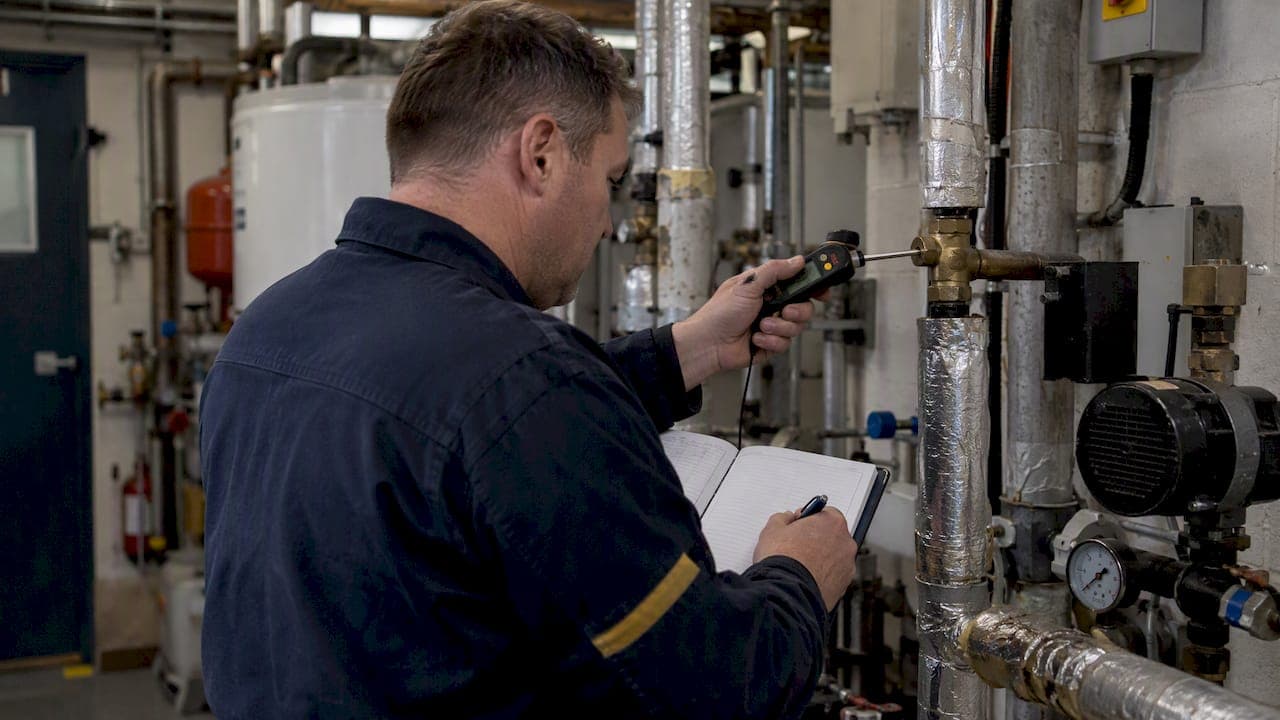
A compliant water hygiene record must name a competent person, hold a written control scheme, and log sentinel temperature checks with dates and corrective actions. If you manage five or more employees, you must record significant findings from your legionella risk assessment. Cold water should read below 20°C and hot water at least 50°C (55°C in healthcare settings), with monitoring records kept for at least five years.
TL;DR:
- Most systems need no routine sampling; cooling towers, suspected contamination, or risk assessments require BS 7592 methods and UKAS accredited lab analysis.
- Delegating checks does not transfer legal responsibility; the dutyholder must appoint someone with the skills, knowledge, and authority to manage the system.
- Keep monitoring records for at least five years; retain superseded assessments and control schemes for two, and individual COSHH exposure records for 40 years.
- Sensors can flag temperature changes, but they cannot replace site specific risk assessments, physical inspections, or a person interpreting results and signing off corrective action.
Table of Contents
- What an inspector expects to see in your records
- Sentinel checks, temperature thresholds and when to test for bacteria
- Who the competent person is and what they owe you
- How long to keep records, and when to notify the authorities
- A template that captures every required field
- Using sensors and software without losing compliance
- What actually moves the needle on compliance
- Keeping water hygiene reporting audit ready across every site
- FAQ
- Sources
What an inspector expects to see in your records
Water hygiene reports exist to prove that risk is being managed, not just assessed on paper once and forgotten. Inspectors look for a specific set of elements, and gaps in any one of them tend to trigger follow-up questions.
Key elements of a water hygiene record include:
- The name of the competent person responsible for managing the system.
- A written control scheme describing how risk is controlled, including a schematic of the plant.
- Monitoring, inspection and test results, each dated and showing the state of operation at the time.
- Remedial work carried out when a reading falls outside the expected range.
- Records of precautions, monitoring and remedial work.
Records should be accurate and signed or authenticated, and traceable to the person responsible. A missing record of the system's state of operation can give false assurance, and readings should be traceable to the person responsible. Both are avoidable with a consistent template and a rule that nothing gets logged without a timestamp and an author.
Sentinel checks, temperature thresholds and when to test for bacteria
Sentinel outlets are the taps closest to and furthest from the water storage point, chosen because they give the earliest warning of a temperature or stagnation problem across the whole system. The appropriate sentinel outlets depend on the system and its risk assessment.
The standard checks are confirmed by HSE's guidance for water systems.
- Cold water at sentinel outlets should run below 20°C.
- Hot water should reach at least 50°C, or 55°C in healthcare premises, within one minute of running.
- Both the reading and the time taken to reach it should be logged, not just the final figure.
The time taken to reach the target temperature should be recorded, since a slow rise can point to a dead leg or a failing mixing valve.
Microbiological sampling is not a routine requirement for most hot and cold water systems, but it becomes necessary for open systems such as cooling towers, when contamination is suspected, or when the risk assessment specifically calls for it. Where sampling is needed, it must follow BS7592 methods and be analysed by a UKAS-accredited laboratory, with open systems typically sampled at least quarterly.

Who the competent person is and what they owe you
Appointing a competent person does not transfer legal responsibility. The dutyholder, meaning the business or site operator, remains accountable for compliance even when day-to-day monitoring is delegated to an employee or an external contractor. What matters is that whoever holds the role has the skills, knowledge and authority to manage the system properly.
A competent person should deliver:
- A signed risk assessment covering the whole water system.
- A written control scheme setting out how risks are controlled.
- A monitoring schedule with clear frequencies for each check.
- Interpretation of results, not just raw numbers.
- Written instructions for corrective action when something falls outside range.
Pro Tip: Ask your competent person to review the control scheme regularly, even when nothing has changed, so there is always a current version on file.
Healthcare sites, care homes and other complex buildings should follow sector-specific technical memoranda such as HTM 04-01 on top of the general HSE guidance, since these settings carry tighter temperature and monitoring requirements.
How long to keep records, and when to notify the authorities
Retention periods differ depending on the type of record, and getting this wrong is one of the easiest compliance gaps to create by accident. HSE guidance sets these minimums:
- Monitoring, inspection and test results: at least 5 years.
- Risk assessments and the written control scheme: kept while current, then for at least 2 years after they are superseded.
- COSHH personal exposure monitoring records: 40 years, where representative of an individual's exposure.
Separately, RIDDOR requires reporting of certain legionellosis cases linked to workplace exposure, and cooling towers or evaporative condensers must be formally notified to the local authority under the 1992 notification regulations. If an outbreak or inspection does happen, the fastest way to respond well is to have records already organised by site, by date and by verified action, rather than reconstructing a timeline under pressure, as seen in recent Glangwili Hospital wards closed after scabies and flu outbreaks.
A template that captures every required field
A single, repeatable structure stops fields getting missed when different staff are filing reports across multiple sites. A workable template runs through these sections in order:
- Site and contact details, including the building name and the person on site.
- A schematic or plan of the water system.
- The competent person's name and credentials.
- A summary of the current risk assessment.
- The written control scheme.
- Monitoring logs, with sentinel readings and the time each was taken.
- Remedial actions, linked to the reading that triggered them.
- A log of contractor visits.
- Laboratory results, where sampling has taken place.
- The review date and an authorised signature.
Recording the "state of operation" matters more than it sounds: a reading taken on a system that was switched off or rarely used tells you nothing useful, so each entry should state clearly whether the outlet was in regular use. Version control on the control scheme itself lets a reviewer see exactly when something changed and why.
Pro Tip: Attach photos of sentinel outlets and scanned contractor certificates directly to each log entry, so an export can stand alone as evidence without anyone needing to chase supporting paperwork.
Using sensors and software without losing compliance
Automated monitoring can help identify temperature changes, but HSE is clear that automation supports a site-specific risk assessment rather than replacing it, and physical inspections remain necessary alongside it.
Before trusting a digital system, check it provides:
- Secure, tamper-evident timestamps on every reading.
- Authenticated user actions, so every entry is tied to a real person or sensor.
- Exportable audit trails that a manager or inspector can review without needing the live system.
- Sensor placement that matches proper sentinel logic, near and far outlets, not just convenient ones.
- Clear data retention settings matching the periods above.
Treat automation as an early-warning layer with documented escalation rules, not as a replacement for someone interpreting the results and signing off corrective action.
What actually moves the needle on compliance
Most sites get water hygiene reporting roughly right but fall down on consistency. Name a competent person, agree a record template across every site, and ensure records are signed or authenticated.
Start with the basics: set a schedule for sentinel temperature logging and produce management exports regularly. Bring in automation gradually, and never let a sensor reading stand in for a documented human check.
— Luke Herridge
Keeping water hygiene reporting audit ready across every site
Running water hygiene records alongside job scheduling, asset registers and contractor logs in separate systems is where most gaps creep in. We built our water hygiene software to help keep compliance information organised, so an export is audit ready without anyone stitching paperwork together from separate tools.

Because compliance work can sit alongside jobs and assets rather than in a separate spreadsheet, a manager can see which sites are overdue for a check or missing a signed control scheme at a glance:
- Organise competent person records, control schemes and sentinel logs.
- Prepare records for review.
- Keep lab results and contractor visits organised with site and asset information.
If you manage water hygiene compliance across several sites, current prices are on our pricing page, or watch a demo to see how the records fit together before you commit.
This article is general information, not a substitute for advice from a qualified lawyer. Consult a qualified legal professional about your own circumstances before acting on anything here.
FAQ
What records must a dutyholder keep for legionella compliance?
A dutyholder with five or more employees must record the competent person, the written control scheme, monitoring results and any remedial action taken. Smaller organisations are not legally required to document this, though HSE recommends it for due diligence.
How long do water hygiene monitoring records need to be kept?
General monitoring, inspection and test records should be kept for at least 5 years, while risk assessments and the written control scheme stay on file while current and for two years after. Personal exposure records under COSHH must be retained for 40 years.
What temperature should hot and cold water reach at sentinel outlets?
Cold water at sentinel outlets should stay below 20°C, and hot water should reach at least 50°C, or 55°C in healthcare premises, within one minute of running. Both the reading and the time taken should be logged.
When is microbiological water testing required?
Microbiological sampling becomes necessary for open systems such as cooling towers, when contamination is suspected, or when a risk assessment specifically calls for it, and must use BS7592 methods carried out by a UKAS-accredited laboratory. Routine hot and cold water systems do not usually need microbiological testing.
Who is legally responsible if the competent person makes a mistake?
The dutyholder remains legally responsible for water hygiene compliance even when a competent person, internal or external, manages the day-to-day monitoring. Choosing someone with the right skills, knowledge and authority is part of that ongoing responsibility.