
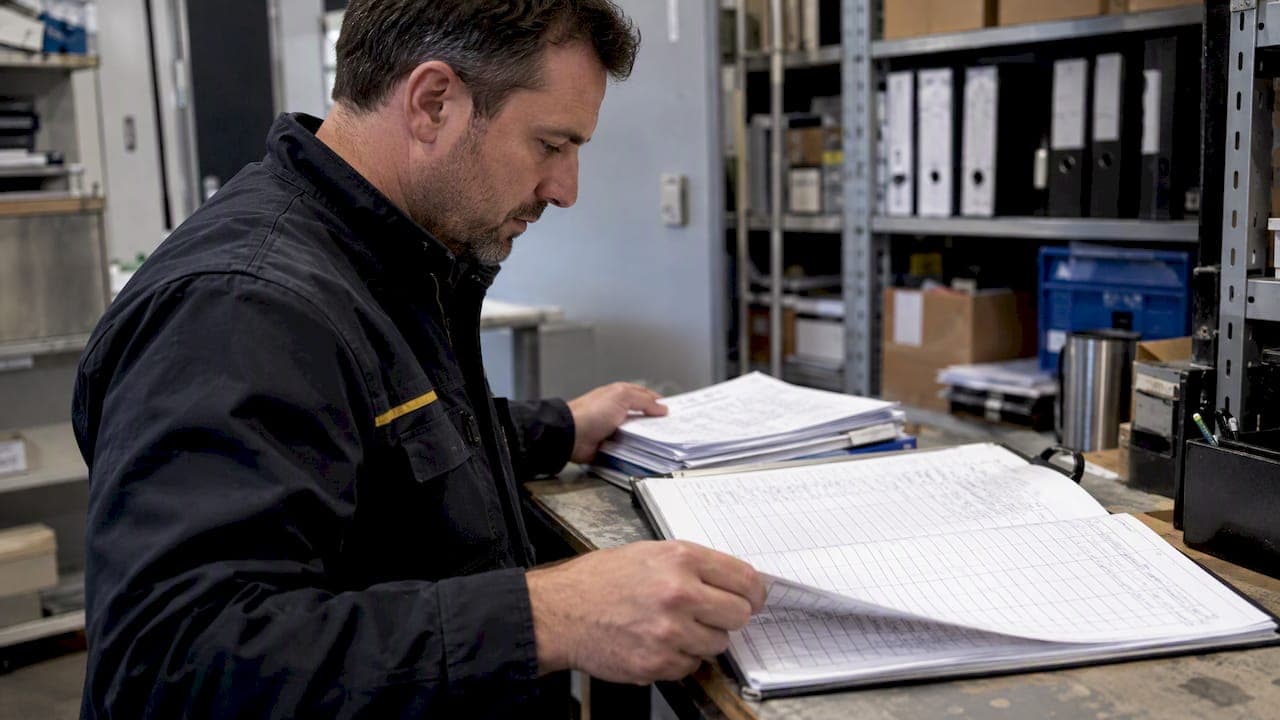
Once a workplace has five or more employees, HSE guidance requires the significant findings of a Legionella risk assessment to be recorded, alongside monitoring results, kept for inspection. At minimum, your logbook needs a written risk assessment, a written scheme of control, monitoring records for temperatures and flushing, test results, remedial actions and a signed record of who carried out each task.
TL;DR:
- Keep monitoring and test records for at least five years; retain current risk assessments and control schemes for two years after they are superseded.
- The risk assessment should set monitoring frequency; sentinel outlet temperatures are often checked monthly, while other outlets follow a defined rotational cycle.
- Use microbiological testing for open systems, suspected control failures, or inconclusive monitoring; send samples to a laboratory accredited by UKAS using BS7592 methods.
- Authenticate every entry with the worker’s signature or secure digital mark, and identify the exact asset, location, date, measured result, and any corrective action.
Table of Contents
- What to include in a legionella logbook: practical checklist
- Who must keep records and when: the five-or-more-employees rule
- How long to retain legionella records and how to organise archives
- Monitoring tasks and typical frequencies
- Testing and sampling: when it's needed and how to record results
- Auditing and inspection readiness: what to include in an audit pack
- Paper vs electronic logbooks: practical guidance
- Integrating legionella logbooks with wider compliance and asset management
- Training requirements for staff involved in legionella monitoring
- Legal consequences of poor legionella record-keeping
- Author perspective: immediate steps for duty holders
- How Curcle helps make legionella logbooks audit ready
- FAQ
- Sources
What to include in a legionella logbook: practical checklist
A compliant logbook is not a single document. It is a set of linked records that together show the written scheme is being followed day to day. HSE and the L8 Approved Code of Practice set out the items that should appear, and most audit failures come down to one of these being missing or incomplete rather than the whole system being absent.
Your logbook should contain:
- The names and positions of the duty holder, responsible person and any deputies, so inspectors can see who holds accountability.
- The significant findings of the risk assessment, written in plain terms rather than left as a generic template.
- The written scheme of control, including a schematic diagram or system plan showing tanks, calorifiers, outlets and dead legs.
- Monitoring records showing outlet identifiers or locations, the date and time of each check, measured temperatures, and flushing events for outlets used infrequently.
- Chemical dosing and water treatment logs, cleaning and disinfection reports, and contractor visit certificates.
Every entry needs authentication: a signature, initials or a secure digital mark, plus contact details for the person who carried out the task. This matters because HSG274 and L8 treat signed records as evidence that the scheme is actually being implemented, not just that a scheme exists on paper.
For each item, record who did the work, what they did, where (the specific outlet or asset), when, the measured result, and whether any action was required or completed. A temperature reading without a location reference or a flushing log without a date are both common gaps that turn a routine inspection into a drawn-out one.
Pro Tip: Keep a single index page at the front of the logbook listing every outlet and asset by reference number, so an inspector can cross-check entries against the system schematic in seconds.
Who must keep records and when: the five-or-more-employees rule
The statutory record-keeping duty applies once an organisation employs enough people to meet the statutory threshold, counting everyone on site, not just those working directly with water systems. A small office with four staff and a school with forty both fall under the same logic once headcount crosses that line.
- The duty holder is the person or organisation with overall legal responsibility for managing Legionella risk, typically the employer or building owner.
- The responsible person is appointed day to day to carry out monitoring, record-keeping and oversight of the written scheme.
- A competent person carries out the risk assessment and sets the scheme, with competence judged by knowledge and experience rather than a single fixed qualification.
External consultants are worth bringing in when the system includes cooling towers, when pipework is complex or poorly documented, or when nobody internally has the knowledge to judge whether the written scheme is adequate.
How long to retain legionella records and how to organise archives
HSE sets two retention periods: monitoring, inspection, test and check records must be kept for at least five years, while other records, such as risk assessments and scheme documents, should be retained while current and for at least two years after they are superseded.
- Use consistent naming conventions for files and folders so monitoring logs, test certificates and remedial actions are easy to tell apart at a glance.
- Keep records in chronological order within each category rather than mixing routine checks with remedial work in one folder.
- Maintain a separate, clearly labelled set of remedial action records distinct from routine monitoring, since inspectors often ask for these first.
- Assemble a standing "audit bundle" containing the current risk assessment, written scheme and the most recent monitoring period, ready to hand over without searching.
- Where records are digital, confirm backups run automatically and that digital authentication (login, timestamp or secure signature) is robust enough to count as evidence.
Monitoring tasks and typical frequencies
The risk assessment, not a generic template, sets the final frequency for each task, but HSG274 Part 2 gives representative frequency patterns that most schemes follow as a starting point.
- Check sentinel point temperatures (the outlets nearest and furthest from the calorifier or tank) on a routine basis, often monthly.
- Carry out representative, rotational checks on other outlets so that every point is covered over a defined cycle rather than checked individually every month.
- Flush outlets used infrequently to prevent stagnation, with frequency increased for higher-risk areas such as unused rooms or seasonal buildings.
- Inspect tanks and calorifiers for scale, corrosion, sediment and sludge, and check thermostatic mixing valves (TMVs) as part of the same cycle.
- Record calorifier inspections separately, since these often carry a different frequency to routine outlet checks.
Where a reading falls outside the expected range, whether that is a cold-water temperature that is too warm or a hot-water temperature that is too cool, the logbook should show the remedial action taken, the date it was completed, and who authorised and carried it out.
Testing and sampling: when it's needed and how to record results
Microbiological testing is not usually required for enclosed hot and cold water systems that are being properly monitored, but it becomes necessary where there is an open system such as a cooling tower, a suspected control failure, or where routine monitoring alone cannot confirm the scheme is working.
- Environmental samples should be tested by a UKAS-accredited laboratory using BS7592 sampling methods, with a detection limit no greater than 100 bacteria per litre for culture-based methods.
- Clinical confirmation and strain typing for suspected cases are handled through UKHSA's Respiratory Virus and Pulmonary Bacteria Reference Unit (RVPBRU), separate from routine environmental sampling.
- Record the sample point, date and time, laboratory accreditation details, method used, detection limit, results and any corrective action taken as a result.
Auditing and inspection readiness: what to include in an audit pack
Inspectors and clients tend to ask for the same core set of documents, so building a standing pack saves time whenever a request comes in.
- The current risk assessment and written scheme of control, including the system schematic.
- The last 12 months of monitoring records, covering temperatures, flushing and inspections.
- The last five years of test results and any environmental sampling reports.
- Training records for everyone involved in monitoring and record-keeping.
- Contractor certificates and visit reports, filed by date and contractor name.
Present records chronologically and indexed by asset or outlet, with each entry authenticated by signature, initials or a digital mark tied to the person who did the work.
Pro Tip: If gaps turn up during an internal review, reconstruct missing entries using contractor invoices, equipment service reports and dated photographs, then document the correction with a date and signature rather than leaving the gap unexplained.
Paper vs electronic logbooks: practical guidance
Paper logbooks work, but they fragment easily across sites and get harder to search as years of records accumulate. Centralised, digital record-keeping keeps monitoring logs, certificates and risk assessments searchable in one place, timestamps every entry automatically, and can generate an export the moment an inspector or client asks for one.
A logbook that mirrors HSE's expectations in digital form typically needs: these core fields: task actor and role, asset or location reference, measured result and method used, supporting evidence such as a photo or certificate, remedial action taken, authentication, and the next review date. Having these fields built into the system rather than typed freehand each time reduces the chance of a missing signature or an unreferenced outlet.
- Centralised storage removes the risk of logbooks being left on-site or lost between contractors.
- Automated reminders for sentinel point checks and flushing reduce missed monitoring windows.
- Searchable records let you pull every entry for a single outlet or a single month in seconds rather than flicking through a paper binder.
Water hygiene software built around these fields, such as the approach we take in our water hygiene platform, is designed to keep this structure consistent across every site a business manages.
Integrating legionella logbooks with wider compliance and asset management
Legionella records rarely sit in isolation. The same outlets, calorifiers and tanks that appear in a water hygiene scheme are often also tracked for general asset maintenance, and the same duty holders are usually accountable for other statutory regimes such as gas safety, electrical inspection or lifting equipment checks.
Keeping Legionella monitoring inside a wider asset register means a calorifier's service history, its last descale, and its Legionella monitoring sit against the same asset record rather than in separate systems that need manually cross-checking. That matters most for multi-site organisations, where consistent asset references and naming conventions cut the time it takes to assemble an audit bundle and reduce the risk of records being filed against the wrong site or outlet.

A connected approach also makes it easier to see when a water hygiene task and a related maintenance job overlap, such as scheduling a tank inspection alongside a planned calorifier service rather than sending two separate site visits. Our LOLER inspection software works on the same principle for lifting equipment, linking inspection frequency to a shared asset register rather than tracking it as a standalone spreadsheet.
For duty holders managing several compliance regimes at once, the practical benefit of integration is fewer places to look when an inspector asks a question, and fewer chances for a record to exist in one system but not the other.
Training requirements for staff involved in legionella monitoring
Anyone carrying out monitoring, sampling or record-keeping needs enough training to understand what they are checking and why it matters, even where they are not the named competent person for the risk assessment itself. This includes recognising what a sentinel point check involves, how to record a temperature correctly, and when a result falls outside the expected range and needs escalating.
Training should also cover how to complete and authenticate a record properly, since a monitoring entry without a clear signature or digital authentication can undermine the evidence that the written scheme is being followed, regardless of how diligently the check itself was carried out.
Records of who has been trained, when, and on what should sit inside the logbook alongside monitoring data, because inspectors often ask for training evidence as part of demonstrating that the written scheme is resourced properly, not just documented on paper. Refresher training is worth scheduling periodically, particularly where staff change roles or where a system has been altered in a way that changes monitoring points or frequencies.
Legal consequences of poor legionella record-keeping
Failing to keep adequate Legionella records is a breach of the duties set out in the L8 Approved Code of Practice and underlying health and safety legislation, and it is typically uncovered during a routine HSE inspection, a client audit, or in the aftermath of an outbreak investigation. Where records cannot demonstrate that monitoring took place or that remedial action followed an abnormal result, enforcement action can range from improvement notices through to prosecution, with penalties scaled to the severity and duration of the failure.
Beyond formal enforcement, incomplete records make it far harder to defend a position if a case of Legionnaires' disease is later linked to a site, since the written scheme and its supporting logbook are the primary evidence that reasonable control measures were in place and followed. Insurers and commercial clients increasingly ask to see Legionella records as part of due diligence, so gaps can also affect contracts and tenancy agreements independently of any regulatory action.
The practical takeaway is that the records themselves carry as much weight as the control measures they document. A well-run water system with poor record-keeping is, from an inspector's point of view, indistinguishable from a poorly run one.

Author perspective: immediate steps for duty holders
Most audit failures I come across are not missing control measures, they are missing signatures, unreferenced outlets or monitoring logs split across three different folders. Three things fix most of that quickly: assemble a single audit bundle today, schedule a sentinel-point review this month, and set a monitoring rota with a clear authentication step for every entry.
— Luke Herridge
How Curcle helps make legionella logbooks audit ready
We built our compliance tools around the gaps that cause audit headaches: scattered records, missing signatures and no single view of an asset's history. Our platform keeps water hygiene records, asset registers and engineer sign-offs in one place, exportable as an audit-ready bundle the moment it's requested.

- Compliance fields that mirror HSE record expectations, from sentinel point checks to remedial actions.
- Asset registers linking Legionella monitoring to the same calorifiers, tanks and outlets tracked for other maintenance.
- A mobile engineer app for logging checks on-site, including offline, with photo and certificate capture.
- Audit-ready exports and templates, including our free compliance templates, for the documents duty holders are asked for most often.
See how it fits your sites on our pricing page, with plans from £99 a month, or watch a demo first.
FAQ
How long do you need to retain Legionella records?
Monitoring, inspection and test records must be kept for at least five years. Other records, such as the risk assessment and written scheme, should be retained while they remain current and for at least two years after they're superseded.
How can I test for Legionnaires' disease?
Environmental testing of water systems should be carried out by a UKAS-accredited laboratory using BS7592 methods. Clinical diagnosis of Legionnaires' disease in a patient is a medical matter handled through a GP or hospital, with confirmed cases referred to UKHSA's reference unit for typing.
Who checks for Legionella?
Routine monitoring and record-keeping are carried out by the responsible person appointed by the duty holder, while the risk assessment itself is carried out by a competent person, who may be an internal appointee or an external consultant depending on system complexity. Regulatory oversight sits with HSE, which can inspect records at any workplace with five or more employees.
What should I check before choosing a way to keep legionella records?
Whether paper or digital, check that the system can show signed or authenticated entries, store records for the retention periods HSE sets out, and let you produce a complete history for any outlet quickly when asked. A system that makes it hard to find gaps is as risky as one with no records at all.