
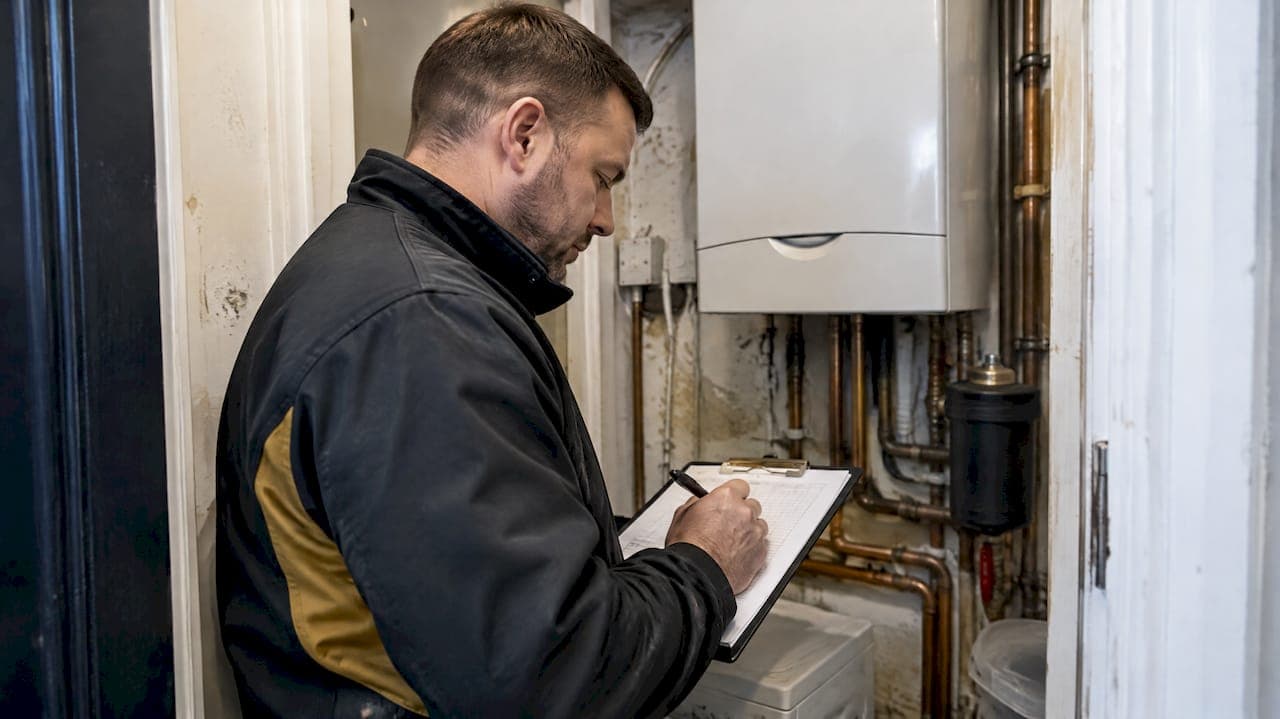
A compliant Gas Safe inspection record needs, at minimum, the site address, the date of inspection, the engineer's name and Gas Safe registration number, a description of each appliance checked, and a clear note of any defects and remedial action taken. Businesses are expected to retain these records for at least six years under Gas Safe Register's Rules of Registration, with HSE and the IGEM GIUSP framework setting the wider rules engineers and operations teams must follow.
TL;DR:
- Record each appliance separately with make, model, serial number, location, operating pressure, heat input, combustion and carbon monoxide readings, plus flue and tightness test results.
- Keep calibration certificates for flue gas analysers; flag borderline readings and document subsequent actions instead of rounding results into a pass.
- For Immediately Dangerous cases, disconnect the appliance and issue a warning notice; for At Risk cases, issue a notice and leave it safe.
- Document the unsafe classification, client consent or disagreement, Emergency Service Provider involvement, and copies of notices or required reports under a written company procedure.
- Complete records on site, capture the engineer’s electronic signature before leaving, and issue the finished record to the client immediately, even if repairs require follow up.
Table of Contents
- Minimum data fields every record must contain
- Per-appliance technical data and test results to capture on-site
- Record retention, audit trail and making records audit-ready
- Unsafe situations and GIUSP: classification, required actions and recording evidence
- Operational workflow: from on-site capture to office archive
- Common compliance failures and the fixes that actually work
- How Curcle keeps Gas Safe records audit-ready
- FAQ
- Sources
Minimum data fields every record must contain
Most audit findings trace back to a missing or vague field rather than a technical error. HSE guidance on gas safety check records sets out the baseline items every record must carry, and they double as a useful pre-issue checklist for any engineer closing a job.
- Site identification: exact address and a unique record or job reference, not just a postcode.
- Engineer identity: full name, signature (an electronic signature is accepted), and Gas Safe registration or licence number.
- Date of inspection, plus a statement confirming the work followed the Gas Safety (Installation and Use) Regulations where applicable.
- Appliance detail: a description and precise location of every appliance or flue checked, not a generic "boiler checked" line.
- Defects and remedial action: what was found, what was done about it, and who authorised the fix.
Records that skip the authorisation line or bundle several appliances into one vague description are the most common cause of a failed spot check. Each field should stand on its own, readable without needing to call the engineer who wrote it.
Per-appliance technical data and test results to capture on-site
A record that names the appliance without recording how it performed is only half the job. Gas Safe Register's inspection guidance lists the technical data inspectors expect to see attached to each appliance, not just noted in passing.
- Make, model and serial number, plus the exact room or location, so a future engineer can find the same unit without guesswork.
- Operating pressure and heat input, recorded against the manufacturer's data plate figures where relevant.
- Combustion analysis readings and carbon monoxide levels, captured with a calibrated flue gas analyser.
- Flue and ventilation checks and tightness test results, with a photo or log entry as supporting evidence.
Gas Safe Register's guidance notes that inspectors expect businesses to have calibrated flue gas analysers and related calibration certificates available during a work inspection. A missing calibration certificate can undermine an otherwise complete record. Where a reading sits close to a threshold, note it explicitly as borderline and record the follow-up action rather than rounding it into a pass.
Record retention, audit trail and making records audit-ready
Gas Safe registered businesses should retain adequate work records for at least six years to satisfy Rules of Registration and stand up to a work inspection at short notice. Retention alone is not enough: a record also needs to be retrievable, legible and tied to its supporting evidence.
An audit-ready record typically has a unique ID, a timestamp, a stored signature, and a link through to any remedial work order or client communication that followed it. Storage that relies on paper files in a van or a single engineer's inbox fails the retrievability test even when the records themselves are technically complete.
- Keep records in one indexed, backed-up system rather than split across engineers' devices.
- Cross-link each record to any follow-up job it generated.
- Run a periodic review to catch gaps before an inspector does.
Pro Tip: Index records by site and date from day one. Retrofitting a filing structure across six years of paper or scattered files is far harder than building it in from the first job.
Unsafe situations and GIUSP: classification, required actions and recording evidence
Where an appliance is unsafe, the IGEM GIUSP framework sets out two main classifications, Immediately Dangerous (ID) and At Risk (AR), each carrying different on-site actions and record obligations.
- Classify the fault as Immediately Dangerous or At Risk based on the risk it presents, using the criteria GIUSP sets for each category.
- Take the required action: disconnection and a warning notice for an Immediately Dangerous situation, or a warning notice with the appliance left in a safe state for At Risk.
- Record the decision and the evidence: the classification applied, any consent or disagreement from the client, and whether an Emergency Service Provider was involved.
- Report where required, keeping copies of warning notices and correspondence so the business can evidence the action taken if Gas Safe Register or HSE later asks for it.
GIUSP places the compliance responsibility on the employer, not just the individual engineer, so a written company procedure should back up every unsafe-situation decision made in the field.
Operational workflow: from on-site capture to office archive
Getting from a completed job to an audit-ready record is a process, not a single form. Breaking it into three stages keeps nothing falling through the cracks.
Before the job: confirm the engineer's Gas Safe ID is current, check the flue gas analyser is calibrated, and have the record template loaded with the site details already populated.
On-site capture: fill structured fields rather than free text, attach photos of the appliance and any defect, log combustion readings directly against each appliance, and get an electronic signature before leaving site so the record is issued on completion rather than days later.
- Use the same field layout for every job so engineers do not have to relearn the form each time.
- Issue the record to the client immediately, even when a defect needs a follow-up visit.
Back at the office: upload to a central system indexed by site and date, link any remedial job created from the visit, schedule the follow-up, and apply the retention policy automatically rather than relying on someone remembering to archive it.
Pro Tip: A free CP12 template gives field teams a consistent structure to start from, which cuts down on the incomplete fields that cause most audit findings. Teams that want more detail on the notification side of the process can also look at practical notification guidance for the steps that follow a completed inspection.
Common compliance failures and the fixes that actually work

The records that fail a spot check almost always have the same two problems: a missing or unverifiable engineer identity field, and incomplete technical readings because the record was finished from memory after the job rather than on-site.
Both are fixable with process, not more paperwork. Enforcing on-site completion before the engineer leaves, using a locked template that will not let a field go blank, and running periodic sample audits from the operations desk catch the gaps before a real inspector does.
— Luke Herridge
How Curcle keeps Gas Safe records audit-ready
We built Curcle around the same checklist above, so the fields that cause audit findings get caught before an engineer leaves site rather than discovered months later.

Our mobile app structures each job around the fields HSE and Gas Safe Register expect, captures photos and combustion readings against the right appliance, and takes an electronic signature on the spot. Every record gets a unique ID and timestamp, and our retention settings keep the six-year audit trail running without anyone having to remember to archive anything.
- Job templates that match the minimum data fields auditors look for.
- An audit trail that cross-links each record to its remedial work order automatically.
- A free CP12 template for teams not yet ready to move their whole workflow.
Teams managing calibrated tools alongside compliance records often also need to track custody of equipment like flue gas analysers, which tool and asset tracking software can handle alongside the record itself.
See how the workflow fits your team on our Gas Safe software page, or check plans from £99 a month to find the right fit for your business.
FAQ
What fields must a Gas Safe inspection record contain?
At minimum, a record needs the site address, inspection date, the engineer's name and Gas Safe registration number, a description of each appliance checked, and any defects with the remedial action taken, as set out in HSE guidance. A statement confirming the work followed the relevant regulations should also be included where applicable.
How long must Gas Safe registered businesses keep records?
Gas Safe registered businesses should retain adequate work records for at least six years to meet Rules of Registration and be ready for a work inspection. Records should be stored centrally and indexed so they can be retrieved quickly if requested.
What is GIUSP and when does it apply?
GIUSP is the Gas Industry Unsafe Situations Procedure, which classifies unsafe appliances as Immediately Dangerous or At Risk and sets the actions engineers must take, including disconnection or a warning notice. Employers must have written procedures backing these decisions and keep records of any warning notices issued.
Can Gas Safe records be signed electronically?
Yes. Gas Safe Register guidance confirms that electronic signatures are acceptable, and records should be issued to the client on completion of the job rather than afterwards.
What happens if a gas safety record is incomplete or missing?
An incomplete or missing record can fail a Gas Safe Register work inspection and leave a business unable to evidence compliance with HSE requirements. Enforcing structured, on-site completion before the engineer leaves is the most reliable way to prevent gaps from reaching the archive.
Sources
- Gas safety check records and what to keep - HSE
- What to expect on a work inspection - Gas Safe Register
- Gas Safety FAQs | Gas Safe Register