
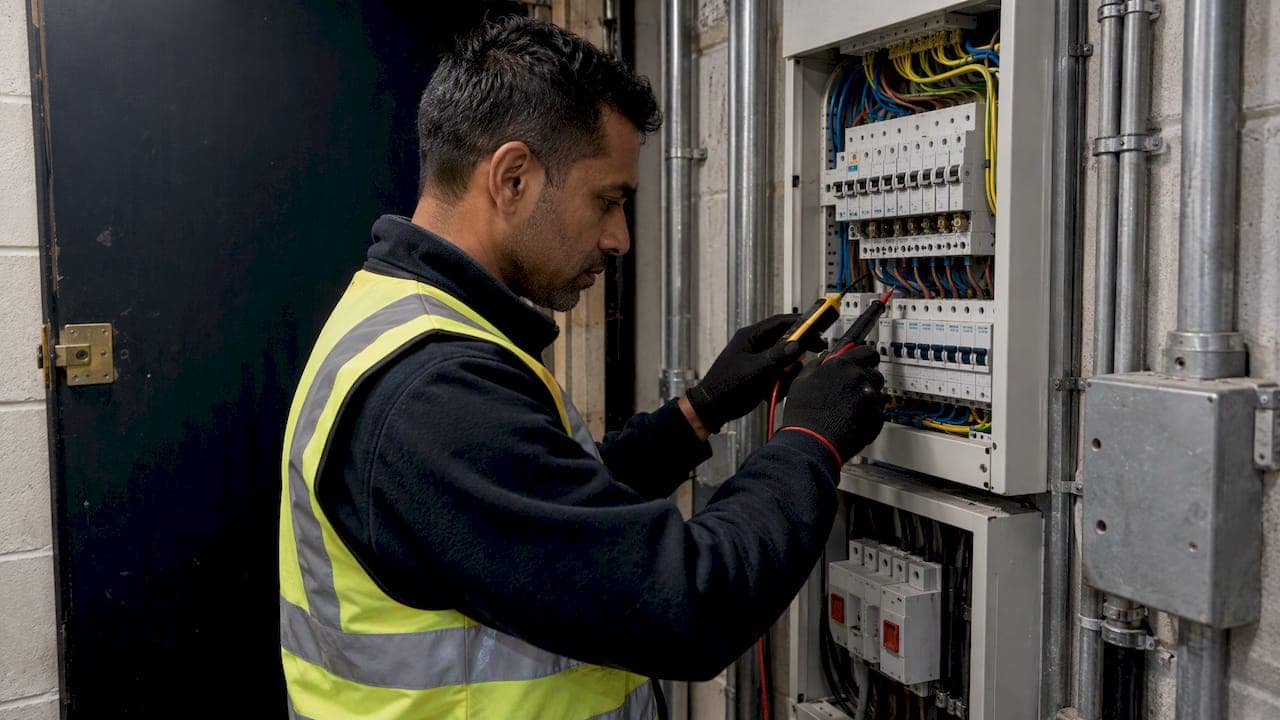
Every observation on an Electrical Installation Condition Report gets one of four codes: C1 (danger present), C2 (potentially dangerous), C3 (improvement recommended) or FI (further investigation required). C1 and C2 make a report unsatisfactory and need remedial work. C3 does not. FI means the inspector could not reach a conclusion and something needs checking. This guide explains how each code is chosen, what follows from it, and how engineering firms can record codes consistently across a team.
TL;DR
- C1 means danger is present and immediate action is needed. C2 means potentially dangerous and urgent remedial action is needed. Either one makes the report unsatisfactory.
- C3 is a recommendation to improve. On its own it does not stop a report being satisfactory.
- FI means further investigation is needed. Treat it as an open job with an owner and a deadline, not a footnote.
- Coding is a professional judgement by the inspector. Clear, factual observation wording is what makes it defensible.
- In England, landlords must complete remedial or investigative work within 28 days, or sooner if the report says so.
Table of Contents
- What an EICR actually assesses
- The four codes at a glance
- C1: danger present
- C2: potentially dangerous
- C3: improvement recommended
- FI: further investigation required
- Who decides the code: professional judgement
- How to write an observation that holds up
- What happens after the report
- Where EICR software helps with coding
- Perspective
- Turning codes into work with Curcle
- Common coding mistakes to avoid
- Related compliance records
- FAQ
- Sources
What an EICR actually assesses
An EICR assesses the condition of an existing electrical installation. It looks for damage, deterioration and defects that could cause danger, then records what it finds against the requirements of BS 7671. The codes are the shorthand that tells the reader how serious each finding is. Electrical Safety First's best practice guide on condition reporting sets out the four classification codes that inspectors use.
The code is attached to the observation, not to the circuit or the property. One report can carry dozens of observations, and the overall outcome depends on the most serious codes among them.
The four codes at a glance
| Code | Meaning | Typical response | Effect on the report |
|---|---|---|---|
| C1 | Danger present, risk of injury | Immediate remedial action | Unsatisfactory |
| C2 | Potentially dangerous | Urgent remedial action | Unsatisfactory |
| C3 | Improvement recommended | Consider upgrading | Does not make it unsatisfactory |
| FI | Further investigation required | Investigate without delay | Treated as requiring action |
The definitions follow the Electrical Safety First guide, and the effect on the outcome follows the government's guidance for the private and social rented sectors.
C1: danger present
C1 is the code nobody wants to write. It means there is a danger now and a risk of injury. Typical examples a reader will recognise: exposed live conductors where someone could touch them, or damaged accessories with live parts accessible. The Electrical Safety First guide states that immediate remedial action is required.

In practice, the inspector does not wait for the paperwork. They tell the client or duty holder on site, and where it is safe and agreed, make the danger safe there and then. The observation is still recorded in full, so the report shows what was found and what state the installation was in at inspection.
C2: potentially dangerous
C2 covers defects that are not an immediate hazard but could become one. The ECA's guidance note on EICR coding describes it as potentially dangerous, calling for urgent remedial action. A missing protective measure, such as absent or ineffective earthing or bonding where it is required, is the kind of finding that tends to sit here.
C2 is where most arguments about coding happen. The same defect can be a C2 in a damp commercial kitchen and a C3 in a dry office, because risk depends on the environment and who is exposed. That is why the code cannot be read off a list.
C3: improvement recommended
C3 means the installation does not meet the current standard in some respect, but there is no immediate or potential danger. The ECA describes it as a defect where upgrading should be considered. Under the government's guidance, a C3 does not require remedial work for the report to be deemed satisfactory.
Two habits to avoid. First, do not inflate a C3 to a C2 to create work or to be cautious; it makes the report unsatisfactory and costs the client. Second, do not bury a genuine C2 as a C3 to keep a customer happy. Both undermine the value of the report.
FI: further investigation required
FI is used when the inspector cannot determine whether something is dangerous without more work. It might be a circuit that could not be traced, or a result that does not make sense. The government guidance says that FI requires further investigation, and for English landlords that work sits inside the same 28-day window as remedial work.
The wording of how FI affects the overall outcome depends on the form version. BS 7671:2018+A4:2026 was published by the IET and SELECT on 15 April 2026, and the previous version could be used until 15 October 2026, when it was withdrawn. Always follow the wording printed on the model form you are issuing, and make the observation itself say what must be investigated and why.
Who decides the code: professional judgement
The ECA guidance is explicit that coding is a professional judgement based on the risk, the environment and the relevant BS 7671 requirement, and the inspector makes the final decision. A client or agent cannot negotiate a code down.

What a business can do is make sure its inspectors work to the same standard. Two engineers looking at the same missing bonding conductor should reach the same code, and be able to explain why. If they do not, the problem is usually shared understanding, not competence.
A simple test for each observation
Before choosing a code, ask in order:
- Is there danger now? If someone could be harmed by touching or using it today, that is C1.
- Could it become dangerous in foreseeable conditions, such as a fault, damp or ordinary use? That is C2.
- Is it a departure from current standards with no danger now or potentially? That is C3.
- Can you not tell without more testing or access? That is FI, and you say exactly what is needed.
This is a way of thinking, not a replacement for the standard. The regulation reference and your own judgement stay in charge.
How to write an observation that holds up
The Electrical Safety First guide asks inspectors to record each concern at the right point in the inspection results schedule, with the detail in the observations section. Each entry should be clear, concise and factual, and understandable to the client. It should not prescribe the remedial fix.
A good observation covers:
- Where: the circuit, distribution board or location, specific enough to find again.
- What: the condition seen or measured, in plain terms.
- Which code: one code per observation.
- Evidence: a test result or photo reference where one exists.
Compare two entries for the same finding. "Consumer unit unsafe" tells the client nothing and invites a dispute. "Consumer unit, hallway cupboard: live parts accessible where a cover is missing" tells the next engineer exactly where to go and why the code was chosen.
What happens after the report
For private rented homes in England, the Electrical Safety Standards regulations require remedial or further investigative work to be completed within 28 days, or a shorter period if the report specifies one. After that, the landlord must give the tenant and the local council the report together with written confirmation that the work is done.
These rules are specific to England. Landlords in Wales, Scotland and Northern Ireland should check the rules that apply there. For the inspection interval side, our guide to EICR inspection intervals for UK landlords covers the timing.
For an electrical contractor, this timeline is a sales and service opportunity as much as an obligation. Every C2 and FI is a quote waiting to be raised, with a deadline attached. If the observation sits in a PDF and the quote sits in someone's inbox, the 28 days slip.
Where EICR software helps with coding
Software does not choose the code. The inspector does. What it can do is remove the friction around it. NICEIC describes its certification system as letting certified businesses record codes and observations from standardised lists, work offline on recent forms, keep a full form history, send electronic or hard copies, and download raw data for reporting.
Those are the right things to look for in any tool. When comparing EICR certificate software, check:
- The form: it should produce EICRs on an available BS 7671 model form. The IET publishes model forms for BS 7671:2018+A4:2026, 2018+A2:2022 and 2018, and permits electronic manipulation in electrical contracting businesses.
- Consistent wording: reusable observation phrases that reduce free-text variation between engineers.
- Offline working: basements, plant rooms and rural sites rarely have signal.
- Follow-on work: whether a C2 or FI can become a quote or a job without retyping.
- History and audit trail: who recorded what, when, and what changed.
- Data export: the ability to report on code frequency by site, engineer or client.
On that last point, coding data is useful beyond the individual certificate. If one engineer codes a particular defect as C2 and another as C3 across hundreds of reports, you will see it in the data before a customer complains.
Perspective
We built Curcle inside a real UK service and engineering business, so we have watched the EICR paperwork problem from the van, the office and the audit. The code on the page is rarely where things go wrong. The failures happen afterwards: a C2 that nobody turned into a quote, an FI that was never booked, a report that cannot be found when the council or an insurer asks for it.
That is why we put compliance in the backbone of the platform instead of bolting it on. An observation should be able to become a job, a quote and a tracked deadline without being retyped, and the history should show who did what and when. We think software should help a business see what needs attention, not just record what has already happened.
We also believe in leaving judgement where it belongs. The engineer decides the code. Our job is to give them standard wording, offline forms and a clean record, so every click earns its place and the office sees the same facts the engineer saw on site.
Luke Herridge
Turning codes into work with Curcle
If your team issues EICRs, the pattern above is what our EICR software for electrical contractors is designed around: certificates, assets, jobs, quotes and invoices in one connected record, with a mobile engineer app that works offline. You can see how it fits electrical firms on our electrical contractor page and how it works with certification bodies on our NICEIC and electrical compliance page.

Plans start from £99 per month for Starter, from £249 per month for Professional and from £499 per month for Business, with Enterprise available on request. Full details are on our pricing page. If you are still building your inspection process, our EICR inspection checklist template is a practical starting point for site visits.
Common coding mistakes to avoid
- Coding to the client's budget. The code reflects risk. The cost of the fix is a separate conversation.
- Two codes on one observation. Record one code per observation and split the finding if needed.
- Vague locations. "Various circuits" cannot be actioned or re-inspected.
- Prescribing the fix. Describe the condition. Leave the remedial design to whoever quotes for it.
- Leaving FI open-ended. Say what needs to be investigated and what would settle it.
- Not tracking follow-up. A coded observation with no owner and no date is a missed deadline in waiting.
Related compliance records
Electrical firms rarely issue EICRs in isolation. The same customers often need portable appliance testing, and our guide to PAT testing frequency and a PAT testing register template help you keep those records alongside electrical reports. Multi-trade teams working on managed sites can also look at our facilities management software for SLA and multi-site compliance tracking.
FAQ
What do C1, C2, C3 and FI mean on an EICR?
C1 means danger is present and immediate action is needed. C2 means potentially dangerous and urgent remedial action is needed. C3 means improvement is recommended, with no danger now or potentially. FI means further investigation is required.
Which EICR codes make a report unsatisfactory?
Under the government's guidance for private rented homes in England, C1 and C2 make a report unsatisfactory. FI requires further investigation, and C3 does not require remedial work for a satisfactory outcome. Always check the wording on the model form version used for your report.
Can a customer ask for a code to be changed?
No. Coding is a professional judgement made by the inspector based on risk, environment and the relevant BS 7671 requirement. A customer can ask for the reasoning to be explained, which is why clear, factual observation wording matters.
How long do landlords have to fix a C1, C2 or FI in England?
Remedial or further investigative work must be completed within 28 days of the inspection, or within any shorter period stated in the report. The landlord must then give the tenant and the local council written confirmation of the work along with the report.
What should I look for in EICR certificate software?
Check that it produces reports on a current BS 7671 model form, supports standardised observation wording and offline working, keeps a full history, and lets you export data. Ideally it also turns coded defects into quotes and jobs without re-entry.
Sources
- Electrical Installation Condition Reporting, Electrical Safety First best practice guide
- ECA guidance note on EICR coding consideration
- Electrical safety standards in the private and social rented sectors, GOV.UK
- Certification and reporting, NICEIC
- Model electrical forms, IET
- BS 7671:2018+A4:2026 certification guide, SELECT