
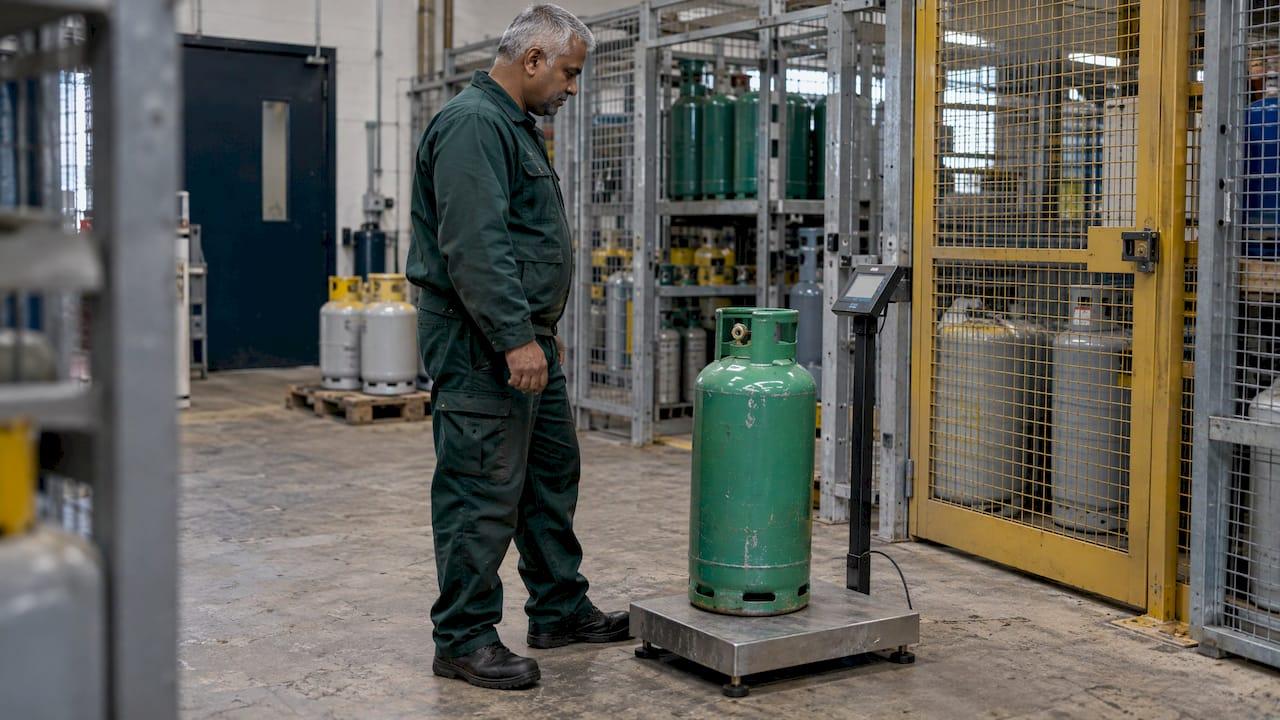
F-gas cylinder tracking means being able to show, for every cylinder you own or hire, where it is, who has it, which job and which piece of equipment its gas went into, and what happened to it afterwards. The legal duty sits on the equipment record rather than the cylinder itself, so the best tracking is the kind that ties each cylinder movement straight to a job, an asset and an engineer. When the cylinder log lives in one place and the job and asset records live in another, that link is where the gaps appear. That is why we build F-gas records and stock control into one system at Curcle, so a cylinder issued to a van ends up on the asset history of the system it was used on.
TL;DR
- Records of gas type, quantity added, leak checks and recovery must be kept for 5 years for equipment containing F-gas equivalent to 5 tonnes of CO2 or more.
- A cylinder log on its own proves little. The useful record connects a cylinder to a job, an engineer, a certified company and a specific asset.
- Track the full life of a cylinder: receipt, storage, issue, use, return or recovery, and disposal with the right waste paperwork.
- GB's HFC quota steps down again from 1 January 2027, so every kilogram you cannot account for is getting more expensive.
- Spreadsheets can work as a register, but only if they can be produced on request and match the job records.
Table of Contents
- What F-gas cylinder tracking covers
- What the law makes you record
- Tracking a cylinder through its whole life
- The identifiers that make it work
- Why spreadsheets and paper struggle
- Why the 2027 quota step makes this worth doing now
- A worked example
- What good looks like in a single system
- Our perspective
- Bringing it together with Curcle
- Getting started: a short checklist
- FAQ
- Sources
What F-gas cylinder tracking covers
The phrase gets used for two different things, and it helps to separate them.
The first is stock control: knowing how many cylinders of which refrigerant you hold, which are full, part-used or empty, and which are with engineers or the supplier. This protects your money. Refrigerant is costly, and rental cylinders usually attract charges when they are not returned.
The second is compliance traceability: showing a regulator that gas put into or taken out of a system was recorded against that system, by a certified company and engineer, and that recovered gas went somewhere lawful.
A UK service business needs both, and needs them to agree. If the stock count says 3.2 kg left the van but the job records only account for 2.1 kg, you have either a recording error or a leak somewhere, and an inspector will see it the same way.
What the law makes you record
In Great Britain the F-gas rules sit in the retained version of EU Regulation 517/2014, enforced through the Fluorinated Greenhouse Gases Regulations 2015. Northern Ireland follows different, EU-aligned rules, so check which applies to each site.
The operator of equipment, and the company servicing it, must keep records for any equipment that has to be leak checked. GOV.UK guidance on recording F gas sets out what that means for equipment holding F-gas equivalent to 5 tonnes of CO2 or more:
- the quantity and type of gas installed and any added during maintenance;
- the dates and results of leak checks;
- recovery and disposal actions;
- details of the companies that install, service or decommission the equipment;
- recovered quantities and facility details where gas is recycled or reclaimed.
The records must be kept for five years. Article 6 of the regulation adds that the undertaking's identity and certificate number should be recorded with each intervention, and that the records or copies must be kept for at least five years.
Notice what is not on that list: a cylinder serial number. The law asks about gas added to equipment and gas recovered from it. But the quantity you add came out of a cylinder, so the cylinder is the evidence trail behind every figure. That is why tracking matters in practice.
If you want the leak-check side in depth, our guide to F-gas leak check requirements, frequency and records covers it, and our piece on mapping GOV.UK F-gas duties to audit-ready records is written for facilities teams.
Tracking a cylinder through its whole life
A cylinder passes through six stages. At each one, the question is what you need to capture and what usually goes wrong.
1. Receipt
When a cylinder arrives, record the refrigerant type, the cylinder identifier, the size, the supplier and whether it is owned or rented. If you buy from a seller, GOV.UK guidance on selling F gas in cylinders says the seller must check your company certification and individual qualifications, and keep records of your certificate number and the quantities bought for at least five years. Your own receipt record should match what the seller holds about you.
Where it goes wrong: cylinders arrive on a van or at a branch, nobody logs them, and the first time the office hears of them is on the supplier's invoice.
2. Storage
Record the location: depot, cage, van or customer site. Keep different refrigerants apart and labelled. The point is that anyone in the office can answer "where is it?" without phoning round the engineers.
3. Issue to an engineer
Log who has the cylinder, when, and the starting weight. This is the step most firms skip, and it is the one that makes reconciliation possible later. Without a starting weight, you cannot test the engineer's recorded usage against what actually left the cylinder.
4. Use on a job
This is the critical link. At the point of use, the engineer records the weight of gas added, the refrigerant type, the asset it went into, the reason (top-up after a leak repair, for example) and the leak check result. The job record then carries the certificate details required for the company and engineer. A mobile app that works offline matters here, because plant rooms and rooftop units are poor places for signal.
Where it goes wrong: the engineer writes the figure on paper, and it is retyped days later, or not at all.
5. Return or recovery
Part-used cylinders go back to stock with a closing weight. Recovered gas goes into a refillable, labelled cylinder holding one gas type only. The GOV.UK offshore F-gas guidance states that principle for recovered gas, and it is good practice for any recovery cylinder you keep. Mixed gas is a costly mistake: it usually cannot be reclaimed and must be destroyed.
Rental is part of this stage too. Cooling Post reported in 2019 that sellers must take back containers for refilling and that most established suppliers run rental schemes with monthly charges to encourage empty cylinders to come back. Knowing which cylinders are on which van is how you avoid paying for ones you no longer have.
6. Disposal or reclamation
When waste refrigerant leaves your hands, the cylinder trail needs to end in paperwork: a registered waste carrier, a licensed facility, and a consignment note that identifies the cylinders included. Keep that document attached to the same records as the jobs that generated the recovered gas, so a single search finds both.
The identifiers that make it work
A cylinder trail only works if everything has a name that never changes. In practice that means four identifiers:
| Identifier | What it links to | Why it matters |
|---|---|---|
| Cylinder ID (serial, barcode or your own label) | Stock record, supplier, test date | Shows where a cylinder is and when it was last tested |
| Asset ID | The system gas was added to or recovered from | Builds the leak and top-up history per system |
| Job reference | Date, site, engineer, work done | Connects the gas to the visit and the customer |
| Engineer and company certificate | Qualification and company registration | Proves the work was done by a certified person |
If any one of the four is missing from an entry, the entry is weaker evidence. If all four are on every entry, a question from the regulator or a client auditor takes minutes to answer rather than days.
Why spreadsheets and paper struggle
The register itself can legitimately be paper or digital. What it cannot be is unavailable: the Environment Agency may ask to see records during an inspection, and repeated top-ups on the same system are a pattern auditors look for.
That last point shows why the problem is connection rather than format. To spot repeat top-ups, you need gas additions grouped by asset, across every engineer and every visit. A cylinder spreadsheet groups by cylinder. A job system groups by job. Neither shows the asset's history unless someone merges them by hand, and merging is the work that gets postponed when the diary is full.
Common symptoms in disconnected setups:
- stock counts that never reconcile to job usage;
- certificates and consignment notes stored in someone's inbox;
- the same asset named three ways across files;
- a five-year history that has to be assembled the week before an audit.
Why the 2027 quota step makes this worth doing now
Gas you cannot account for is lost money, and the price pressure is rising. GOV.UK's quota guidance says Great Britain is phasing down HFCs by 79% by 2030, measured against 2009 to 2012 average use. Quota is needed before HFCs are placed on the market, and eligible applicants apply annually.
FETA's GB F-Gas update of May 2026 reports that, after consultation, DEFRA will not legislate in 2026 to change the phasedown steps from 1 January 2027. That means quota drops from 31% to 24% of baseline in January 2027, a 22.6% fall in refrigerant availability, with a further step to 21% from 1 January 2030. Those are the published figures for those steps; check the latest government and trade body updates for any later changes.
The practical consequence for a service firm is simple. Virgin refrigerant is set to become scarcer, and recovered and reclaimed gas will matter more. Both depend on knowing, to the kilogram, what you recovered and where it went.

A worked example
Take a multi-site maintenance firm with six engineers and a small refrigerant stock.
A 11.3 kg cylinder of R410A is booked out to an engineer at a starting weight of, say, 14.6 kg. Across a week, three jobs add 1.8 kg, 0.9 kg and 2.4 kg to three different units. The engineer returns it at 9.5 kg.
The recorded additions total 5.1 kg, and the weight change is 14.6 minus 9.5, also 5.1 kg. The books reconcile, and each of the three assets now has an updated top-up history.
Now imagine the cylinder came back at 8.7 kg. Something is off by 0.8 kg: an unrecorded top-up, a mis-weighed entry or gas lost in transit. You can only see that if the cylinder movement and the job entries sit side by side. The figures here are illustrative, not from a real job, but the logic is the one an inspector applies.
The same exercise on the asset side shows the other benefit. If one of those three units has taken top-ups on its last three visits, the record flags a likely leak that needs a proper investigation and repair, which is what the leak check rules are there to catch.

What good looks like in a single system
When the pieces live together, the routine gets short:
- The engineer opens the job on the mobile app and selects the asset from the site register.
- They record gas type and quantity added, the leak check result and photos of the nameplate or work area.
- The system stamps the job with their qualification and the company's details.
- Stock falls by the quantity used, so the next count starts from the right place.
- The asset history updates, and a leak check report or audit export is a filter away rather than a project.
Our refrigeration software covers F-gas records and asset history, and the HVAC maintenance software page shows how that fits planned maintenance. For multi-site estates, the facilities management page covers SLAs and compliance across sites.
Our perspective
Most F-gas record problems we hear about are not knowledge problems. Engineers know they must log gas additions. The trouble is that the cylinder is in one place, the job in another and the asset history in a third, and the office is the glue.
Curcle was born inside a real UK service and engineering business, and that is why we treat compliance as the backbone of the platform rather than a bolt-on. A gas addition should be written once, at the job, and then show up in the asset history, the stock position and the audit export without anyone retyping it.
We believe software should show a manager what needs attention, not just record what has already happened. For F-gas that means spotting a pattern of top-ups on the same system, or a stock difference that does not match the job records, while there is still time to act. Every click should earn its place, and AI should assist human judgement, never replace it.
If your five-year history currently lives in several files, the best time to bring it together is before the next audit or the next quota step, not after.
Luke Herridge
Bringing it together with Curcle
Curcle is an operations platform for UK service businesses. It brings jobs, assets, compliance, stock, quoting, invoicing and reporting into one connected system, with an offline-capable mobile engineer app, document and photo capture, audit trails and F-gas certificate and report generation. Site and asset registers and stock control sit alongside the jobs, so field and office teams work from the same information.
Plans start at £99 a month for Starter, £249 for Professional and £499 for Business, with Enterprise priced on request. See Curcle's pricing for what each plan includes, or the features page for the wider platform.

Getting started: a short checklist
Whether you are moving off spreadsheets or tightening an existing process, work through this order:
- List your in-scope equipment. Identify every system at 5 tonnes CO2e or more, and give each a permanent asset ID.
- Standardise cylinder labels. One ID per cylinder, written on it and in the register.
- Record weights at issue and return. This is what makes reconciliation possible.
- Require gas entries on the job itself. Not afterwards, and not in a separate file.
- Attach waste paperwork to the records. Consignment notes and carrier details belong with the jobs that created the waste.
- Reconcile monthly. Compare stock movement with job usage, and investigate any difference straight away.
- Review top-up patterns by asset. Repeat top-ups are the signal to investigate a leak.
FAQ
How long do I have to keep F-gas cylinder and equipment records?
Five years. For equipment containing F-gas equivalent to 5 tonnes of CO2 or more, GOV.UK requires records of gas added, leak checks and recovery to be kept for that period and shown to the regulator on request. Sellers of F-gas in cylinders must also keep customer certificate and quantity records for at least five years.
Do the EU's 2024 F-gas changes apply in the UK?
No. They apply in the EU, while Great Britain works from the retained version of Regulation 517/2014 and the 2015 UK regulations. Northern Ireland follows EU rules, so firms working across both should check which regime covers each site.
Is F-gas being phased out in the UK?
It is being phased down. GOV.UK says Great Britain is cutting HFC supply by 79% by 2030 against the 2009 to 2012 average. The next quota step takes effect on 1 January 2027, which is why accurate gas accounting and recovery records matter more each year.
Can I keep F-gas records on paper or a spreadsheet?
The register can be paper or digital, provided it can be produced when the Environment Agency asks. The harder test is whether it links cylinders, jobs, assets and engineer certificates so that a full history can be shown quickly. A single connected system makes that routine rather than a project.
Sources
- Record F gas in equipment you own or service, GOV.UK
- Selling F gas in cylinders or equipment, GOV.UK
- Regulation (EU) No 517/2014, Article 6, legislation.gov.uk
- Fluorinated greenhouse gases guidance, September 2024, GOV.UK
- Refrigerant sellers must take back cylinders for refilling, Cooling Post
- UK F-Gas Regulations: Business Compliance Guide
- Applying for quota to produce or import F gas, GOV.UK
- GB F-Gas Update 28/05/26, FETA