

Role-based access control assigns system permissions to roles rather than individuals, then grants users access by placing them in those roles. It scales far better than managing permissions one person at a time, enforces least privilege by design, and creates a clean audit trail. The catch: RBAC only stays useful if someone actively governs it, because roles left unreviewed drift into privilege creep within months.
TL;DR:
- Hierarchical RBAC allows senior roles to inherit permissions, reducing role explosion but complicating audits and permission tracing.
- Automating role provisioning through APIs and establishing clear ownership prevents privilege creep and maintains accurate access over time.
- Use app-native roles first to minimize technical debt, reserving custom data stores for complex scenarios that demand flexibility.
- Large organizations should adopt role hierarchies, federate identity across units, and embed role reviews into change management processes for scalability.
- RBAC supports compliance standards by providing clear role definitions, documented assignments, and audit logs, but requires ongoing governance to avoid decay.
Table of Contents
- What is RBAC: core concepts and the three primary rules
- How RBAC works in practice: architecture and implementation patterns
- RBAC models and policies: core, hierarchical and constrained RBAC
- Step-by-step RBAC implementation checklist and phased rollout
- Benefits, risks and operational governance to keep RBAC effective
- RBAC vs ABAC and ACL: decision rules and hybrid designs
- Practitioner perspective: RBAC in field-service and compliance workflows
- Security compliance standards and regulations related to RBAC
- Tools and technologies commonly used to manage and enforce RBAC policies
- Metrics and monitoring techniques to evaluate RBAC effectiveness and detect anomalies
- Strategies for scaling RBAC in large and dynamic organisations
- Real-world examples and case studies illustrating successful RBAC implementation
- Author's closing recommendations and immediate next steps
- Sources
What is RBAC: core concepts and the three primary rules
RBAC rests on a small vocabulary that everything else builds on. Users are the people or service accounts needing access. Roles are named job functions ("field engineer", "compliance reviewer"). Permissions are the specific operations allowed on specific objects ("edit customer record", "approve invoice"). A role is simply a bundle of permissions, and a user gets access by being assigned to one or more roles rather than having permissions granted directly.
NIST's RBAC reference model, formalised in the ANSI/INCITS 359 standard, defines three primary rules that any genuine RBAC system follows:
- Role assignment: a user can only exercise a permission if they have been assigned an active role.
- Role authorisation: a user's active role must be one they are authorised to hold, preventing self-assignment.
- Permission authorisation: a user can only exercise permissions that are authorised for their currently active role.
Two extensions have become near-standard in practice. Role hierarchies let senior roles inherit permissions from junior ones, so a regional manager automatically holds everything a site supervisor holds, plus more. Separation of duties stops a single user holding two roles that together create fraud risk, such as someone who can both raise a purchase order and approve it. Both extensions exist because flat, unstructured roles stop scaling the moment an organisation grows past a few dozen people.
How RBAC works in practice: architecture and implementation patterns
The conceptual model above has to land somewhere concrete, and that's usually an identity provider (IdP) acting as the role-of-record. Okta, Microsoft Entra ID, or an on-premises directory holds the master list of who belongs to which group, and every downstream application trusts that source rather than maintaining its own copy.
Microsoft's identity platform documentation describes three practical approaches to implementing RBAC for apps:
- App roles defined directly in the application manifest and assigned through the IdP. Microsoft recommends this as the easiest route where the platform supports it.
- Security groups mapped to permission sets inside the application, useful when you already manage groups for other purposes.
- Custom data stores, where role logic lives in the application's own database. This offers the most flexibility but the most maintenance.
Once a role is assigned, it typically travels as a claim inside an authentication token (a JWT, for instance), which the application reads at login. That token assertion only works if the server enforces it. Client-side role checks, such as hiding a button in the interface, stop nobody with a browser console or an API client. Enforcement belongs on the server, every time, without exception.
Provisioning and de-provisioning increasingly run through SCIM or similar provisioning APIs, syncing role membership automatically when someone joins, changes team, or leaves. This joiner-mover-leaver automation is what keeps token assertions honest over time rather than just on day one.
Pro Tip: If your application supports app roles natively, start there before building a custom store. Custom role logic is the single biggest source of RBAC technical debt teams report years later.
RBAC models and policies: core, hierarchical and constrained RBAC
NIST's reference model actually describes a progression of four levels, though most practitioners talk about three in day-to-day use.
- Core RBAC is the flat baseline: users, roles, permissions, and the three primary rules with no inheritance or constraints layered on top. It suits small, stable teams well.
- Hierarchical RBAC adds inheritance, so roles form a tree and senior roles pick up junior permissions automatically instead of duplicating them.
- Constrained RBAC adds separation-of-duties rules, either static (two conflicting roles can never be assigned to the same user) or dynamic (a user can hold both roles but never activate them in the same session).
The practical tension shows up in role design. Hierarchies reduce duplication but make audits harder to reason about, since a permission's origin might be three levels up the tree. Skip hierarchies and constraints altogether and organisations tend toward "role explosion": hundreds of near-identical roles created for tiny permission differences, each one needing its own review forever. Constrained RBAC is the fix, but it demands upfront discipline that flat models don't.
Step-by-step RBAC implementation checklist and phased rollout
IBM's implementation guidance lays out a phased approach that avoids the two most common failure modes: rolling out too fast and breaking access for real users, or designing roles in a vacuum that nobody in the business actually recognises.
- Inventory identities and assets first. Pull a bottom-up list of every user, application, and existing entitlement before designing a single role. You cannot design sensible roles against data you don't have.
- Design roles using both directions at once. Combine top-down business function mapping (what does a compliance reviewer actually need to do?) with bottom-up entitlement clustering (what do people in that job actually hold today?). IBM's guidance specifically warns against relying on either method alone, since top-down design invents roles nobody uses and bottom-up clustering ossifies bad historical access.
- Set naming conventions and role scope, then map each role into your IdP and each connected application.
- Pilot with one department or site, validate that nothing breaks, then migrate the rest in staged waves rather than a single cutover.
- Build governance into the rollout itself, not as an afterthought: scheduled access reviews, an exception log for anything granted outside the standard model, and a just-in-time elevation path for the rare occasions someone genuinely needs temporary elevated access.
Pro Tip: Assemble IT, HR, compliance, and application owners in the same room before touching any configuration screen. Roles designed by IT alone almost always miss a real workflow that HR or a department head could have flagged in five minutes.
Benefits, risks and operational governance to keep RBAC effective
The upside is measurable. RBAC cuts the administrative overhead of provisioning, because granting a new starter access means adding them to two or three roles rather than configuring dozens of individual permissions. It enforces least privilege structurally rather than relying on someone remembering to restrict access manually, and it gives auditors a role-to-permission map they can inspect instead of reverse-engineering years of ad hoc grants.
NIST's own analysis frames these administrative savings as the core economic case for RBAC in large organisations, alongside a reduction in configuration errors that come from repeating permission grants by hand.
The risks sit on the other side of the same coin:
- Privilege creep, where users accumulate roles as they change jobs but nobody removes the old ones.
- Role explosion, where the model fragments into hundreds of near-duplicate roles nobody can maintain.
- Misaligned role semantics, where a role's name no longer matches what it actually grants after months of small edits.
IBM warns explicitly against treating RBAC as "set it and forget it": without scheduled lifecycle reviews, automated joiner-mover-leaver flows, and clear exception logging, the governance gap widens quietly until an audit finds it for you. Building those controls in from day one, rather than retrofitting them, is what separates RBAC deployments that stay clean for years from ones that need a full re-platform every eighteen months.
RBAC vs ABAC and ACL: decision rules and hybrid designs
RBAC, ABAC, and ACLs solve overlapping problems in different ways, and picking wrong tends to cost you either flexibility or manageability.
- RBAC wins on scale and simplicity: define a job function once, assign it to hundreds of users, and audits become straightforward.
- ABAC (attribute-based access control) wins where context matters, since decisions can factor in time of day, location, device, or data sensitivity rather than a static role.
- ACLs (access control lists) win at the individual-object level, useful for a single shared file or folder where a full role model is overkill.
A sensible rule of thumb: use RBAC as your baseline wherever access maps cleanly to job function, which covers most of an organisation. Layer ABAC conditions on top only where context genuinely changes the risk, such as blocking finance-system access outside office hours or from unrecognised devices. NIST itself describes ABAC as the more dynamic model and recommends hybrid designs rather than treating the two as rivals. A hybrid pattern might use RBAC to grant a base set of permissions and ABAC conditions to restrict the highest-risk operations within that role.
Practitioner perspective: RBAC in field-service and compliance workflows
Field-service and compliance-led businesses live with RBAC's toughest edge case: engineers working offline on-site who still need role-scoped access the moment connectivity returns.
- An engineer role typically limits access to assigned jobs, asset history, and certificate templates, nothing more.
- A compliance reviewer role needs read access across sites plus approval rights on certificates like EICR or Gas Safe records.
- A dispatcher role needs scheduling and job-assignment permissions but no visibility into invoicing or payroll data.
Curcle's role-based dashboards are built around exactly this separation, so a mobile engineer app surfaces only what that engineer's role permits, even offline, while audit trails capture who approved what compliance evidence and when. Anyone wanting to see role scoping in an operational context can review the product tour.
Security compliance standards and regulations related to RBAC
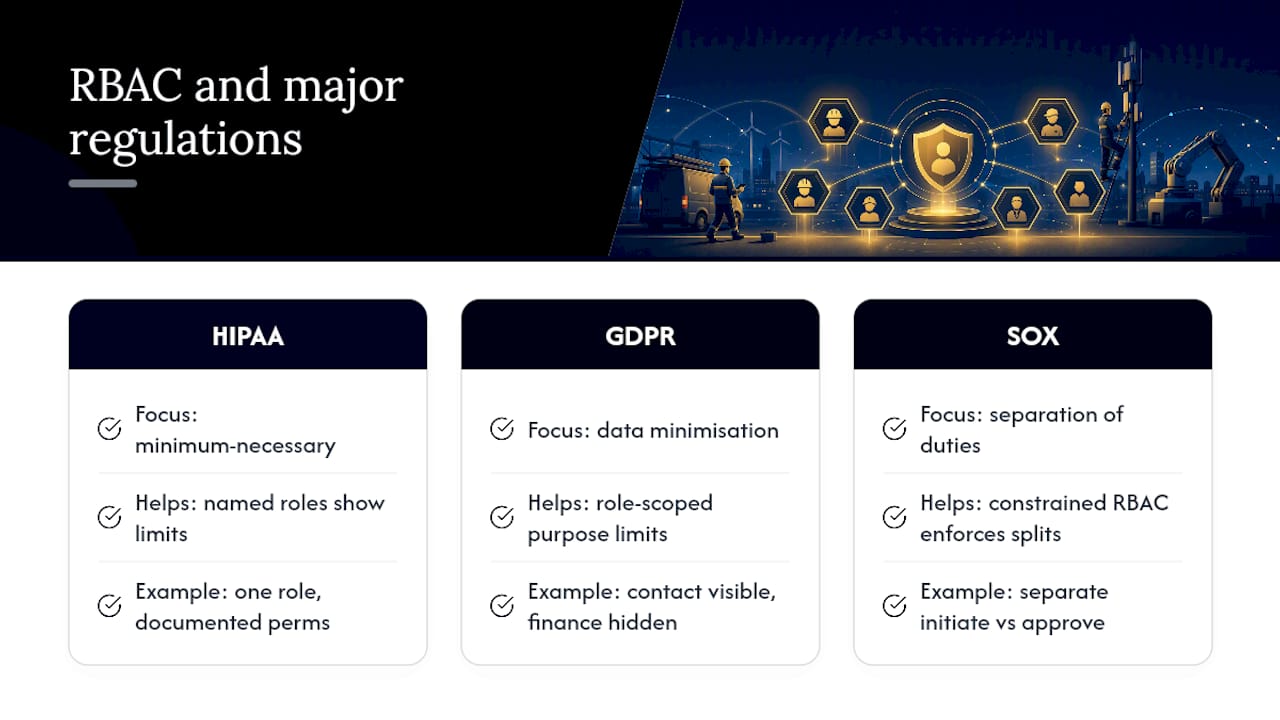
RBAC doesn't satisfy any regulation on its own, but it's the structural mechanism most compliance frameworks assume is already in place. HIPAA's minimum-necessary standard, which governs access to protected health information in US healthcare, is far easier to demonstrate when access is granted through named roles with documented permissions rather than ad hoc individual grants. Auditors can inspect the role definition once instead of interviewing every user.
GDPR, which governs personal data handling for anyone processing EU residents' data, doesn't mandate RBAC by name, but its principles of data minimisation and purpose limitation align closely with role-scoped access. If a support role can see a customer's contact details but not their financial history, that's data minimisation enforced structurally rather than through policy documents nobody reads.
SOX compliance for public companies leans heavily on separation of duties, precisely the constrained RBAC concept covered earlier. A financial controls audit will specifically ask whether the same person can both initiate and approve a payment, and constrained RBAC with static separation-of-duties rules answers that question by design rather than by hoping nobody notices the overlap.
None of these frameworks certify RBAC as sufficient by itself. What they reward is evidence: a documented role model, a record of who approved which role assignment, and a log showing reviews happened on schedule. RBAC generates that evidence as a natural by-product of how it works, which is largely why it has become the default access model auditors expect to see, regardless of which specific regulation applies to a given business.
Tools and technologies commonly used to manage and enforce RBAC policies
Most RBAC deployments run on a stack of three layers rather than a single product. The identity provider sits at the centre: Microsoft Entra ID, Okta, and similar platforms hold the master role assignments and issue the tokens that carry role claims into every connected application.
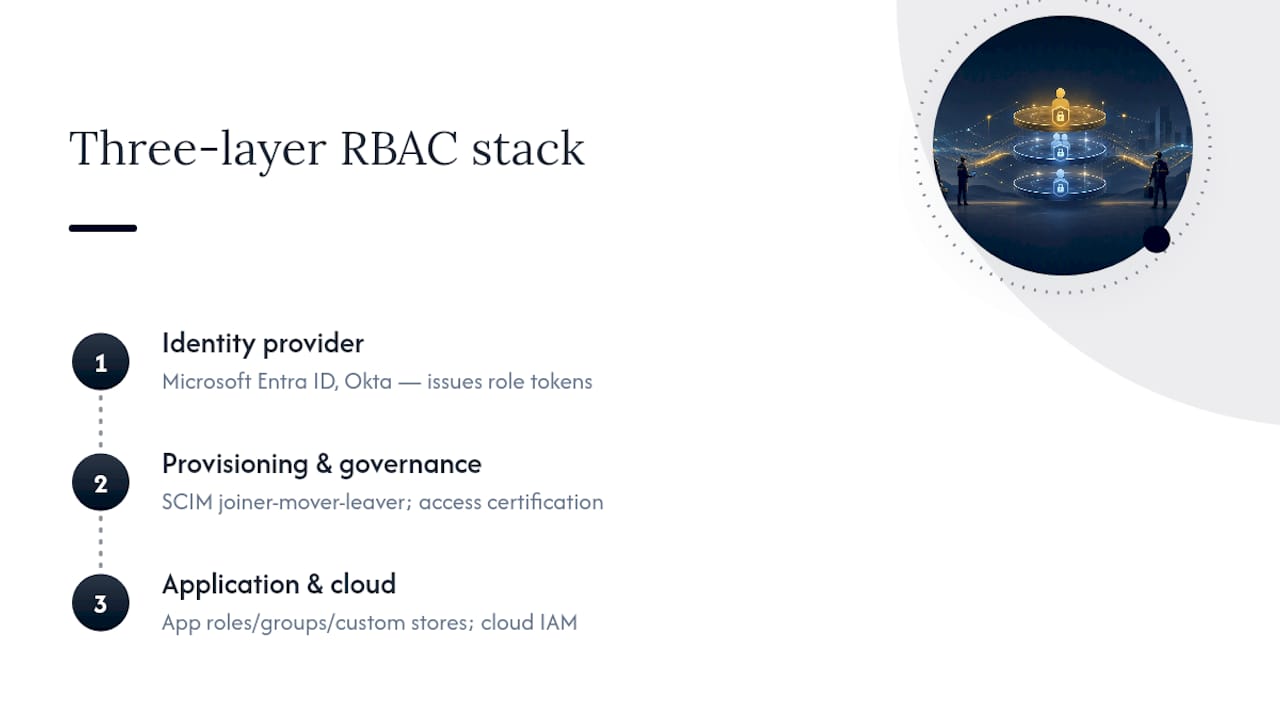
Sitting alongside the IdP, provisioning and governance tools handle the lifecycle side. SCIM-compatible provisioning APIs automate the joiner-mover-leaver flow so role membership updates the moment HR systems record a change, rather than waiting for someone to remember. Identity governance platforms add scheduled access certification campaigns, where role owners periodically confirm every assignment is still correct.
At the application layer, the implementation pattern depends on what the platform supports. As covered earlier, Microsoft's guidance points to app roles as the simplest option where available, with security groups and custom data stores as fallbacks. Cloud infrastructure platforms (AWS IAM, Azure RBAC, Google Cloud IAM) each ship native role systems for controlling access to infrastructure resources specifically, distinct from application-level roles.
Operational platforms built for specific industries increasingly bake RBAC directly into their permission model rather than leaving it to IT to bolt on. That matters for compliance-heavy sectors especially, where the platform itself needs to distinguish an engineer's mobile access from an office manager's reporting access without a separate configuration project. Curcle's trust and security documentation covers how that access control and audit trail layer works inside a field-service context specifically.
Metrics and monitoring techniques to evaluate RBAC effectiveness and detect anomalies
An RBAC model you can't measure is one you're guessing about. Four metrics catch most of the drift that undermines a well-designed system before it becomes a security incident.
Active roles per user flags creep directly: if the average user's role count keeps climbing month over month, people are accumulating access rather than having it right-sized as they change jobs. Orphaned roles, meaning roles with no current business owner able to explain why they exist, are the single clearest sign a review cycle has lapsed. Every role should have a named owner accountable for its contents.
Frequency of exception approvals matters because exceptions are meant to be rare escape valves, not a parallel access system. If the same exception gets approved repeatedly, the underlying role definition is wrong and needs fixing rather than the exception being rubber-stamped again. Time-to-revoke for departed users is the metric auditors ask about first, since a gap of days or weeks between someone leaving and their access being pulled is exactly the finding that turns a routine audit into a formal incident report.
Beyond these four, anomaly detection increasingly leans on behavioural signals: a role holder accessing systems at unusual hours, from unusual locations, or touching objects far outside their normal working pattern. None of that replaces the core RBAC metrics above, but it catches the edge case where someone's role assignment is technically correct and their behaviour still isn't.
Strategies for scaling RBAC in large and dynamic organisations
RBAC that works cleanly for 200 users can collapse under its own weight at 20,000 unless the design anticipates scale from the start. Hierarchical RBAC is the first lever: instead of building a flat role for every job title, structure roles as a tree so a regional director inherits a site manager's permissions automatically rather than needing a separately maintained duplicate role.
Federation across business units is the second. Large organisations rarely run one IdP instance for everyone; instead, they federate identity across subsidiaries or regions while keeping a single governance standard for how roles are named, reviewed, and retired. Without that shared standard, each division invents its own role taxonomy and the whole model fragments within a couple of years.
Automation is non-optional at scale. Manual role assignment might survive a 50-person rollout but becomes untenable once thousands of joiners, movers, and leavers pass through the system monthly. SCIM-based provisioning synchronised against HR data is what keeps role assignment accurate without a growing administrative team to match.
Dynamic organisations, meaning ones that restructure, acquire, or reorganise teams frequently, need role reviews built into the change management process itself rather than run as a separate annual exercise. Every reorganisation should trigger an automatic re-evaluation of affected roles, because a role hierarchy designed around last year's org chart quietly stops matching how the business actually works, and nobody notices until an audit or an incident forces the question.
Real-world examples and case studies illustrating successful RBAC implementation
Healthcare systems offer one of the clearest illustrations of constrained RBAC in action. A hospital's electronic health record platform typically defines roles like clinician, nurse, billing administrator, and records auditor, each mapped to a distinct permission set, with static separation of duties preventing a billing role from also holding clinical edit rights. That structure is precisely what lets the organisation demonstrate HIPAA's minimum-necessary standard during an audit rather than reconstructing individual access history after the fact.
Financial services firms lean on the SOX-driven separation-of-duties pattern described earlier: a payment-initiation role and a payment-approval role are deliberately kept mutually exclusive, enforced through constrained RBAC rather than a policy document someone might forget to check. When an internal audit asks whether that separation is real, the answer sits in the role model itself, not in a spreadsheet.
Field-service and engineering businesses show a different pattern worth noting: role design here has to account for offline mobile access alongside office-based reporting. An engineer's role needs to work identically whether they're in a signal dead zone on-site or connected to the office network, which pushes the enforcement logic onto the mobile application itself rather than relying purely on a live token check against the IdP. That's a meaningfully different implementation challenge from a purely office-based SaaS deployment, and it's why generic RBAC advice sometimes needs adapting for teams working outside a stable network connection.
Author's closing recommendations and immediate next steps
RBAC is the right baseline for almost any organisation trying to move access control off spreadsheets and individual grants. Three actions matter more than the rest: inventory what you actually have before designing a single role, pilot with one team before rolling out company-wide, and name a specific person accountable for ongoing governance, because a model with no owner decays within a year regardless of how well it was designed. If you want to see role scoping and compliance evidence handled inside an operational platform rather than in theory, Curcle's field service management software is worth a look.
— Luke Herridge
Sources
- Role Based Access Control | CSRC
- What Is Role‑Based Access Control (RBAC)? | IBM (implementation guidance)