

Yes, most businesses engaging contractors will need to run right to work checks once the regime expands on 1 October 2026, and completing one of the three prescribed checks gives you a statutory excuse against civil penalties. If you use contractors, subcontractors or agency labour, start now: review supplier contracts, map who actually engages each worker, and rebuild onboarding so no one starts work unchecked.
TL;DR:
- Contractors, subcontractors, and agency workers will require right-to-work checks from October 2026, expanding beyond direct employees.
- Responsibility for checks lies with the direct employer and the labour user, with extended liability if either fails to verify properly.
- Valid checks depend on the individual's nationality and immigration status, with three methods recognized: manual, online, and digital verification.
- Maintaining ongoing, documented rechecks is critical as most List B permissions are time-limited, requiring a recheck before expiry.
- Embedding compliance into operational workflows, centralizing evidence, and including specific contract clauses help prevent penalties and ensure readiness for inspections.
Table of Contents
- What changes on 1 October 2026 and who it affects
- Who must carry out checks: employer, labour user and extended liability explained
- Which checks give a statutory excuse and acceptable evidence
- Follow-up checks, timings and keeping evidence
- Extended liability and what to put in supplier and subcontractor contracts
- Operationalising right to work checks in field service and contracting businesses
- Penalties, enforcement and what to do if you discover non-compliance
- Compliance-first operations for service businesses
- Sources
What changes on 1 October 2026 and who it affects
The right to work regime has always applied to direct employees. From 1 October 2026, it stretches much further. The Border Security, Asylum and Immigration Act 2025 expands the regime to catch contractors, subcontractors, agency workers and labour supplied through third parties, alongside a draft Code of Practice that spells out how the rules apply in practice.
The policy intent is straightforward: close the gap where businesses avoided checks by structuring work through contracts rather than employment. If someone works under your direction, on your site, or within your operational chain, the Home Office wants that engagement in scope, regardless of the paperwork wrapped around it.
That said, genuinely self-employed tradespeople running their own business, invoicing multiple clients, controlling their own hours and equipment, generally sit outside the expanded rules. The distinction turns on substance, not job title. A one-person electrical firm you hire for a single project and never supervise looks very different from a "contractor" who turns up daily, uses your tools and answers to your site manager.
Arrangements now firmly in scope include:
- Individual contractors and subcontractors engaged directly
- Workers supplied through labour agencies or umbrella companies
- Platform-introduced workers filling gaps in your field teams
- Labour supplied through a chain of intermediary businesses
For field service and engineering firms, this hits particularly hard. A heating engineering business that pulls in three subcontract engineers during a busy quarter, or a facilities management contractor that leans on an agency for seasonal cover, both need to treat those engagements as checkable relationships, not informal favours.
Who must carry out checks: employer, labour user and extended liability explained
Two roles matter here, and confusing them is where most compliance gaps start. The "employer" is whoever has a direct contractual relationship with the worker. The "labour user" is whoever actually benefits from and directs that person's work, which is often a different business further up the chain.
Extended liability is the sting in the expanded regime. If your subcontractor fails to check someone properly, and that person works on your site or within your operation, liability can reach you too. The expansion creates potential extended liability across supply chains, which is exactly why procurement teams, not just HR, need to understand this.
Use this sequence to triage any engagement:
- Identify the direct employer. Who issues the contract and pays the individual?
- Identify the labour user. Who directs the day-to-day work and controls the site?
- Check if they're the same entity. If yes, standard checks apply and you're the one who must run them.
- If they differ, assess your exposure. Ask whether you can rely on the other party's checks, and whether you have contractual evidence that they were done properly.
- Default to checking directly wherever the contractual chain is unclear, informal, or involves a small or unfamiliar supplier.
For HR and commercial teams, the practical note is short: don't assume a supplier contract mentions right to work compliance just because it's a professional-looking document. Read it. Most standard-form contractor agreements say nothing about it at all, which leaves the labour user exposed the moment something goes wrong.
Which checks give a statutory excuse and acceptable evidence
Three checks can establish a statutory excuse, and which one applies depends entirely on the individual's nationality and immigration status, not on what's convenient for your onboarding process. Employers cannot mandate which method someone uses to prove their status, so your team needs to be comfortable running all three.
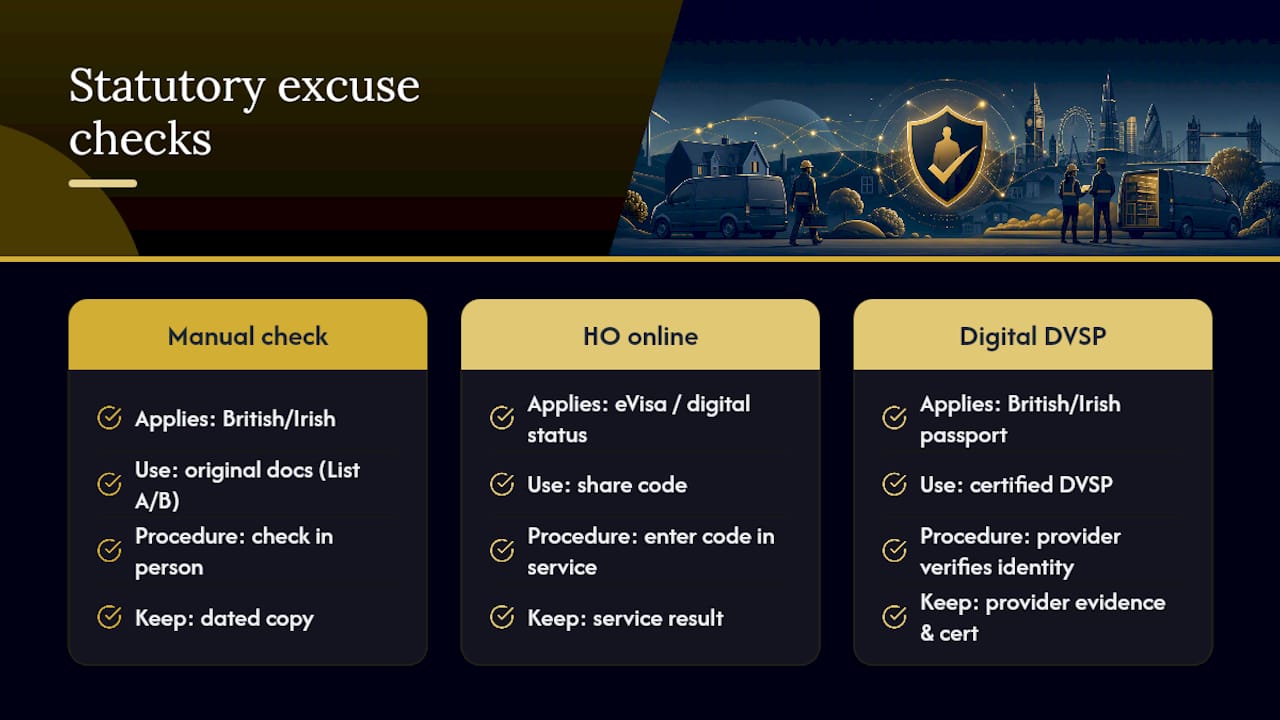
Manual document check. This suits British and Irish citizens presenting a passport, and follows three steps: obtain original documents from List A or List B, check them in the individual's presence to confirm they're genuine and belong to the holder, and take a clear copy for your records with the date of the check noted.
Home Office online check. Anyone with an eVisa or digital immigration status generates a share code, which you enter into the Home Office right to work checking service to see their current permission and any conditions attached to it.
Digital verification service (IDSP/DVSP). For British and Irish citizens who hold a valid passport but prefer not to hand over the original, a certified Identity Document Validation Technology provider can verify identity digitally. Guidance recommends using a DVSP that meets at least a medium confidence level, and you must obtain and retain the evidence output the provider generates.
Pro Tip: Using a DVSP doesn't transfer your liability. Guidance is explicit that employers must reasonably believe the provider followed the correct process, so keep the provider's certificate alongside your own records, not instead of them.
Where someone can't immediately produce evidence, either because an application or appeal is pending or because their documents are with the Home Office, the Employer Checking Service becomes the route. A Positive Verification Notice from the ECS gives you a time-limited statutory excuse while their case is resolved.
Follow-up checks, timings and keeping evidence
Not every statutory excuse lasts forever. List A documents, generally held by British and Irish citizens, establish a continuous excuse with no expiry. List B documents, covering people with time-limited permission, only give you a time-limited excuse that expires alongside their visa or leave.
That means your compliance system needs a calendar, not just a filing cabinet. Build these habits in:
- Flag every time-limited permission with a recheck date before it expires
- Recheck no earlier than necessary, but never leave it until after expiry
- Store copies of every document checked securely for the length of the engagement and for two years afterwards, in line with Home Office retention guidance
- Note the date and method of each check against the individual's record, not just the document itself
Positive Verification Notices from the ECS generally have a time-limited validity, so anyone checked that way needs a diary entry for renewal, not a one-off tick. If your onboarding system can't tell you which contractors are due a recheck next month, that's a gap worth fixing before an inspector finds it for you.
Extended liability and what to put in supplier and subcontractor contracts
Contract wording is where most of the expanded regime actually gets managed day to day. The shift, as legal commentators frame it, moves compliance obligations from businesses that merely "employ" workers to businesses that merely "engage" a worker, which is a much wider net.
Build these into every supplier and subcontractor agreement:
- A warranty clause confirming the supplier has checked and will continue to check every individual it supplies.
- A substitution control clause that restricts who can be sent to site without prior notice and verification.
- An evidence-sharing obligation requiring the supplier to produce copies of checks on request, not just assert they've been done.
- An audit right letting you inspect the supplier's right to work records periodically.
- A termination trigger for material non-compliance discovered during an audit or Home Office inquiry.
Beyond the clauses themselves, due diligence has to be ongoing rather than a one-off procurement tick-box:
- Request sample evidence before onboarding a new labour supplier
- Repeat spot checks annually, not just at contract signing
- Keep a written record of why you relied on a supplier's checks, including what evidence you actually saw
Relying on a supplier's word alone, without ever seeing evidence, will not protect you if that reliance turns out to be misplaced. Legal advisers are blunt that firms shouldn't accept a declaration at face value; the safer position is documented, periodic verification built into the commercial relationship itself.
A short checklist for legal and procurement teams: warranty clause in place, substitution controls agreed, evidence-sharing obligation signed, audit rights exercised at least once a year, and a clear owner named for chasing renewals.

Operationalising right to work checks in field service and contracting businesses
Getting this right on paper doesn't help if your onboarding process still runs on email threads and someone's memory. A workable sequence looks like this: triage every supplier by risk, attach the right contract clauses, run the check before the first day on site, centralise the evidence, then audit the whole set periodically rather than waiting for a problem to surface.
Centralisation is the part most businesses underestimate. When engineer records, compliance documents and contractor evidence sit in one connected system rather than scattered inboxes, producing a complete audit trail during a Home Office inquiry takes minutes, not days. That matters because contemporaneous, well-organised evidence materially reduces enforcement exposure when questions get asked.
Curcle's free compliance templates, including its PAT testing register, show the same principle applied elsewhere in field service compliance: a simple, consistent log beats an ad hoc folder every time. Right to work evidence deserves the same discipline.
- Assign one owner per contractor for check completion and renewal tracking
- Store check evidence against the individual record, not a shared drive
- Automate renewal reminders so time-limited permissions never lapse unnoticed
- Review supplier compliance quarterly, not just at annual contract renewal
Penalties, enforcement and what to do if you discover non-compliance
Civil penalties for employing someone without the right to work can run to significant sums per breach, and repeat offenders face steeper consequences than first-time ones. A correctly completed check is your defence against that penalty, which is precisely why the paperwork matters as much as the intention.
If you discover someone lacks permission to work, act immediately:
- Pause their work on your site or project straight away
- Contact the Employer Checking Service to establish current status
- Preserve every record relating to their engagement, including contract and check history
- Document each remedial step you take and when you took it
Write down what happened and why, in real time, rather than reconstructing events after a letter arrives. If the situation involves a subcontractor's employee rather than your own, get legal or immigration specialist advice before deciding how to handle the contractual relationship. Acting fast and documenting properly won't erase a breach, but it demonstrates good faith that regulators do take into account.
Compliance-first operations for service businesses
Most non-compliance I see traces back to a single cause: businesses treat contractor onboarding as an administrative afterthought rather than an operational gate. The check happens, if at all, after the person has already started work, which defeats the entire purpose of a statutory excuse.
What actually works is building the check into the moment someone gets scheduled, not the moment someone remembers to ask. Integrated systems that tie compliance records to job scheduling remove the temptation to skip a step under time pressure, which is when most gaps happen.
— Luke Herridge
Curcle brings scheduling, contractor records and compliance evidence into one connected view, so your team can see who's cleared to work before a job gets assigned rather than after. If you're mapping out how the October 2026 changes affect your supplier base, the field service management platform built for UK trades is worth a look before the deadline arrives.
Sources
- Right to work checks: an employer's guide
- Right to Work Checks: New rules, wider liability and increased risk - Ward Hadaway HR Protect
- Guidance: Right to work checks - an employer's guide (26 June 2025)