

RAMS are the risk assessment and method statement you produce and brief to your team before starting high-risk or principal-contractor-controlled work on a UK construction site. The risk assessment identifies hazards and controls; the method statement sets out the safe sequence of work. If a principal contractor has appointed you, or your task falls under Schedule 3 of CDM 2015, you need a task-specific RAMS ready before you mobilise, not a generic template pulled from a drawer.
TL;DR:
- A competent person must review and sign off the RAMS, providing evidence of qualifications such as cards or certificates relevant to the task.
- RAMS need to be task-specific, structured clearly with hazard controls directly linked to specific work steps, and include site details, signatures, and revision history.
- Generic templates are unlikely to be accepted, especially if they lack site-specific information, clear hazard controls, signed briefing records, and version control.
- Digital tools improve RAMS management by ensuring version control, timestamped signatures, and easy retrieval of the exact document used during work.
- Proper training for operatives and supervisors in hazard recognition, RAMS review, and site-specific risks is essential for effective safety communication and compliance.
Table of Contents
- RAMS and UK law: what CDM 2015 and MHSWR 1999 actually require
- Who writes, reviews and signs off your RAMS
- What to include: a practical RAMS template
- How to draft a job-specific RAMS before you mobilise
- Common pitfalls and a principal contractor acceptance checklist
- Examples of completed RAMS for different construction tasks
- Customising RAMS for subcontractors and multi-contractor sites
- Digital tools and software solutions to create and manage RAMS
- Where RAMS sit inside a wider site safety system
- Training requirements and best practice for understanding RAMS
- Why most RAMS problems are admin problems, not safety problems
- Curcle: templates and compliance tools that keep RAMS evidence audit-ready
- Sources
RAMS and UK law: what CDM 2015 and MHSWR 1999 actually require
"RAMS" is not a term you'll find in any statute. It's industry shorthand for two separate legal duties that contractors bundle into one document because principal contractors expect to see both together.
The risk assessment half comes from Regulation 3 of the Management of Health and Safety at Work Regulations 1999, which requires every employer and self-employed person to carry out a suitable and sufficient assessment of risks to workers and others affected by their work. The method statement half sits under CDM 2015, which puts clients, principal designers and principal contractors under a duty to plan, manage and monitor construction work safely. Guidance from TradeRAMS makes the point clearly: CDM doesn't demand a document called "RAMS", it demands proof of planning, and RAMS is how the trade demonstrates that.
In practice, a RAMS becomes effectively mandatory when:
- A principal contractor's site rules require one before access is granted, regardless of task risk.
- The work falls under Schedule 3 CDM activities, such as demolition, work at height, or excavation near services.
- Your own risk assessment flags a hazard with no adequate existing control on site.
On inspection, an HSE inspector isn't looking for a polished cover page. They're checking whether the document matches what's actually happening on the ground, whether operatives can explain the controls in their own words, and whether the sign-off record proves the briefing happened before work started, not after an incident.
Who writes, reviews and signs off your RAMS
The contractor carrying out the work writes the task-specific RAMS, not head office and not the principal contractor. The PC's job is to review it against the Construction Phase Plan and either accept it, reject it, or request amendments before granting site access.
Sign-off needs to come from a competent person, someone with the training, experience and knowledge to judge whether the controls are adequate for that specific task. That's not a job title, it's a demonstrable fact, and PCs will often ask for evidence:
- Relevant CSCS or CPCS cards for the trade involved.
- Certificates for specific competencies (working at height, confined space, asbestos awareness).
- A named author on the RAMS itself, with a role and contact detail, not just a company logo.
If any of that is missing, a principal contractor is well within their rights to refuse site entry until it's sorted. That's not bureaucratic gatekeeping. It's the PC protecting themselves under their own CDM 2015 duties, and it's exactly why turning up with a vague or unsigned document costs you a day's work more often than a five-minute fix would.
What to include: a practical RAMS template
A RAMS that gets accepted first time follows a predictable structure. Miss a section and you're inviting a rejection email instead of a start date.
- Header block — site name and address, date, document version number, scope of works (specific, not "general building works"), author name and role, and the name of whoever approves it.
- Hazard identification table — columns for hazard, who's at risk, existing controls, likelihood and severity scoring, and the residual risk after controls are applied. This last column is the one contractors most often skip, and it's the one PCs check first.
- Method statement — a numbered sequence of work steps, each one cross-referenced to the specific control in your hazard table that manages the risk at that step.
- Plant and equipment — what's being used, its inspection status, and who's certified to operate it.
- COSHH assessments — for any substances hazardous to health, referenced or attached.
- Competence evidence — cards, tickets and certificates for the operatives named on the job.
- PPE requirements — specific to each task step, not a blanket list at the bottom of the page.
- Emergency procedures — first aid arrangements, fire action, and what happens if the method has to stop mid-task.
- Briefing and sign-off record — every operative's name, signature and the date they were briefed on this version.
- Revision history — what changed, when, and why, so a PC can see the document has been kept live rather than filed and forgotten.
Pro Tip: Keep your hazard table and method statement on facing pages or adjacent sections. If a PC has to flick back and forth to check that a control in row four actually appears in step four of the method, you've made their acceptance decision harder than it needs to be, and harder decisions get parked.
How to draft a job-specific RAMS before you mobilise
Producing a RAMS doesn't need to eat a whole afternoon once you've got a repeatable process. SafetyStack's worked examples and industry template guidance both point to the same sequence working reliably across trades.
- Gather site information before you write anything. Request the Construction Phase Plan, site access arrangements, welfare provisions, and details of other trades working nearby whose activities might interact with yours.
- Walk the task in your head, then on site. Identify hazards specific to this job, this site, this week, not generic hazards copied from last year's job. HSE's construction health risks guidance is a useful prompt list if you're worried about missing something.
- Assign persons at risk for each hazard — your own operatives, other trades, members of the public, and site visitors all sit in different categories with different controls.
- Score risk with a simple 1 to 5 matrix for likelihood and severity, multiply them, and record the residual score once controls are applied.
- Write method steps that reference your controls directly, so step three doesn't just say "install barrier" when your hazard table specifies where and to what standard.
- Evidence competence, brief every operative, and collect signatures before the first tool touches the job, then store the signed version somewhere retrievable if a PC or inspector asks for it later.
Structured templates paired with a proper competent-person review let most trades turn around an acceptable RAMS in 30 to 60 minutes, even using AI drafting tools to speed up the first draft. That review step isn't optional, though. A tool can structure your document; it can't judge whether your controls are adequate for the task in front of you.
Common pitfalls and a principal contractor acceptance checklist
Generic templates fail for one simple reason: PCs can spot them instantly. A RAMS with no site address, no date, and hazard controls that could apply to any job on any street tells the reviewer you haven't actually thought about this task.
- No named author or missing signature — fix it by adding a real name, role and contact detail before submission, not "site management".
- No briefing record — a signed sign-off sheet is your best evidence if anyone later asks whether operatives knew the controls; treat it as mandatory, not optional paperwork.
- PPE listed first, elimination never mentioned — the hierarchy of control runs eliminate, substitute, engineer, administer, and PPE last. A RAMS that jump straight to gloves and goggles without asking whether the hazard could be removed or reduced first reads as lazy to any competent reviewer.
- Copy-pasted risk scores — if every hazard scores identically, it looks like nobody actually assessed anything.
Pro Tip: Before you submit, run this five-point check yourself: site-specific scope stated clearly, named competent author, competency evidence attached, briefing record ready to be signed, and version number updated from the last job. That's roughly what a PC checks in the first sixty seconds of reading your document.
Examples of completed RAMS for different construction tasks
A RAMS for scaffold erection looks nothing like one for asbestos removal, and treating them as interchangeable is where a lot of rejected submissions come from.
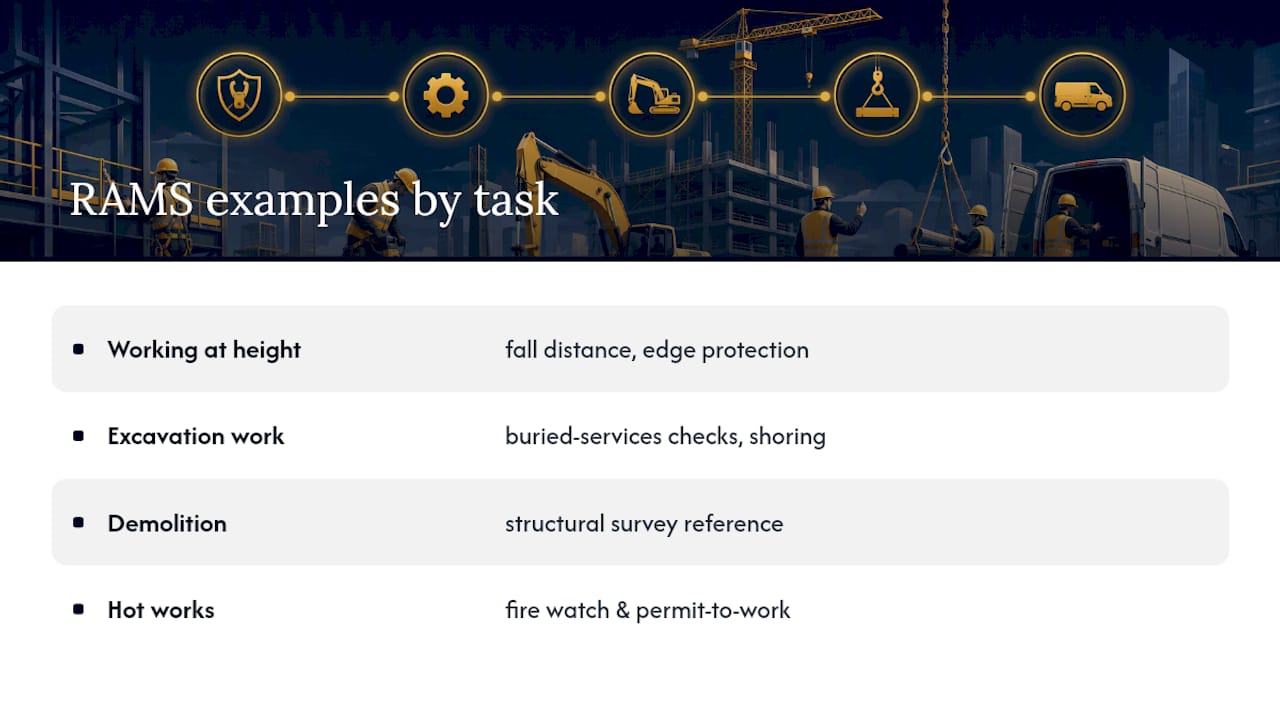
For working at height, the hazard table centres on fall distance, edge protection, and weather conditions, with method steps covering scaffold tagging, harness inspection, and exclusion zones below the work area. For excavation work, the emphasis shifts to buried services checks, shoring or battering method, and spoil management, with a much heavier weighting on the Schedule 3 activity status that CDM 2015 flags for extra scrutiny.
A demolition RAMS, which HSE's demolition guidance treats as a distinct high-risk category, needs a structural survey reference, asbestos survey status, and a clear sequence for isolating services before any structural element comes down. A hot works RAMS for welding or cutting focuses on fire watch arrangements, permit-to-work cross-references, and the removal of combustible materials from the immediate area, plus a stated cooling-off period after work stops.
The common thread across all of them isn't the specific hazards, it's the discipline of matching every control in the table to a numbered step in the method. A roofing RAMS and a groundworks RAMS should look structurally identical even though the content inside each section is completely different. If you're building your own template library, keep the skeleton fixed and only let the hazard content change between tasks. That consistency is exactly what makes a reviewer's job faster, and a faster review is what gets you on site sooner.
Customising RAMS for subcontractors and multi-contractor sites
Multi-contractor sites create a specific problem: your RAMS can be perfectly written for your own trade and still get rejected because it ignores everyone working around you.
When you're a subcontractor working under a main contractor's principal contractor arrangement, your RAMS needs to reference their Construction Phase Plan directly, not just acknowledge that one exists. Name the interfaces explicitly: which other trades are working in adjacent areas, what shared access routes look like, and what happens if your task and theirs need the same space at the same time. A groundworker and an electrician both working in the same trench at different times of the same week is exactly the kind of interface that gets missed when everyone writes their RAMS in isolation.
If you're the main contractor coordinating multiple subcontractors, the practical fix is standardising the template each subcontractor submits, so hazard tables, sign-off pages and version numbering all follow the same format. That doesn't mean writing their RAMS for them; competence and task knowledge still sit with the trade doing the work. It means you're not spending Monday morning translating five different document formats before you can even compare them for conflicts.
Version control matters more here than on a single-trade job. If a subcontractor amends their method after an early briefing, everyone whose work interfaces with theirs needs to know. A dated revision log that's actually checked, not just filed, is the difference between catching a conflict on paper and catching it on site.
Digital tools and software solutions to create and manage RAMS
Paper-based RAMS still work, but they create a specific admin problem: nobody can prove a document was current on the day it was used unless someone physically dated and filed it correctly, every time, across every job.
Digital RAMS tools solve three things paper struggles with. First, version control happens automatically, so there's no argument about which draft was briefed. Second, sign-off records are timestamped and tied to the exact document version, which is precisely the evidence SafetyStack's PC acceptance research identifies as the strongest defence in a dispute or inspection. Third, templates can be reused and adapted per job rather than rebuilt from scratch, provided the platform actually enforces site-specific detail rather than letting users tick through a generic form.
AI-assisted drafting tools have started appearing across the trade, and they genuinely speed up first drafts. But every credible guide on this makes the same point: AI can structure a document, it cannot judge whether your controls are adequate for a specific task, and a competent person still has to review and sign every output before it goes near a site. Treat AI drafting the way you'd treat a junior admin assistant, useful for the first pass, never the final word.
Whatever tool you choose, the test is simple: can you retrieve the exact version that was briefed on a specific date, with signatures attached, six months later if someone asks? If the answer's no, the tool isn't doing its job regardless of how polished the output looks.
Where RAMS sit inside a wider site safety system
A RAMS document doesn't function in isolation. It's one input into a much larger safety management structure that includes the Construction Phase Plan, site inductions, permit-to-work systems, and ongoing monitoring by supervisors and the principal contractor.
The connection that matters most in practice is between your RAMS and your permit-to-work system, where one exists. A hot works permit, a confined space permit, or a permit to dig should cross-reference the RAMS covering that task, not duplicate its content from scratch. When these systems run separately with no link between them, you end up with a permit that says one thing and a RAMS that says another, which is exactly the kind of inconsistency an inspector notices immediately.
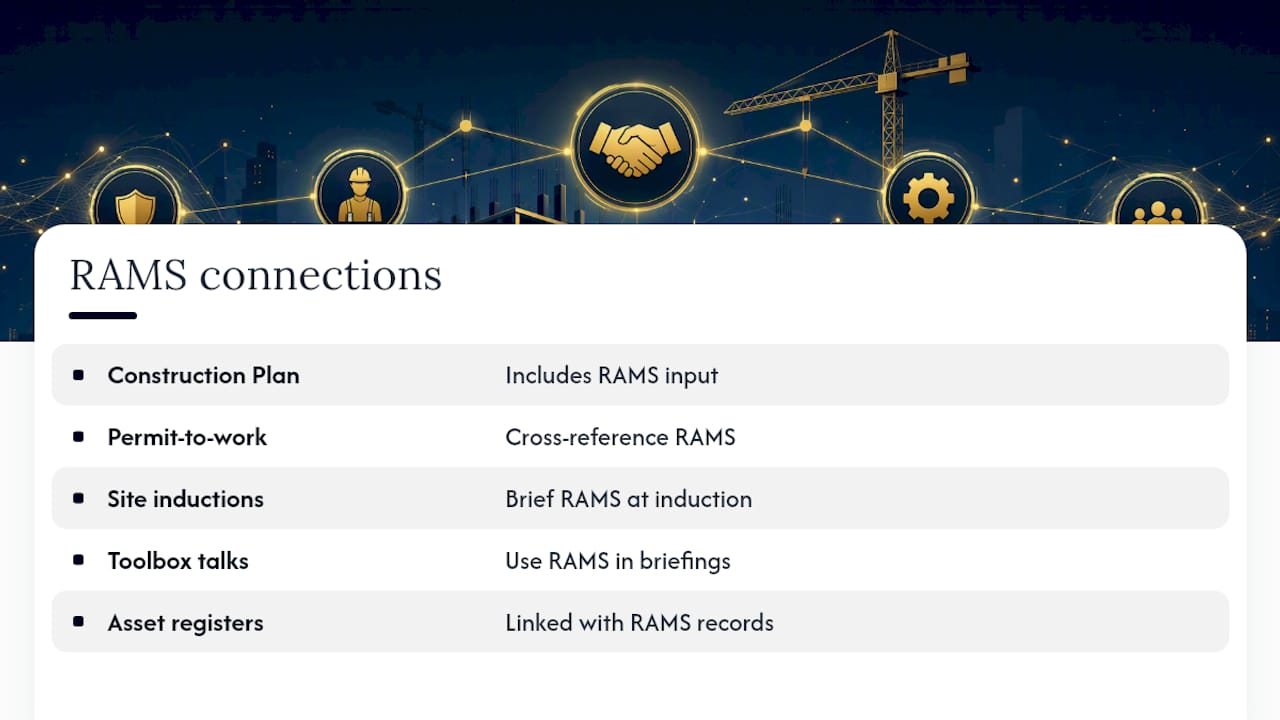
Toolbox talks and daily briefings are where a RAMS earns its keep day to day. A document that's briefed once at mobilisation and never referred to again isn't really integrated into anything, it's a filing exercise. Sites that treat RAMS as a living reference, pulled out during toolbox talks when conditions change or a new hazard appears, tend to have far fewer near-misses tied to "we didn't know that was the plan." Integrating RAMS into asset registers and compliance tracking more broadly, alongside inspection records and certification data, gives supervisors one place to check whether a task is actually cleared to proceed rather than chasing paperwork across three different systems.
Training requirements and best practice for understanding RAMS
Writing a good RAMS is only half the job. The other half is making sure the people executing the task actually understand what's in it, which is a training and communication problem as much as a documentation one.
Operatives need enough understanding of the hazard identification process to recognise when site conditions have drifted from what the RAMS assumed, not just the ability to sign a briefing sheet. That means briefings should be conversations, not read-throughs, with time for questions about anything unclear in the method sequence. Supervisors and site managers benefit from specific training on reviewing RAMS critically, checking that hazard scores aren't copy-pasted and that the hierarchy of control has actually been applied rather than jumped straight to PPE.
For anyone newer to producing RAMS, understanding the CDM 2015 framework itself matters more than memorising a template, because templates change between companies but the underlying legal logic doesn't. A worker who understands why residual risk matters will spot a poorly controlled hazard even without a form in front of them. That's the standard worth training toward, competence that survives a change of paperwork, not just familiarity with one company's specific form.
Why most RAMS problems are admin problems, not safety problems
The RAMS that get rejected on UK sites rarely fail because the contractor doesn't understand the hazards. They fail because the paperwork doesn't prove what the contractor already knows in their head. Time and again, the same issues come up: no named author, a briefing record that's been backdated or never existed, a version number that doesn't match what's actually being done on site.
That gap between operational reality and documented evidence is where the real cost sits, not in the hour it takes to write a decent RAMS, but in the half day lost when a PC bounces it back for the third time over something as basic as a missing signature page. Joined-up systems that keep templates, sign-off records and version history in one place close that gap because nothing gets lost between the site office, the van, and head office. That's not a safety improvement so much as an admin one, but on a site running to a tight programme, admin delays are exactly what cost contractors money.
— Luke Herridge
Curcle: templates and compliance tools that keep RAMS evidence audit-ready
Every problem covered above, generic templates, missing sign-off, version confusion, comes down to information living in the wrong place. Curcle brings job records, compliance templates and document storage into one system, so the RAMS you briefed last Tuesday is the exact version a PC or inspector sees when they ask for it.

Curcle's free compliance templates give you a structured starting point rather than a blank page, and its version control means every amendment, briefing and signature ties back to a single traceable record instead of scattered paper copies or forgotten PDF drafts. For contractors juggling multiple sites and subcontractors, that single source of truth is what turns a repeated admin headache into a five-minute check before mobilisation. Take a look at the field service management platform built around exactly this kind of compliance evidence, or book a product tour to see how templates, sign-off and audit trails work together before you commit to anything.
Sources
- Construction (Design and Management) Regulations 2015 guidance - HSE
- Legislation
- What Is a RAMS Document? CDM 2015 Guide + Worked Example - SafetyStack
- Create a RAMS document: UK trades template and step-by-step guide (2026) - TrainAR