

PPM scheduling is a programme of recurring, pre-planned maintenance tasks, timed to prevent equipment failure before it happens. The first job for any facility or maintenance manager is not choosing software or setting frequencies. It's building or validating an accurate asset register and agreeing baseline service intervals against it, because everything else, reliability, compliance evidence, forecastable workload, depends on getting that foundation right.
TL;DR:
- Building an accurate asset register and defining clear task instructions are critical for a reliable PPM schedule to meet compliance and operational goals.
- Using a blend of time-based, usage-based, condition-based, and risk-based scheduling maximizes efficiency and adapts to the variability of different assets.
- Regularly reviewing and adjusting maintenance frequencies based on fault history prevents over-servicing and optimizes resource allocation.
- A good PPM software should include full metadata, mobile access, automated notifications, and integrated compliance evidence to support effective scheduling.
- Common pitfalls include setting arbitrary frequencies, poor asset data, lack of technician guidance, and ignoring feedback from ongoing schedule performance.
Table of Contents
- What is PPM and how does it differ from other maintenance approaches?
- Why PPM scheduling matters: benefits and measurable outcomes
- Common PPM scheduling methods and when to use each
- How do you build a PPM schedule step by step?
- What software features actually support PPM scheduling?
- Common pitfalls when scheduling PPM
- PPM examples by facility type
- What building PPM schedules in the field actually teaches you
- Running your PPM schedule day to day
- Sources
What is PPM and how does it differ from other maintenance approaches?
PPM stands for planned preventative maintenance: scheduled inspections, servicing and repairs carried out on a fixed cadence to stop breakdowns before they start, rather than fixing things once they've already failed. That's the opposite of reactive maintenance, where a boiler dies on the coldest day of the year and someone scrambles for an emergency call-out. PPM is defined as a proactive strategy precisely because the work is scheduled in advance, not triggered by failure.
Here's where confusion creeps in. Search for "PPM" and you'll find two entirely different disciplines sharing an acronym. One is facilities and field service maintenance. The other is project portfolio management, the practice of prioritising and governing a portfolio of business projects, which has its own standard in ISO 21504. The Association for Project Management warns explicitly that buyers need to specify "facilities" or "field service" PPM when briefing software suppliers, otherwise you risk being sold a project-governance tool with no asset register, no certificate management and no relevance to a boiler service schedule.
A workable PPM schedule needs five components in place for every task: the asset it applies to, the specific task description, the frequency it runs at, clear instructions for whoever carries it out, and a record of completion. Miss any one of those and the schedule looks complete on paper but breaks down in practice, usually at the point an auditor asks for evidence.
Why PPM scheduling matters: benefits and measurable outcomes
The case for PPM scheduling isn't theoretical. It shows up directly in your maintenance budget, your compliance file and your callout log.
Facilities teams running structured PPM see fewer emergency repairs because failures get caught at the inspection stage rather than the breakdown stage. Assets serviced on schedule also tend to last longer, which delays capital replacement costs that can dwarf a year of routine servicing. Vendor data on facilities PPM points to the same pattern: managing scheduling, tracking and reporting from a single system improves budget predictability and makes compliance audits far less painful, because the evidence already exists rather than needing to be reconstructed under pressure.
The measurable outcomes worth tracking:
- Ratio of planned to reactive jobs, the single clearest signal of schedule health
- Percentage of statutory inspections completed within their compliance window
- Mean time between failures on critical assets
- SLA compliance rate across sites or contracts
- Total emergency callout spend, quarter on quarter
Pro Tip: If you only track one number, track the planned-to-reactive ratio. A schedule that's actually working shows that ratio climbing month on month, because fewer things are breaking unexpectedly.
Where PPM tasks intersect with statutory duties, gas safety, electrical inspection, lifting equipment, the underlying legal obligations sit in UK legislation rather than in any vendor's interpretation of best practice. Your schedule should generate the evidence trail; the law sets the minimum standard it needs to meet.
Common PPM scheduling methods and when to use each
Not every asset needs the same scheduling logic, and using one method everywhere is one of the fastest ways to waste engineer hours or, worse, under-service something critical.
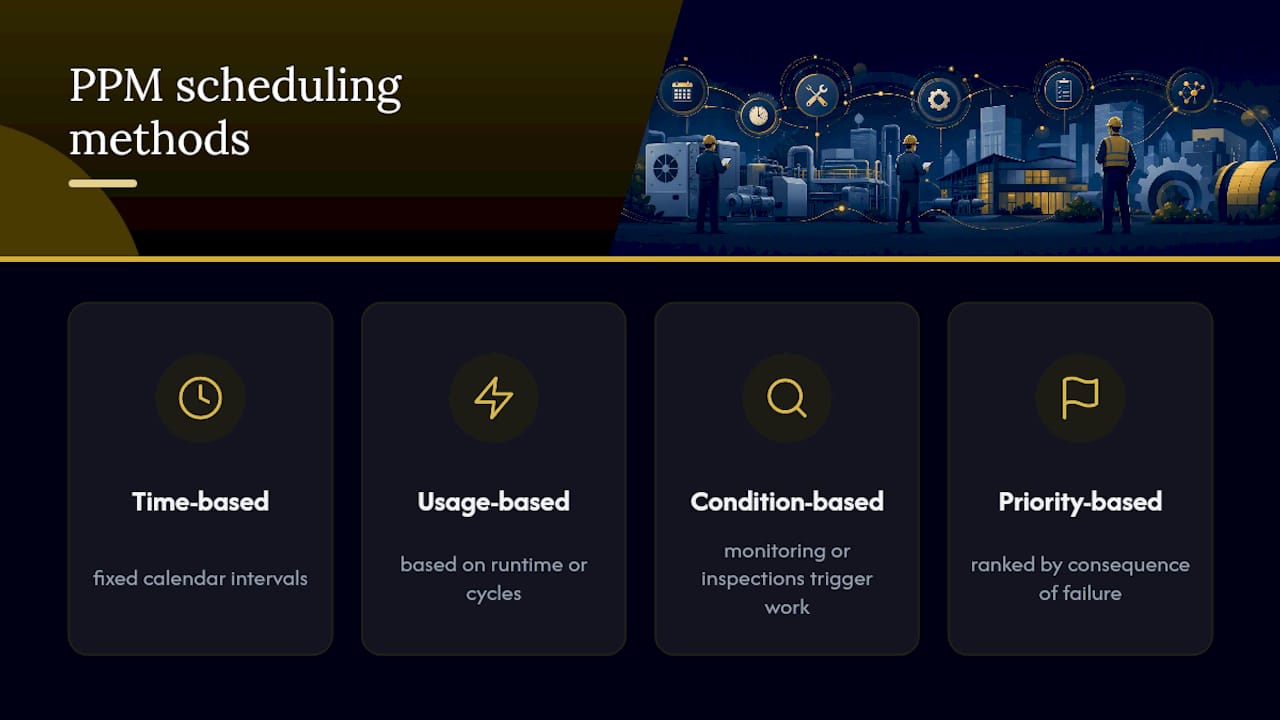
Time-based scheduling runs on a fixed calendar interval: quarterly, six-monthly, annual. It's simple to plan and simple for technicians to follow, which makes it the right default for low-variability assets like fire extinguishers or fixed wiring where usage doesn't swing much between sites.
Usage-based scheduling ties intervention to actual wear, hours run, cycles completed, litres pumped, rather than the calendar. A generator that's barely used doesn't need the same servicing frequency as one running daily, and usage-based logic catches that where a blanket time interval wouldn't.
Condition-based scheduling relies on inspection or monitoring data to trigger work: vibration readings, refrigerant pressure, thermal imaging results. It suits critical or expensive plant where you want the earliest possible warning of degradation, not just a fixed check-up.
Priority or risk-based scheduling comes into play when resource is tight and everything can't be done this week. It ranks jobs by consequence of failure, so a lift inspection outranks a routine filter change when your technician capacity is limited.
Most working PPM schedules blend all four: time-based for the routine bulk of tasks, usage and condition-based for the assets that actually vary, and priority-based logic sitting over the top to triage when the diary gets tight.
How do you build a PPM schedule step by step?
Building a schedule that survives contact with reality takes more than a spreadsheet and good intentions. Here's the sequence that actually holds up.
- Create or verify your asset register. Every asset needs a unique identifier, location, make and model, installation date, and any statutory classification (F-Gas, LOLER, EICR, and so on). An incomplete register is the single biggest reason PPM schedules fail later.
- Build standardised task libraries. Write out what "service the AHU" actually involves, step by step, rather than trusting every technician to know. Add site-specific or installation-specific notes where equipment deviates from the standard model.
- Set initial frequencies. Start with manufacturer guidance as your baseline, then adjust for usage intensity and risk classification. A kitchen extraction system in a busy commercial kitchen needs a tighter interval than the same unit in a quiet office canteen.
- Allocate resource windows. Slot recurring jobs against actual technician availability, not an idealised diary. Scheduling policies commonly need rules for default start dates, which days to include, and resource availability, and a decent scheduling tool will flag conflicts and resource shortages automatically rather than leaving you to spot them manually.
- Pilot before you commit. Run the schedule for a defined period, then use what actually happened, missed windows, jobs that took longer than planned, assets that needed attention early, to tune both frequencies and task content. The priority is visibility and flexibility, not a perfect schedule on day one.
- Lock in record keeping. Certificates, photographs, and technician sign-off need to attach to the specific job and asset, not sit in a separate folder someone has to cross-reference later.
| Stage | What "done" looks like |
|---|---|
| Asset register | Every asset has ID, location, install date, statutory tags |
| Task library | Written step-by-step instructions per task type |
| Frequencies | Set from manufacturer data, adjusted for usage/risk |
| Resourcing | Jobs slotted against real technician capacity |
| Pilot | A trial period with outcomes reviewed |
| Records | Certificates and sign-off attached to the job at completion |
A few things worth building into the process from day one:
- Assign an owner for each asset category, not just each site
- Build in a review point at 90 days to catch frequencies that were set wrong
- Keep task instructions accessible on-site, not buried in a separate document nobody opens
Compliance-heavy tasks benefit from a dedicated approach to recurring audits and certificate renewals, since the paperwork burden on statutory work is usually heavier than on routine servicing.
What software features actually support PPM scheduling?
Choosing a tool for PPM scheduling comes down to matching features to the process you've just built, not picking whatever ranks highest in a review roundup.
The essentials: an asset register that holds full metadata and statutory classifications, recurring job templates so you're not rebuilding the same task every cycle, a mobile app engineers can use on site (ideally one that works offline, since plant rooms and basements rarely have reliable signal), and built-in certificate and photo capture so compliance evidence attaches directly to the job.
Beyond the basics, look for scheduling controls that handle the messy real-world stuff:
- Blackout windows for sites that can't take disruption on certain days
- Resource availability rules that stop jobs being allocated to engineers who are already booked
- Automated notifications when a job is approaching its due date or has slipped
- Re-prioritisation tools for when an emergency job needs to jump the queue without losing track of what got bumped
Reporting matters just as much as scheduling. You need an audit trail that shows what was done, when, by whom, and with what evidence, because that's what an auditor or insurer will actually ask to see. Integration with stock and parts systems avoids technicians turning up without the right filter or seal, and integration with accounting and telematics closes the loop between job completion, invoicing and vehicle movements. For HVAC-specific compliance work, F-Gas and TM44 scheduling needs its own certificate logic layered on top of the general asset register.
Common pitfalls when scheduling PPM
Most failed PPM schedules don't fail because the manager didn't care. They fail because of a handful of repeatable mistakes.
- Over-prescribing frequency without data. Setting every asset to monthly "just in case" burns engineer hours on assets that didn't need attention, and starves the ones that did.
- Poor or missing asset metadata. A register with vague locations or missing installation dates makes accurate scheduling almost impossible, however good the software.
- No technician-facing instructions. If the task says "service unit" with nothing else, expect repeat visits and inconsistent quality between engineers.
- Ignoring feedback loops. A schedule set once and never revisited drifts further from reality every quarter, especially as assets age or usage patterns change.
Pro Tip: Review your frequencies against actual fault history every six months. If an asset hasn't needed attention between services twice running, you're probably over-servicing it, and that's budget you could redirect elsewhere.
PPM examples by facility type
Frequencies and priorities shift a lot depending on what kind of building you're running, which is why generic templates only get you so far.
- Offices: HVAC filters and controls typically sit on a quarterly cycle, lift inspections follow statutory intervals, and fire alarm testing usually runs weekly for call points with an annual full system check.
- Healthcare: Critical plant, medical gas systems, backup generators, needs tighter frequencies and stricter documentation, since downtime risk extends beyond cost into patient safety.
- Education: Termly and annual splits work well, servicing heating systems before winter term and playground or sports equipment ahead of the summer season.
- Hospitality and retail: Refrigeration and kitchen extraction respond best to usage-based scheduling, since a site running double covers at weekends wears equipment faster than a quiet weekday.
What building PPM schedules in the field actually teaches you
Working alongside UK service and engineering businesses building their own PPM schedules, a few patterns show up again and again. The businesses that struggle almost always have a strong template but a weak asset register, the plan looks polished until you ask where a specific pump actually is.
Three lessons stand out. First, perfect frequencies don't exist on day one, and chasing them delays getting started. Second, reactive work never disappears entirely, so schedules need slack built in, not a diary packed edge to edge. Third, technicians who understand why a task matters follow instructions far more consistently than those just handed a job sheet.
These are the operational realities that shaped how Curcle approaches scheduling, built from inside a working service business rather than designed at a distance from one.
— Luke Herridge
Running your PPM schedule day to day
Everything covered so far, the asset register, the frequency logic, the resourcing rules, has to live somewhere your team actually uses, or it quietly reverts to a spreadsheet nobody trusts. That's the gap Curcle by Herridge is built to close.

Curcle brings the asset register, recurring job templates, certificate generation and a mobile engineer app into one connected system, so technicians see their instructions on site, office teams see status in real time, and compliance evidence attaches to the job automatically instead of living in a separate folder. For teams juggling multiple sites and statutory deadlines, that means fewer missed inspections and far less time spent chasing paperwork after the fact. If you're overhauling a PPM schedule or setting one up properly for the first time, take a look at how Curcle's field service platform handles scheduling, dispatch and compliance together, and book a walkthrough to see it against your own asset list.