
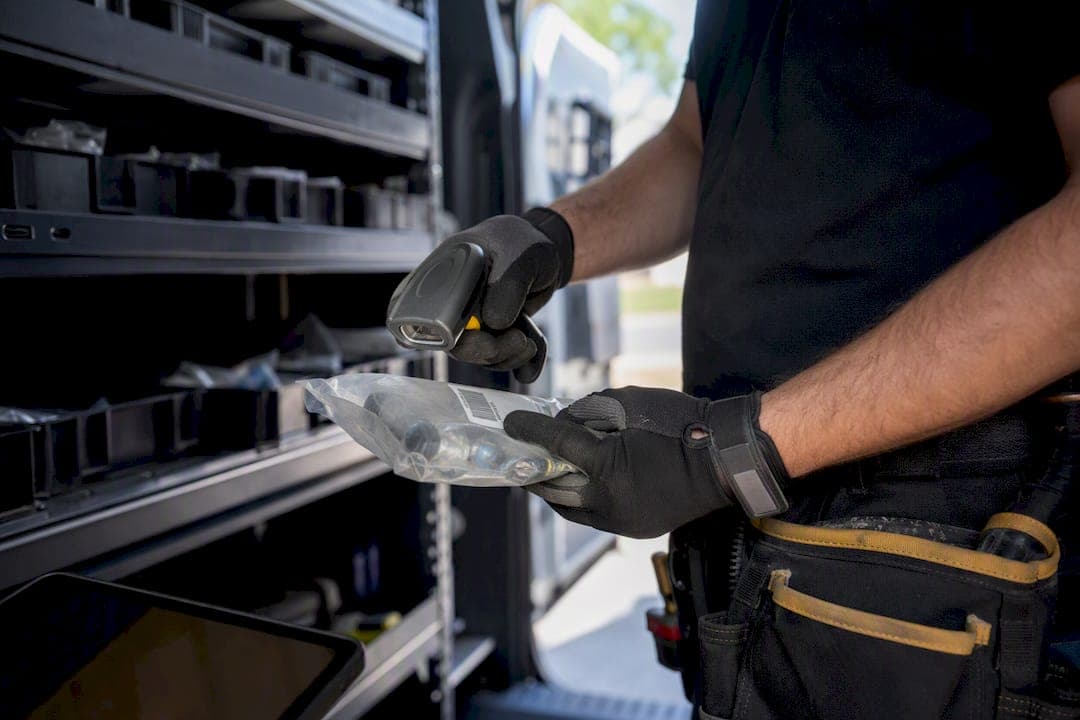
Parts traceability in field service means recording every part fitted on-site with an identifier and linking it to the job, the asset and the invoice. Nothing more, nothing less, and it has to happen every time.
Done properly, it produces four immediate wins: audit readiness, faster invoicing, warranty claims you can actually defend, and a measurable lift in first-time fix rates. Done badly, or not at all, you get the opposite of all four.
The minimum viable version looks like this:
- A part code (SKU or serial) captured at the point of fit, not written up later
- A job ID and technician ID attached to that part automatically
- A timestamp and location proof
- A direct link through to the invoice line and any compliance certificate
Curcle builds this into its job and stock workflow, and offers free compliance templates including a PAT testing register for teams that want a working structure before they build anything custom.
Key Takeaways
Parts traceability succeeds when every fitted part is recorded with an identifier and linked automatically to its job, asset and invoice, with no manual reconciliation.
| Point | Details |
|---|---|
| Fix the van-level gap first | Shrinkage starts closest to the asset, in vans and forward stock, not the warehouse. |
| Capture the right fields | SKU, serial, technician ID, timestamps and certificate ID must all attach at the point of fit. |
| Choose technology by risk | Use barcode or QR for routine parts; reserve NFC/RFID for concealed or regulatory-critical fits. |
| Keep ERP as finance's record | Let a field layer capture consumption and feed it upward rather than duplicating ERP. |
| Curcle as an implementation route | Curcle links job, certificate and invoice automatically and reports a 95% invoice collection rate. |
Table of Contents
- Why parts traceability matters for operations and compliance
- Essential data to capture for every fitted part
- Workflows and technology that make on-site capture fast and reliable
- Integrations and simple process rules to keep systems aligned
- Implementation checklist: pilot, roll-out and measurement
- Records, retention and audit readiness
- How Curcle implements a compliance-first approach to parts traceability
- What most traceability advice gets backwards
- Get parts traceability working without building it yourself
- Frequently asked questions
- Sources
Why parts traceability matters for operations and compliance
The parts closest to the asset, the ones sitting in a van or a forward stocking location, tend to have the worst data of any inventory in the business. Warehouse stock gets counted. Van stock gets guessed at.
That gap has a direct cost. Research from Ventory found that missing parts drive repeat visits and notable shrinkage across vans and forward stocking locations. Every repeat visit is a technician back on the road, a customer waiting longer, and a job that costs more to close than it should.
The knock-on effects show up in three places:
- First-time fix collapses when an engineer arrives without the part actually fitted last time or the part the asset needs
- Invoicing slows down, because nobody can confirm what was used until someone chases the paperwork
- Warranty and insurance claims weaken, since there's no clean record tying a specific part to a specific installation date
None of this is exotic. It's the ordinary cost of not knowing what's on the van.
Essential data to capture for every fitted part
The fields you capture at the point of fit determine whether a record is useful six months later or just noise in a spreadsheet. Most field-service businesses under-collect, then discover the gap when a warranty dispute or an audit lands on their desk.
Split the requirement into three tiers.
- Identification fields: SKU or part code, serial number where the part carries one, quantity fitted, job ID, technician ID, and a timestamp with location proof. This is the backbone record. Without it, nothing else links up.
- Compliance fields: certificate ID, test result, expiry or warranty date, and the asset's make, model and serial number. This tier is what turns a stock movement into evidence. It's also what regulators and insurers actually ask for.
- Inventory and audit fields: van location or stock bin, lot or batch number, the reason for consumption (fitted, scrapped, returned), and an edit audit trail showing who changed a record and when.
Field service forms should also capture the customer name and exact service address alongside technician ID and timestamps. Legal Clarity's review of service-record requirements notes that administrative conversion from field record to billing typically takes a short period of business days after verification, so any gap in these fields at the point of capture creates a delay you feel at invoicing, not just at audit time.
Pro Tip: Make the certificate ID and the part serial number the same lookup key wherever you can. When an auditor or a warranty assessor asks for evidence, one search should pull the part, the test result and the job record together, not three separate systems.
Version control matters as much as the fields themselves. If a technician corrects a serial number entered wrong on-site, the system needs to keep the original entry, the correction, and who made it. That's what makes a record defensible rather than just plausible.
Workflows and technology that make on-site capture fast and reliable
The best traceability system is the one technicians actually use, and that comes down to speed. A scan-at-fit workflow should take 10 to 30 seconds: open the job, scan the part, confirm the quantity, and it auto-links to the job and the invoice line. Anything slower gets skipped under time pressure, and a skipped scan is a gap in your audit trail.
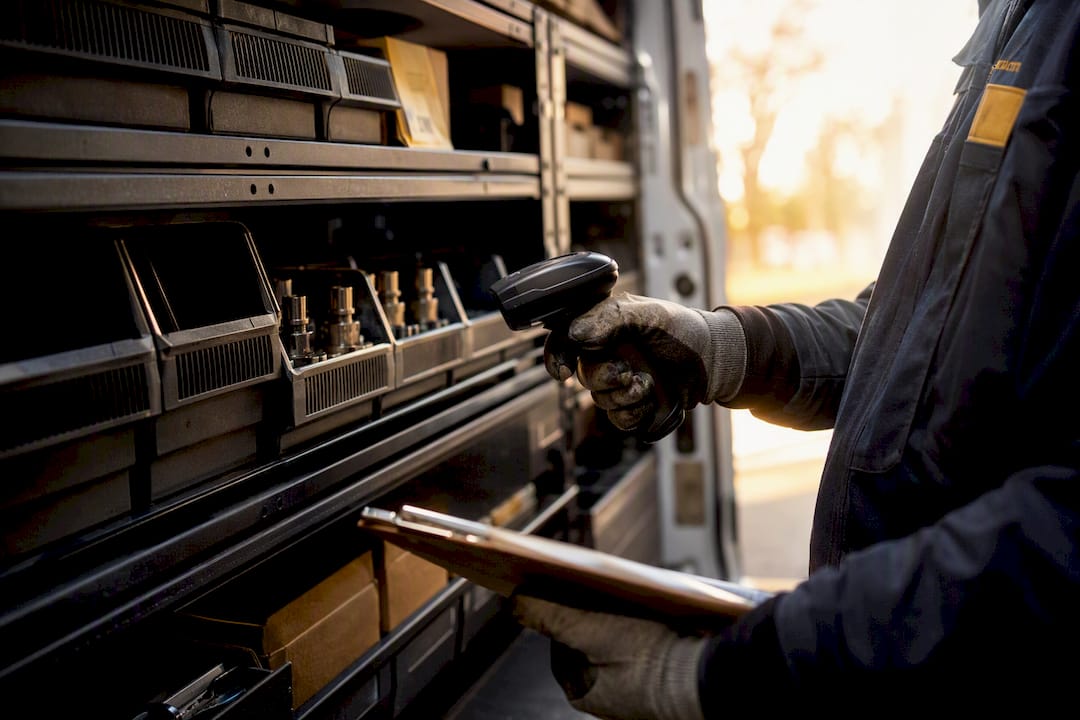
Barcode and QR codes handle most service parts well. They're cheap, fast to print, and need nothing more than a phone camera. Barcodes require line-of-sight but cost almost nothing per label, which makes them the default for routine consumables and standard components.
NFC and RFID earn their higher per-item cost in specific situations:
- Concealed installations, where the part disappears behind a wall, ceiling or casing and a barcode scan is physically impossible after fitting
- Installation verification, where you need proof the exact component was fitted, not just delivered, since RFID enables installation verification that a delivery note alone can't provide
- Regulatory-critical fits, where a tamper-evident, time-stamped record protects you in a dispute
Offline-first mobile capture is non-negotiable for field work. Basements, plant rooms and remote sites routinely have no signal, and a system that refuses to work offline just gets abandoned. Scans should queue locally and sync automatically the moment connectivity returns.
Pro Tip: Reconcile van manifests weekly, not monthly. Phantom inventory, stock the system says is on the van but physically isn't, compounds fast when nobody checks it until the quarter-end count.
Integrations and simple process rules to keep systems aligned
Your ERP stays the system of record for finance. The field layer's job is to capture consumption events accurately and feed them upward, not to replace what accounting already relies on.
That division of labour keeps four things working:
- Automated replenishment triggers off real consumption against set minimum and maximum thresholds, so vans get restocked based on what's actually been used, not guesswork
- Dispatch decisions use real-time van manifests rather than assumed stock lists, which stops engineers being sent to jobs without the part the job needs
- Billing reconciles cleanly, because every fitted part traces to one invoice line and one service-history entry, with no manual matching required
- Stockouts and over-ordering both drop, since replenishment responds to actual fitted quantities instead of periodic guesses
This is the field inventory layer approach Ventory's research describes: a lightweight system sitting alongside ERP and CMMS, scan-first and offline-capable, feeding verified data back rather than duplicating what finance already owns.
Implementation checklist: pilot, roll-out and measurement
Roll this out in stages rather than all at once.
- Define pilot scope and baseline metrics covering first-time fix, shrinkage and invoice lag before you change anything.
- Configure required fields and scanning method, and set the mobile app's offline rules.
- Train engineers on speed, making the scan genuinely faster than the workaround, or adoption fails.
- Integrate with ERP and CMMS, enable replenishment, and set verification and audit rules.
- Measure, iterate and scale.
Ventory's field inventory research puts realistic timescales for a pilot and scale across a fleet within a few weeks to several months. Treat that as the pace to plan around, not a target to beat.
Records, retention and audit readiness
Retention periods vary by trade and regulation, so check the specific requirement for your compliance regime rather than assuming one blanket figure. Electrical, gas and lifting-equipment records commonly need to survive well beyond the life of a single contract, particularly where warranty periods or statutory inspection intervals run for years.
Practical rules that hold regardless of the exact retention window:
- Attach certificates and service reports directly to the asset and the job record, not to a separate filing system an auditor has to hunt for
- Keep the original submission alongside any correction, with author metadata on each version
- Make sure a warranty or compliance query can be answered from one lookup, not three
Multi-stage verification systems like SiteOn show what strong tamper-evidence looks like in practice: operator ID, timestamp, GPS and tag UID recorded at every stage. Field service doesn't need that level of rigour for every part, but the principle, verified identity plus verified time plus verified place, is exactly what makes a record stand up to scrutiny.
How Curcle implements a compliance-first approach to parts traceability
Curcle consolidates job scheduling, certificate generation and invoicing with stock and asset registers, so a part fitted on-site links automatically to the job, the certificate and the invoice line, no separate reconciliation step required.
The platform backs this with two concrete proofs: a 95% invoice collection rate across customers, and free compliance templates such as the PAT testing register and a LOLER checklist that gives teams a working record structure from day one.
- Mobile scanning with offline-first operation for basements, plant rooms and low-signal sites
- Audit trails with version control, so edits never overwrite the original entry
- Document and certificate linking straight to the asset and job history
Pro Tip: Start your pilot with the templates rather than a blank system. It's faster to adapt a working structure than to design your own field list from scratch.
| Point | Details |
|---|---|
| Data captured at fit | Automatically links part, job, certificate and invoice line in one record. |
| Proven collection rate | Curcle customers report a 95% invoice collection rate across billed work. |
| Free starting templates | The PAT testing register template gives new users a working structure immediately. |
What most traceability advice gets backwards
Most guidance on this topic treats parts traceability as a data problem. It isn't. It's an adoption problem wearing a data problem's clothes.
You can design the perfect field schema, every identifier, every compliance tag, every timestamp, and it will fail the moment a technician finds it faster to skip the scan than complete it. The research bears this out: the worst data sits closest to the asset, in vans and forward stock, precisely because that's where the workflow friction is highest and the oversight is lowest.
So the priority isn't more fields. It's fewer seconds. A scan-at-fit process that takes half a minute will get used. One that takes three minutes will get bypassed by Friday. That single design constraint, speed over completeness, should drive every decision before you touch integrations or reporting.
Where Curcle's approach earns attention is in refusing to separate the record from the billing. A part logged without a route to an invoice line is half a system. Get that link right first, and the audit trail follows almost as a side effect.
Get parts traceability working without building it yourself
Curcle gives engineering and compliance teams a working parts traceability system from day one, without months spent designing field schemas or stitching together separate tools for stock, certificates and invoicing.

Everything covered in this guide, linking a fitted part to its job, its certificate and its invoice line, is already built into the platform, alongside mobile scanning, offline-first capture and version-controlled audit trails.
If you're planning a pilot, start with the free PAT testing register template to see the record structure in practice, then take the product tour to see how job, stock and invoicing connect on the Curcle field service platform. Booking a tour costs nothing and shows you exactly how a pilot would run on your own jobs.
Frequently asked questions
What is parts traceability in field service?
It means recording every part fitted on a job with an identifier, such as a SKU or serial number, and linking that record to the job, the asset and the invoice, so anyone can retrieve the full history later.
What's the minimum data needed for parts traceability?
Part code, quantity, job ID, technician ID, timestamp and location proof cover the baseline. Add certificate ID and asset serial number for compliance-heavy trades.
Do I need RFID or NFC, or is a barcode enough?
Barcodes and QR codes handle most routine parts at low cost. Reserve NFC or RFID for concealed installations or regulatory-critical fits where you need tamper-evident proof of installation.
How long should parts traceability records be kept?
Retention depends on the trade and the regulation involved, since warranty periods and statutory inspection cycles vary. Check the specific requirement for your compliance regime rather than applying one fixed period.
How does parts traceability improve first-time fix rates?
Accurate van manifests mean engineers arrive with the right part already confirmed on the vehicle, which directly cuts the repeat visits that stem from missing or misrecorded stock.

Sources
Spare Parts Inventory Management: The Aftermarket's Hidden Margin — Ventory
How RFID Enables True Building Materials Traceability on Construction Sites — RFIDSolution
Field service forms: types, requirements and records — Legal Clarity
ACCUZ® SiteOn™ — Component Verification System — RFID Solution
- Spare Parts Inventory Management: The Aftermarket's Hidden Margin - Ventory
- How RFID Enables True Building Materials Traceability on Construction Sites - RFIDSolution
- Field service forms: types, requirements and records - Legal Clarity