

A monthly compliance audit is a short, repeatable review that catches process drift before it becomes a regulatory finding, and produces evidence you can hand to an auditor without a scramble. It works when you check a fixed set of areas (documentation, ownership, access, vendors, finance, safety, incidents), assign a named owner to every gap, save the evidence as you go, and close the review with a short summary for management. Success is not zero findings. It's few open high-risk findings and a clean evidence trail.
TL;DR:
- Most high-risk findings in monthly audits relate to access controls, vendor certifications, and safety inspections, which require regular verification.
- Assigning a clear owner to each control and collecting tangible evidence ensures accountability and evidence integrity during audits.
- Spreading audit tasks over the month and integrating them into existing processes reduces workload and improves evidence freshness.
- Keeping evidence for at least five years and storing it in a searchable, linked system facilitates quick retrieval by auditors.
- Focusing on risk-shifting factors, such as recent incidents or personnel changes, helps prioritize areas with the greatest compliance impact.
Table of Contents
- What should a monthly compliance audit checklist cover?
- How do you run the monthly audit process, step by step?
- Evidence retention: what to keep and for how long
- Who should own each control, and how do you assign accountability?
- How do you score findings and report results to management?
- What are the common pitfalls in monthly compliance audits?
- Making the monthly audit a by-product of month-end close
- Which regulations and standards actually shape a monthly compliance audit?
- What tools help run a monthly compliance audit efficiently?
- How do you identify and prioritise high-risk areas each month?
- How should you communicate audit results to management?
- How do you build continuous improvement into future audits?
- How do you handle follow-up audits after remediation?
- Pragmatic priorities for compliance officers
- Running monthly compliance audits with Curcle
- Sources
What should a monthly compliance audit checklist cover?
A working checklist is the difference between an audit that takes two hours and one that eats your whole week. Most compliance officers over-scope the first version, try to check everything, and quietly abandon it by month three. Keep the list tight, group it by area, and mark which items need eyes every single month versus which ones only need a spot check.
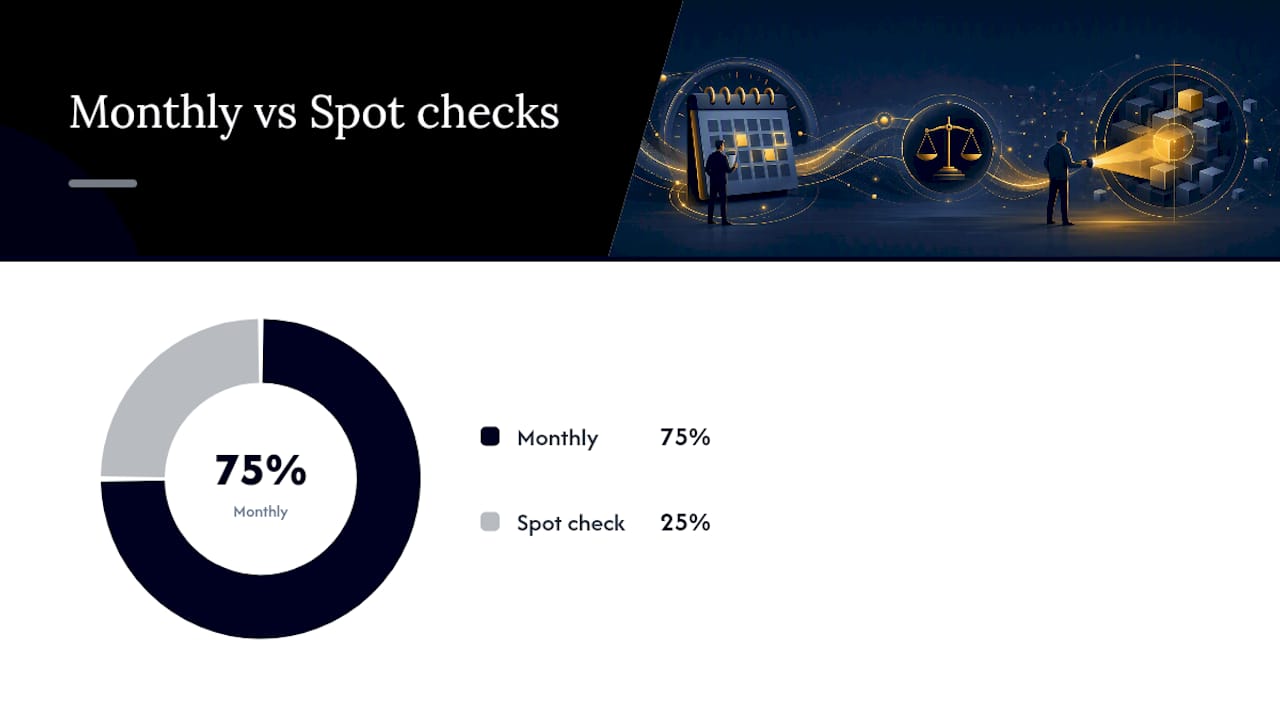
Here is a checklist built around the areas that actually generate regulatory and safety risk, based on the grouping approach used in internal control frameworks such as ISO 27001 evidence reviews.
Process documentation and SOPs
- Confirm the current version of each critical SOP is dated, approved and stored where staff can actually find it. (Monthly)
- Spot check one or two procedures against what staff are really doing on the ground. (Spot check)
- Evidence to save: version number, approval date, screenshot of the document register.
Team and ownership
- Confirm every control on your register still has a named owner, especially after any starter or leaver. (Monthly)
- Check that owners have actually reviewed their assigned items this month, not just been listed against them. (Monthly)
- Evidence to save: updated RACI or ownership log with timestamps.
Tools and access controls
- Review who has admin access to core systems and remove anyone who has changed role or left. (Monthly)
- Check multi-factor authentication is enforced on privileged accounts. (Spot check)
- Evidence to save: access control export, screenshot of the user list with a date stamp.
Vendor and finance checks
- Confirm insurance certificates and key vendor accreditations (Gas Safe, NICEIC, ISO certificates) haven't lapsed. (Monthly)
- Reconcile spend against approved purchase orders for any vendor over your threshold. (Monthly)
- Evidence to save: certificate copies, PO reconciliation sheet, renewal dates.
Safety and operational checks
- Confirm statutory inspections due this month (LOLER, PAT, F-Gas, fire safety) were completed and signed off.
- Check that any equipment flagged as "action needed" last month has actually been actioned.
- Evidence to save: signed inspection reports, photos with timestamps, engineer sign-off.
Incidents and continuity
- Review any incidents, near-misses or breaches logged this month and confirm each has an owner and a closure date. (Monthly)
- Check that your business continuity or incident response contact list is current. (Spot check)
- Evidence to save: incident log extract, corrective action notes.
Reporting and backlog
- Confirm last month's open findings have moved forward, not just carried over untouched. (Monthly)
- Check the backlog age. Anything open longer than 60 days needs a reason attached, not just a status. (Monthly)
- Evidence to save: findings tracker export with ageing column.
That's roughly 20 checks. Most teams can work through it in half a day once the routine beds in, and it's genuinely usable as a compliance review checklist from month one rather than something you build up to.
How do you run the monthly audit process, step by step?
The checklist only works if it sits inside a routine. Treat the monthly audit process as four phases repeated on a fixed rhythm, not a one-off scramble at month end.
- Collect evidence (Week 1). Owners gather logs, certificates, screenshots and sign-offs for their area. This is the phase that fails silently if you leave it to the last week, because nobody remembers what happened three weeks ago.
- Review against the checklist (Week 2). Someone independent of day-to-day delivery, usually the compliance officer, works through the checklist and flags anything missing, expired or inconsistent.
- Assign fixes (Week 3). Every flagged item gets a named owner and a due date. No unowned findings survive into the next cycle.
- Report and close (Week 4). A short management summary goes out, remediation is tracked, and the cycle resets.
A sample week-by-week schedule for a small compliance team might look like this: Week 1 covers access and ownership checks (roughly two hours); Week 2 covers vendor and finance reconciliation (two to three hours); Week 3 covers safety, incidents and technical/cloud checks (three hours); Week 4 is reporting and the review meeting (one hour). Spreading the work this way, an approach several practitioners recommend to avoid dumping the whole audit into a single frantic week, keeps evidence fresh and avoids the panic of trying to reconstruct a month's activity from memory on day 28.
The monthly review meeting itself doesn't need to run long. A 45 to 60 minute agenda works well:
- Five minutes: status of last month's actions (closed, open, overdue).
- Fifteen minutes: walk through new findings by area, worst issues first.
- Fifteen minutes: assign owners and due dates to anything new.
- Ten minutes: agree what goes into this month's management summary.
- Five minutes: confirm next month's schedule hasn't slipped.
Pro Tip: Put the review meeting on the calendar as a recurring invite for the whole year, not month by month. Teams that rebook it manually each time are the ones who "forget" to run it in December.
Evidence retention: what to keep and for how long
Auditors don't want your word that a check happened. They want the artefact. For every checklist item, capture something concrete: a signed inspection report, a certificate with an expiry date, an access control export, an invoice matched to a purchase order, or a screenshot that includes a visible date and context, not just a cropped image with no way to verify when it was taken.
Concrete examples worth building into your evidence habit:
- Signed LOLER, PAT or F-Gas inspection reports, with engineer name and date.
- Vendor accreditation certificates, saved with their expiry date visible.
- Access control exports showing who had admin rights on the audit date.
- Incident logs with a closure date and the name of who signed it off.
- Invoices reconciled against purchase orders, kept together, not filed separately.
On how long to keep all this, Gov recommends retaining documentation, including scope, methodology, findings and management responses, for a minimum of five years. That baseline exists because regulators and auditors need a documented history, not just a snapshot, to demonstrate good faith over time. If a dispute or inspection reaches back further than your storage window, a missing record reads the same as a missing control.
Retention baseline: Keep monthly audit evidence, including scope notes and management responses, for at least five years.
Store evidence somewhere searchable and tied to the control it supports, not scattered across inboxes. A shared drive with a folder per control, or an operations platform that links evidence directly to the relevant asset or job, beats a pile of email attachments every time. The link between evidence and control matters more than the storage medium. An auditor asking "show me the F-Gas records for March" should get an answer in under a minute, not a ten-minute email search.
Who should own each control, and how do you assign accountability?
Process drift happens quietest when nobody actually owns a control. Everyone assumes someone else checked it, and the gap goes unnoticed for months. Naming an individual owner for every control on your register is one of the simplest changes that improves audit readiness, because a person with their name against a task behaves differently than a task sitting in a shared responsibility.
A basic RACI split works for most controls:
- Responsible: the person who actually performs the check (e.g. site engineer, IT administrator).
- Accountable: the named owner who confirms it's done and signs off (e.g. compliance officer, facilities manager).
- Consulted: anyone whose input shapes the check (e.g. vendor account manager for accreditation renewals).
- Informed: management or leadership who see the outcome in the monthly summary.
Add an "Owner" field directly into your audit tracker, next to each checklist item, not in a separate document. It sounds trivial, but a tracker where ownership lives one click away from the finding is far more likely to get chased than one where owners are recorded in a policy document nobody reopens.
Small teams often can't dedicate a full-time person to every control, and that's fine. The fix is a compensating control, not a missing one: rotate ownership monthly across two or three people, or have the same person own multiple related controls (all vendor checks, say) rather than leaving any control unowned. What matters is that when something goes wrong, there is exactly one name attached to explain what happened and why.
How do you score findings and report results to management?
A finding without a status is just noise. Keep the scoring rubric simple enough that anyone on the team can apply it consistently:
- On track: control operating as designed, evidence current.
- Needs update: minor gap, e.g. a document is out of date but the underlying practice is sound.
- Escalate: the control has failed or evidence is missing, and it carries genuine regulatory or safety risk.
Roll these up into a single composite readiness score for the month (percentage of checklist items rated "on track") so leadership gets one number alongside the detail. The self-assessment philosophy here matters: as Foley & Lardner's guidance on compliance self-checks puts it, the goal is to surface "program gaps," where a control exists on paper but fails in practice, so a "no" answer triggers improvement rather than being treated as a failure to hide.
A monthly management summary should cover:
| Section | What it contains |
|---|---|
| Headline readiness score | Percentage on track, trend versus last month |
| Escalations | Any control rated "escalate," with owner and target date |
| Closed since last review | What moved from open to closed |
| New risks this month | Anything newly identified, even if not yet resolved |
| Backlog ageing | Count of items open longer than 60 days |
Prioritise remediation by combining likelihood and severity, not by ticking off whichever items are easiest to close first. An expired fire safety certificate outranks a slightly outdated SOP even if the SOP fix takes five minutes and the certificate renewal takes two weeks. Convert every finding into a tracked action with an owner, a due date and a defined "done" state, so nothing lingers as a vague intention on a spreadsheet.
What are the common pitfalls in monthly compliance audits?
Most audit programmes don't fail because the checklist was wrong. They fail because of habits that creep in around the edges.
- Evidence panic at month end. Trying to reconstruct a month's activity in the final three days produces thin, unreliable evidence. Fix: lock in the week-by-week schedule and treat evidence collection as it happens, not as a retrospective exercise.
- Evidence scattered across email. Attachments buried in inboxes are unsearchable and get lost when someone leaves. Fix: move to a shared, structured store within a week, even if it's just a well-organised folder structure to start.
- No named owners. Findings sit unresolved because nobody feels responsible. Fix: add an owner field to the tracker this week and backfill existing open items immediately.
- Waiting for the "big" annual audit to catch issues. Treating the monthly review as a formality and saving real scrutiny for the annual compliance audit plan lets small gaps compound for eleven months. Fix: give the monthly review the same seriousness as the annual one, just at smaller scope.
Pro Tip: If the same finding appears three months running, stop treating it as a checklist item and start treating it as a systemic problem. That's usually a sign the control design is wrong, not that people keep forgetting.
Escalate to external audit or legal advice when a finding involves a regulatory breach with potential fines, a safety failure with injury risk, or a pattern that suggests deliberate concealment rather than oversight. Internal remediation is for gaps and drift. Anything with legal exposure needs a specialist, promptly.
Making the monthly audit a by-product of month-end close
The most reliable compliance programmes don't run the audit as a separate project bolted onto a busy month. They fold it into work that's already happening. Finance is reconciling accounts at month end anyway; vendor checks can piggyback on that same reconciliation. IT is already reviewing access logs for other reasons; align the timing so the same export serves both purposes.
Spreading the work across a 12-month governance calendar, rather than treating audit readiness as an annual event, converts it from a scramble into a continuous state. Distributing preparation across the year materially cuts the effort required at year end, because nothing has been left to pile up.
Practical ways to integrate the two:
- Map each checklist item to an existing month-end task and note which team already touches that data.
- Use the same evidence export for both the close and the audit wherever the underlying data overlaps.
- Set your audit review meeting for the same week as the finance close review, so both conversations draw on fresh numbers.
- Store templates centrally so nobody rebuilds the checklist from scratch each cycle. Curcle's free compliance templates, covering CP12, EICR and LOLER documentation, are a starting point if you want a structure to adapt rather than build from a blank page.
This also matters because expectations for audit quality are rising. The IIA's Global Internal Audit Standards came into effect and push practitioners toward continuous, standards-aligned work rather than periodic box-ticking. A monthly rhythm tied to existing operational cycles is the practical way to meet that bar without adding a second full-time job to the compliance function.
Which regulations and standards actually shape a monthly compliance audit?
The exact standards on your checklist depend entirely on your sector and geography, but a few recurring frameworks shape how most monthly programmes are structured.
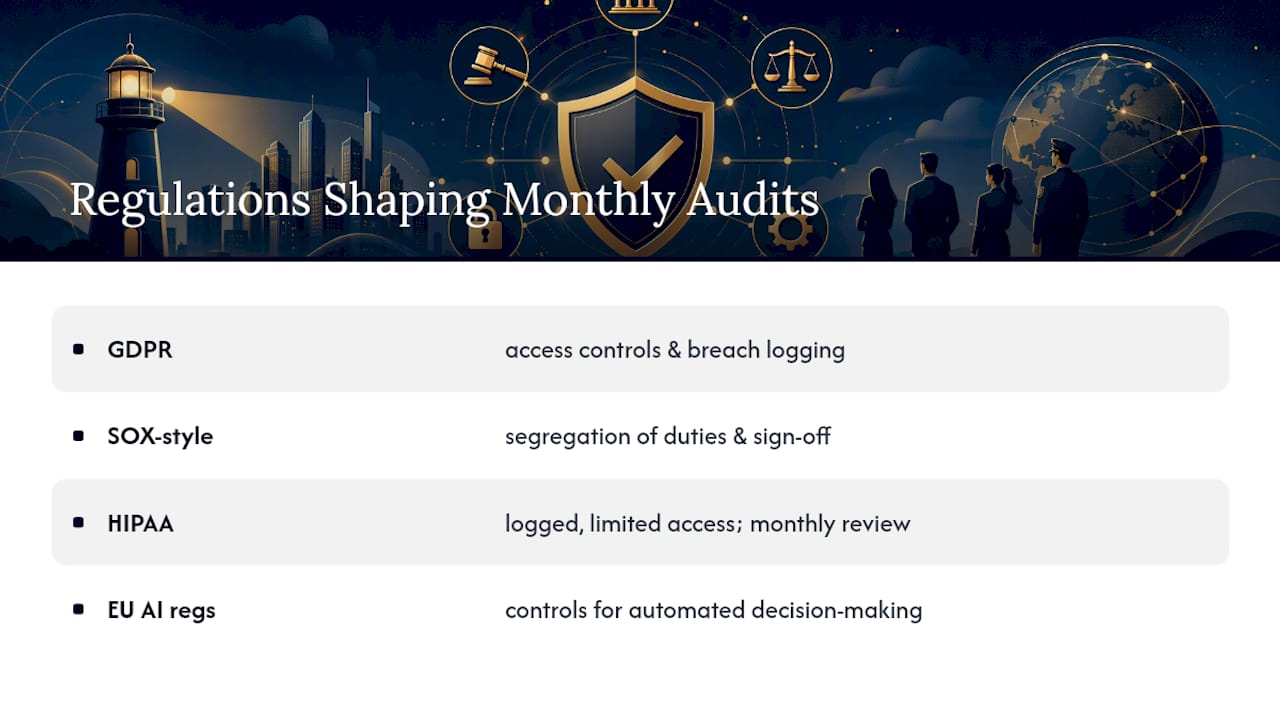
GDPR drives much of the access control and data-handling checklist for any organisation holding personal data, including staff and customer records. Monthly checks typically cover who has access to personal data, whether data processing agreements with vendors are current, and whether any breach needs logging. Smaller organisations often underestimate this scope; practical GDPR guidance for small businesses is a useful reference for scaling expectations to your size rather than assuming enterprise-level obligations apply wholesale.
SOX-style financial controls (formally relevant to US-listed companies but widely used as a design template elsewhere) inform the vendor and finance section: segregation of duties, reconciliation evidence, and sign-off trails on payments above a threshold.
HIPAA applies specifically to US healthcare data handlers, but its principle, that access to sensitive records must be logged, limited and reviewed monthly, shapes how many non-US organisations structure their own access control checks even without direct obligation.
For organisations with cross-border operations, recent EU regulatory texts, including the AI regulation consolidated in EUR-Lex, are worth checking against your control register if any part of your operation touches automated decision-making or data processing within the EU.
None of these frameworks require identical checklists. They require that whatever checklist you run maps clearly back to a named regulation, so an auditor can trace each item to its source.
What tools help run a monthly compliance audit efficiently?
A spreadsheet works for the first few cycles. It stops working once you have more than a handful of controls, several owners, and evidence scattered across departments, because nobody remembers to update a static file and version conflicts creep in fast.
Purpose-built tools tend to fall into three categories. Dedicated audit and GRC (governance, risk and compliance) platforms centralise findings, ownership and evidence in one register, useful for larger compliance functions running multiple audit types in parallel. Operational platforms with built-in compliance modules, the category Curcle sits in for field service and engineering businesses, tie audit evidence directly to the jobs, assets and engineers that generated it, which removes the step of copying evidence from an operational system into a separate audit tool. General document management or shared drive setups can work for very small teams, provided someone enforces folder structure and naming conventions with real discipline.
Whichever category fits your team, look for three capabilities specifically: recurring task scheduling so the monthly cycle doesn't rely on someone remembering to start it, evidence capture that timestamps and links documents to a specific control or asset, and a findings tracker that shows ageing so nothing quietly goes stale. Curcle's compliance inspection features build recurring audits and renewal tracking around exactly this pattern, useful context if you're evaluating what "good" looks like before choosing a tool.
How do you identify and prioritise high-risk areas each month?
Not every checklist item deserves equal attention every month. The skill in running an efficient audit is spotting where risk has actually shifted since last time, rather than treating all twenty checklist items as equally urgent.
Start with what changed. New starters or leavers push access control risk up. A new vendor contract pushes vendor risk up. Any incident logged in the past 30 days pushes that area up automatically, regardless of what the checklist says. Recent regulatory change in your sector deserves a temporary priority bump too.
A useful discipline here is rating compliance based on your worst-performing site, team or system, not your best one. If you have five sites and four are excellent but one has a lapsed inspection, your genuine risk position is set by that one site, not the average. Cherry-picking the strong performer to represent the whole organisation hides exactly the gap a monthly audit exists to catch.
Weight severity against likelihood rather than working alphabetically down the checklist. A control with low likelihood of failure but catastrophic consequences (a lifting equipment certification lapse, say) deserves more attention than a control with higher likelihood but trivial consequences (a slightly outdated internal memo). Keep a running "watch list" of two or three areas flagged as elevated risk heading into next month, so the team walks into the next cycle already knowing where to look first.
How should you communicate audit results to management?
A findings spreadsheet emailed to leadership with no context gets skimmed and forgotten. What lands is a short, structured summary that answers three questions in order: are we improving, where's the risk, and what do you need from me.
Lead with the trend, not the detail. Follow with escalations only, not the full backlog; leadership needs to know what's on fire, not every item rated "needs update." Close with a clear ask: sign-off needed, budget required, or a decision pending.
Match the format to the audience. Operational managers who own individual controls want the detailed tracker with owners and dates. Senior leadership wants the one-page summary with the trend line and the two or three items that need their attention specifically. Sending the full 20-item checklist to a board is a fast way to guarantee nobody reads any of it.
Consistency in timing matters as much as content. A monthly summary that arrives on a fixed date, rather than "whenever it's ready," trains leadership to expect and act on it, which is exactly the credibility a compliance function needs when it eventually has to escalate something serious.
How do you build continuous improvement into future audits?
A monthly audit that looks identical in December to how it looked in January isn't improving. It's just running. Build a short retrospective into the reporting phase each quarter: which checklist items generated zero findings for three months running (candidates for less frequent checking), and which generated repeat findings (candidates for a redesigned control, not just another reminder).
Feed frontline feedback back into the checklist itself. The engineers and administrators doing the actual checks usually know within a few cycles which items are genuinely useful and which feel like box-ticking. A checklist item that nobody can explain the purpose of after six months is a strong candidate for removal or rewording.
Track your composite readiness score over a rolling twelve months, not just month to month. A single bad month tells you little; a downward trend across a quarter tells you a control or a team needs structural attention, not just a talking-to. Revisit the checklist itself annually, ideally alongside your annual compliance audit plan, to fold in new regulatory requirements, retire items that no longer apply, and rebalance frequency based on a year of real data rather than guesswork from when the list was first built.
How do you handle follow-up audits after remediation?
Closing a finding on paper and confirming the fix actually holds are two different things. A follow-up check, whether that's a full reassessment or a targeted spot check on just the fixed item, belongs in the very next monthly cycle after remediation, not months later when memory of the original problem has faded.
Scale the follow-up to the severity of the original finding. A minor documentation gap probably just needs confirmation the update was made. An escalated safety or regulatory finding warrants a proper reassessment: pull fresh evidence, confirm the root cause was actually addressed and not just the symptom, and check whether the same gap exists in similar controls elsewhere in the business.
Keep a visible link between the original finding and its follow-up in the tracker, rather than closing the item and letting the follow-up appear as an unrelated new entry. That link is exactly the kind of evidence an external auditor wants to see: proof the compliance programme doesn't just log problems, it verifies they stay fixed.
Pragmatic priorities for compliance officers
Most compliance programmes drown themselves in scope. The right move isn't a bigger checklist. It's a smaller one, applied consistently, with named owners and evidence habits built in from day one. If you can only fix three things this quarter, fix ownership gaps first, evidence storage second, and backlog ageing third. Everything else is refinement.
Making the case to leadership for sustaining a monthly rhythm is easier than it sounds, because the alternative is visible and expensive: a scramble every time an external audit is announced. Frame the monthly review as insurance against that scramble, not as extra administration, and budget conversations tend to go differently.
Where teams get stuck is usually tooling, not intent. A shared drive and a spreadsheet get you through the first six months. Beyond that, something purpose-built, whether that's a dedicated GRC platform or an operations platform with compliance built in, earns its cost back in the hours it saves chasing evidence that should have been captured automatically the first time.
— Luke Herridge
Running monthly compliance audits with Curcle
Some field service platforms turn the checklist and workflow described above into something your team doesn't have to rebuild from scratch every month. These platforms include recurring audit schedules, named control owners and evidence capture inside the system engineers use for jobs, so a signed inspection or a certificate photo gets linked straight to the asset it belongs to, not lost in an inbox.

For UK engineering and compliance businesses running PPM schedules, F-Gas checks or TM44 assessments, Curcle's HVAC maintenance software and compliance inspection tools handle the recurring scheduling side of the monthly rhythm, while the free compliance templates for CP12, EICR and LOLER give you a starting checklist rather than a blank page. None of this replaces good judgement or a properly staffed compliance function. It's one practical way to stop evidence collection depending on someone's memory. If the monthly process outlined here sounds like where your team wants to get to, book a demo and see how the recurring audit and evidence features work against your own checklist.
Sources
- What every multinational should know about conducting international regulatory compliance self-checks — Foley & Lardner LLP
- The IIA celebrates the effective date of the Global Internal Audit Standards — The IIA
- EUR-Lex — 2024/1689