

A field service audit trail is a tamper-evident, time-stamped record of every job, engineer action, asset change and certificate event, built so an auditor, inspector or manager can reconstruct exactly what happened and prove it. Its job is simple: turn scattered paperwork into retrievable evidence that satisfies the HSE, holds up under ICO scrutiny, and follows the "golden thread" logic GOV.UK now expects of safety-critical records. Platforms built for this, including Curcle, exist specifically to make that evidence easy to produce on demand.
TL;DR:
- Audit trails must record detailed event data, including engineer identity, asset readings, test results, and corrective actions, to ensure traceability and compliance.
- Access controls should restrict editing to authorized personnel, with changes documented as new events rather than overwriting, to maintain tamper-evidence.
- Records such as inspection results and certificates need to be retained at least until the next inspection or as long as contractual or regulatory requirements specify.
- Exported audit reports must include consistent identifiers, readable timestamps, change logs, and supporting evidence to be fully understandable and credible.
- Automating data capture during work reduces errors and ensures records are generated in real time, but workflows should be mapped and tested beforehand for maximum reliability.
Table of Contents
- What should a field service audit trail actually record?
- How do you keep an audit trail tamper-evident and access-controlled?
- How long should you keep audit trail records?
- What must an audit export contain to satisfy an inspector?
- How do you put an audit trail into practice operationally?
- What privacy limits apply to engineer and location data?
- What are the common pitfalls in maintaining audit trails?
- How do you integrate audit trails with field service software?
- What do real audit trail failures and successes look like?
- How do audit trails support compliance with industry regulations?
- Should audit trails be automated or generated manually?
- How do audit trails affect risk management and incident investigation?
- Why treat the audit trail as a control, not a log
- How Curcle turns compliance records into audit-ready evidence
- Sources
- FAQ
What should a field service audit trail actually record?
A defensible record does far more than mark a job "complete". HSE guidance on inspecting work equipment requires inspection results to be recorded and kept until the next inspection, and those records need to be secure enough to hand to an enforcing authority without a scramble through filing cabinets or shared drives.
Logging only status changes is the single most common failure. A status field that flips from "open" to "complete" tells an inspector nothing about who did the work, what they measured, or whether the result was actually safe. HSE's enforcement guidance on safety-critical elements makes the point directly: maintenance records need to answer the right questions, not just tick a box, capturing repair status, downtime and remedial action in a form that demonstrates suitability rather than assumes it, per HSE's SPC/Enforcement/175 guidance.
Each logged event should carry enough context to stand alone. That typically means:
- Assignment and reassignment, with the engineer's identity and timestamp
- Arrival and departure times at the site, ideally with a location or device reference
- Task start and completion, including any pause or interruption
- Readings, test results and pass/fail outcomes against a named standard
- Certificate creation, issue and expiry dates, linked to the relevant asset
- Defect reports, corrective actions and who signed them off
- Photos, documents and any attachment supporting the recorded outcome
NIST's event-logging guidance recommends deciding which event types matter, documenting why, and reviewing that list periodically rather than logging everything by default. A gas safety inspection, for example, is only defensible if the record shows the engineer's identity, the appliance ID, the readings taken, the pass/fail result against the relevant standard, a photo of the installation, and the certificate number issued off the back of it.
How do you keep an audit trail tamper-evident and access-controlled?
Credibility in an audit log comes from one thing: nobody who is being audited can quietly edit the evidence against them. ICO's guidance on logging security states this plainly. Logs must be protected from alteration by ordinary users, reviewed periodically for unauthorised actions, and detailed access limited to a small group of people who are not the same people generating the entries.
That means role-based permissions with a genuine split between operational staff and audit administrators. An engineer can log a reading. They should not be able to edit last week's readings. Practical controls worth building into any system include:
- Read-only audit views for managers who need to check work, not alter it
- Privileged-access review, so changes to sensitive records get a second set of eyes
- Alerts for unusual activity, such as bulk edits or deletions out of hours
- Multi-factor authentication for anyone with elevated access rights, a control ICO's access-control guidance recommends alongside prompt removal of privileged accounts that are no longer needed
Corrections deserve particular care. The right approach is to add a new, attributable event rather than overwrite the original value, so the mistake, the correction, the reason and the approver all remain visible side by side. Offline engineer apps add a wrinkle here too: device IDs and sync timestamps matter, because a reading logged offline on a van and synced three hours later needs to show both times, not just the one that looks tidier.
Pro Tip: Before you trust any audit log, ask who can delete an entry outright. If the answer is "anyone with admin rights," you don't have an audit trail. You have a very organised set of claims.
How long should you keep audit trail records?
There's no single retention period that covers every record type, and treating retention as a blanket policy is how businesses end up either destroying evidence they needed or hoarding data they had no reason to keep. HSE guidance is specific on one point: inspection results must be kept at least until the next inspection is due, which sets a practical floor for that record type.
Beyond that floor, retention should follow the record, not a company-wide default. A workable structure looks like this:
- Inspection and test records — kept at minimum until the next inspection cycle, longer where the inspection interval itself is long.
- Certificates and safety-critical evidence — often held for several years depending on the specific regulation or the contract terms behind the work, since a certificate can be the only proof a job happened at all.
- Job logs and engineer activity — retained long enough to cover warranty periods, dispute windows and any SLA reporting obligations.
- Asset history — kept for the working life of the asset, since a single gap can make an entire maintenance history look unreliable.
- Contractual evidence — held for whatever period the contract specifies, which sometimes outlasts every other category.
Document the rationale behind each category rather than leaving it to memory. ISO's guidance on documented information notes that records should be proportionate to the need they serve, and that objective evidence can come from observation, measurement or test, so retention decisions should trace back to a specific regulatory, contractual or operational reason. Build in a legal hold process too, so records under dispute or investigation are exempted from routine deletion regardless of what the standard schedule says.
What must an audit export contain to satisfy an inspector?
An export is only useful if a reviewer who has never seen your system before can follow it unaided. That's the real test, and it's the same principle behind GOV.UK's golden-thread guidance, which calls for a secure, accessible single source of truth with version control so anyone reviewing a record can see exactly what changed and when, per GOV.UK's golden-thread explainer.
A workable export needs:
- Stable identifiers for the job, site and asset that don't change between systems
- Human-readable timestamps, not raw epoch values buried in a spreadsheet column
- The actor's identity for every entry, not just a username or an ID number
- Old and new values for anything that was changed, alongside the reason and who approved it
- Links to or embedded copies of supporting evidence, such as photos or signed certificates
- The outcome of any corrective action tied back to the original defect
ISO's documented information guidance frames this as "objective evidence", records that demonstrate a process happened and was competent, not just that a box was ticked. A CSV or JSON export covers the machine-readable side; a narrative summary or PDF covers the human side, and both should carry provenance metadata: export version, timestamp and exporter identity, so nobody can question whether the file itself has been altered after the fact.
One data point worth holding onto: the same golden-thread thinking that GOV.UK applies to building safety records shows up again and again in how quickly disputes get resolved. Version history that lets a reviewer see what changed and when turns a "he said, she said" argument over a missed reading into a two-minute check of the record.
How do you put an audit trail into practice operationally?
Most audit trail failures aren't technical. They're organisational: nobody owns the policy, so nobody notices when it stops working. A workable rollout follows five steps:
- Define scope. Decide which job types, assets and certificate categories need audit-grade logging first. Safety-critical work goes first, low-risk routine visits can follow later.
- Map events and evidence. List the specific events each job type must log and the evidence each one needs attached, using NIST's approach of naming event types with a rationale rather than logging everything indiscriminately.
- Configure roles and retention. Set up the permission split between field staff and audit administrators, and apply the retention categories from the previous section.
- Test exports. Pull a sample export and hand it to someone unfamiliar with the job. If they can't follow it, the structure needs work before it goes live.
- Run periodic verification. Sample-check exports quarterly, review privileged-access logs, and fix gaps as they're found rather than waiting for an inspector to find them first.
Ownership needs to be explicit. Operations and compliance teams own the policy itself, IT or platform administrators manage who gets access, and field leads are accountable for making sure evidence actually gets captured on the day, not retrofitted afterwards from memory.
This is the exact gap Curcle was built to close, having grown out of a real UK service and engineering business rather than a whiteboard exercise. Certificate tracking, asset registers, version history and role-based dashboards sit on the same operational backbone as job scheduling, so an engineer completing a LOLER inspection on-site produces the same record an auditor pulls up six months later, not a reconstructed approximation of it. Curcle's features page details how those pieces connect, and the compliance inspection tools are built specifically around recurring audits and renewal cycles rather than one-off logging.
Pro Tip: Pilot your audit export process on your highest-risk job type first, gas, electrical, or LOLER work. If it survives scrutiny there, the lower-risk categories are usually straightforward by comparison.
What privacy limits apply to engineer and location data?
Audit trails that track engineers inevitably capture personal data: names, locations, timestamps, sometimes vehicle telemetry. That data needs the same discipline as any other personal information under data protection law, and the ICO's logging guidance is explicit that access to detailed logs should be limited to selected people, not thrown open to every manager who asks.
Data minimisation is the operating principle worth holding onto. Log what's needed to prove the job happened and who did it, not every location ping a device generates through the day. Continuous GPS tracking might feel like extra proof, but it can capture far more about an engineer's movements than a compliance record actually requires, and that surplus becomes a liability rather than an asset if it's ever requested in a subject access request or a tribunal.
Practical limits worth setting:
- Retain location data only for the duration the audit or dispute-resolution need actually justifies, not indefinitely by default.
- Separate audit-relevant location stamps (arrival, departure) from continuous tracking feeds where the two serve different purposes.
- Give engineers visibility into what's logged about them, which builds trust and reduces disputes over what a record "really" shows.
- Apply the same role-based access controls to personal data within the audit trail as to the compliance data itself, since a log full of names and locations is still personal data regardless of its compliance purpose.
The businesses that get this wrong usually aren't being careless with intent. They're logging everything because it's easier than deciding what matters, which is precisely the trap data minimisation is designed to catch.
What are the common pitfalls in maintaining audit trails?
The gap between having an audit trail and having a credible one is usually one of these five failures.
Logging status, not substance. A record that says "complete" without the underlying reading, photo or approval is a claim, not evidence. HSE's enforcement experience with planned maintenance systems shows this failure repeatedly: systems that don't ask the right questions produce records that look thorough but collapse under any real scrutiny.
Permission creep. Access rights granted for a temporary project rarely get revoked. Six months later, three people who left the audit team can still edit records they shouldn't touch.
Inconsistent retention. Different teams keeping records for different lengths of time, with no documented reason, is one of the fastest ways to fail an audit on a technicality rather than a substantive finding.
Offline gaps. Engineers working in basements, plant rooms or rural sites lose connectivity constantly. If the mobile app doesn't sync reliably once signal returns, entire jobs go unlogged and nobody notices until an inspector asks for a record that doesn't exist.
Export chaos. Data exists in the system but nobody can produce it in a form an outsider can follow within a reasonable timeframe. An audit trail that takes three days and two spreadsheets to assemble has effectively failed its purpose, even if every underlying entry is accurate.
How do you integrate audit trails with field service software?
Bolting an audit log onto software that wasn't designed for it rarely works well. The strongest approach treats the audit trail as a by-product of doing the job correctly, not a separate system engineers have to remember to update.
A few principles make integration hold up:
- Capture at the point of work, not after it. An engineer filling in a reading on-site, on a mobile device, produces a more reliable timestamp and a more honest record than one reconstructed from memory back at the office.
- Link every event to a stable identifier. Jobs, assets, certificates and customers should share consistent IDs across scheduling, invoicing and compliance modules, so a single asset's history doesn't fragment across three separate systems.
- Make the audit view genuinely usable, not an afterthought. If pulling a record requires exporting raw database tables, nobody will do it until they're forced to.
- Build offline resilience into the app itself. Field service work happens in signal dead zones. A platform that queues entries locally and syncs once connectivity returns avoids the silent data loss that plagues systems built for office use only.
- Keep certificate and asset data in the same system as job scheduling. Separate systems for compliance and operations tend to drift out of sync, which is exactly the disconnect that makes audit trails unreliable in the first place.
The businesses that handle this well tend to be the ones where the audit trail was designed alongside the job workflow from the start, not added once someone failed an inspection.
What do real audit trail failures and successes look like?
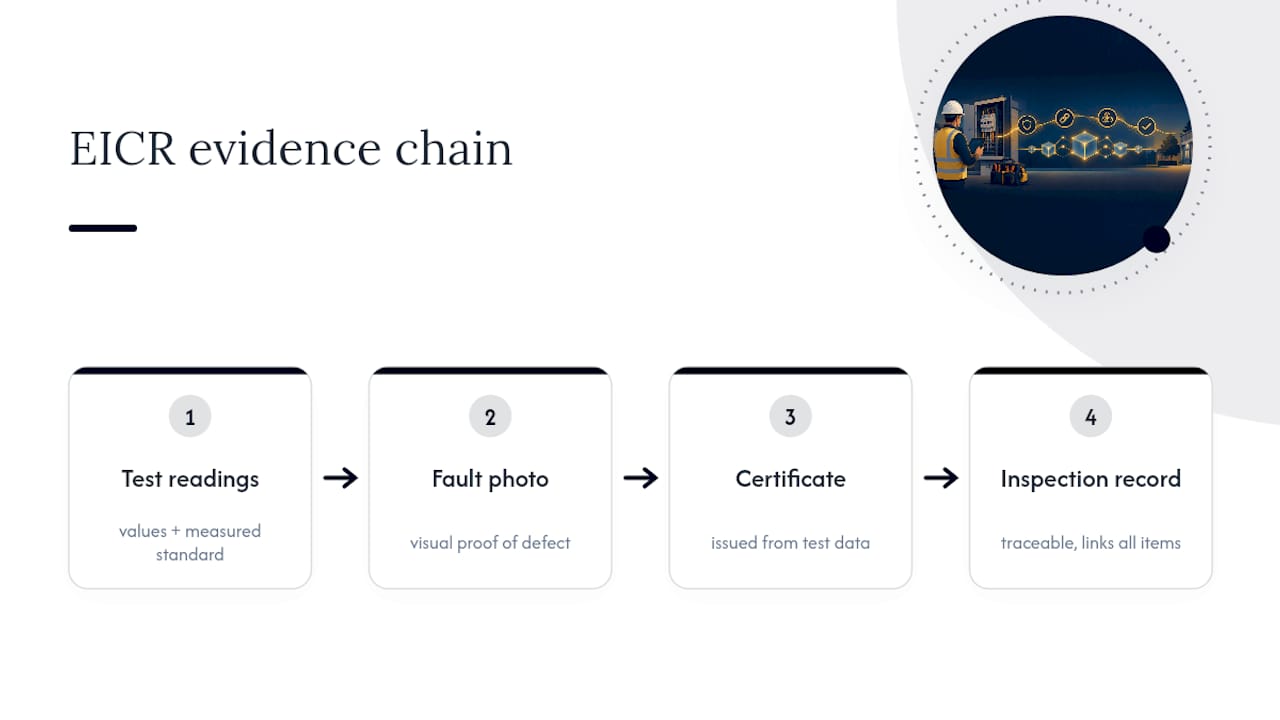
The clearest illustrations of good and bad audit trails tend to surface during disputes, not routine checks. A landlord disputing an EICR finding, for instance, needs more than an engineer's word that a circuit failed. A record showing the specific test readings, the standard they were measured against, a photo of the fault, and the certificate issued off the back of it settles the argument in minutes rather than escalating into a drawn-out complaint.
The inverse also happens constantly. A facilities management contractor loses a service-level agreement dispute not because the work wasn't done, but because nobody can produce evidence it was done on the date claimed. The job log shows "complete" with no timestamp granularity, no photo, and an engineer who's since left the company and can't be asked to confirm anything.
HSE's own enforcement experience with planned maintenance systems for safety-critical equipment is instructive here too: organisations that record test results, downtime and corrective actions traceably tend to demonstrate compliance far more convincingly than those relying on sign-off sheets that only capture a signature and a date. The difference isn't the amount of paperwork. It's whether the paperwork actually answers the question an inspector is going to ask.
How do audit trails support compliance with industry regulations?
Different regulatory frameworks ask slightly different questions, but they converge on the same underlying demand: show your working. HSE's guidance on inspecting work equipment requires that inspection results exist, are retrievable, and cover the period up to the next inspection due date. That's a direct audit-trail requirement, not a suggestion.
ISO 9001 and related ISO management-system standards work slightly differently. Rather than prescribing exact records, ISO's documented information guidance asks organisations to retain whatever demonstrates conformity and competence, with objective evidence obtained through observation, measurement or test. That gives businesses flexibility, but it also means the burden of proving what counts as "sufficient" evidence sits with the organisation, which is exactly why a structured audit trail matters more under ISO's principles-based approach than under a prescriptive checklist.
Sector-specific frameworks such as Gas Safe registration, F-Gas certification, or LOLER thorough examinations layer their own specific record requirements on top. What ties them together is the golden-thread logic GOV.UK has formalised for building safety: a single, versioned, accessible source of truth beats a filing cabinet of disconnected certificates every time a regulator or client asks a question nobody anticipated.
Should audit trails be automated or generated manually?
Manual audit trails, paper forms, spreadsheets, email chains, work until they don't. They're cheap to start and familiar to staff, but every manual step is a point where a record can go missing, get filled in late, or simply get forgotten under pressure. The failure mode isn't dramatic. It's a missed field on a Friday afternoon that nobody notices for six months.
Automated audit trails, generated by the software an engineer already uses to complete the job, remove most of that risk by design. A timestamp captured automatically when a form is submitted can't be backdated by accident. A photo attached at the point of inspection can't be substituted later. The trade-off is setup effort: automation only produces good records if the underlying workflow was mapped correctly in the first place, which is why the implementation steps earlier in this piece matter as much as the software itself.
The realistic answer for most field service businesses is a hybrid, weighted heavily towards automation for anything safety-critical or contractually significant, with manual notes reserved for genuinely exceptional situations, an unusual site access issue, a customer conversation that needs context, that don't fit a structured field. The goal isn't eliminating manual input entirely. It's making sure the record that matters most, the one an inspector or a court might eventually read, was captured automatically rather than reconstructed from memory.
How do audit trails affect risk management and incident investigation?
When something goes wrong, a strong audit trail is the difference between an investigation that takes an afternoon and one that drags on for weeks while nobody can agree on what actually happened. Incident investigators typically want to know exactly what maintenance or inspections preceded a failure, who carried them out, and what the results showed at the time.
Without a reliable trail, investigations lean on memory and assumption, which is exactly where disputes and liability exposure multiply. With one, the sequence of events, readings, approvals and any flagged defects sits ready to review, and version history shows whether a known issue was raised and how it was handled before things went wrong.
This is also where the separation-of-duties principle from ICO's logging guidance pays off in a different context. If a serious incident happens and the only records available were editable by the people whose work is now under scrutiny, the investigation itself loses credibility regardless of what actually occurred. A tamper-evident trail protects the business and the individuals involved in equal measure, because it removes any question about whether records were adjusted after the fact.
Risk management benefits even without an incident. Patterns in defect reports, repeat readings that sit close to a failure threshold, or recurring corrective actions on the same asset become visible across a properly logged history in a way that scattered paper records simply can't surface.
Why treat the audit trail as a control, not a log
Most businesses build their audit trail after something has already gone wrong. That's backwards, and it's the single biggest change I'd push for: treat the export as a live control you test regularly, not an archive you hope never gets opened.
Start with your riskiest job type. Get an export in front of someone who wasn't involved in the job and see if they can follow it cold. If they can't, you've found your gap before an inspector does.
— Luke Herridge
How Curcle turns compliance records into audit-ready evidence
Curcle brings jobs, engineers, assets, certificates and reporting into one connected system, which is precisely the single source of truth the golden-thread principle asks for. Rather than reconciling three separate systems before an inspection, operations managers pull one export that already links a job to the engineer who did it, the asset it affected, and the certificate it produced.

Certificate and asset registers, version history on every change, and role-based dashboards mean the separation between operational staff and audit review is built into the platform rather than managed by policy alone. That matters because a control nobody enforces isn't really a control. Curcle's features page breaks down how job scheduling, compliance tracking and audit exports connect in practice, and the product tour walks through a live view of how a certificate moves from issue to export without leaving the platform.
Pricing runs across four plans: Starter from £99 per month, Professional from £249 per month, Business from £499 per month, and Enterprise on request. If your inspection or certificate volume is growing faster than your paperwork can keep up, book a demo through the pricing page and see what a genuinely exportable audit trail looks like on your own jobs.
This article is general information, not a substitute for advice from a qualified lawyer. Consult a qualified legal professional about your own circumstances before acting on anything here.
Sources
- Inspection of work equipment - HSE
- What are the security considerations for logging? | ICO
- Understanding the golden thread | GOV.UK
- Documented information needed to be retained (ISO)
FAQ
What is a field service audit trail?
It's a tamper-evident, time-stamped record linking every job, engineer action, asset change and certificate event so the sequence can be verified later. Platforms such as Curcle build this directly into job scheduling and compliance tracking, so the record exists as a by-product of the work itself.
How long must audit trail records be kept?
Retention depends on record type rather than a single blanket period. HSE requires inspection results to be kept at least until the next inspection, while certificates and contractual evidence may need longer depending on the specific regulation or agreement.
What makes an audit trail tamper-evident?
Ordinary users must be unable to alter existing entries, corrections should appear as new attributable events, and privileged access should sit with a small, reviewed group. ICO's logging guidance sets out these controls as the baseline for credible logs.
What should an audit export include?
A usable export needs stable job, site and asset identifiers, readable timestamps, actor identity, old and new values for any changes, and links to supporting evidence such as photos or certificates. This mirrors the objective-evidence approach in ISO's documented information guidance.
How much does Curcle cost?
Curcle's plans start at £99 per month for Starter, with Professional from £249 and Business from £499 per month. Enterprise pricing is available on request through the pricing page.