

Track five numbers: asset certification coverage, certificate completion rate, inspection pass and remediation rate, SLA compliance, and mean time to resolve compliance issues. Together they show where a certificate is about to lapse, which sites are falling behind, and how fast your team closes the gap. Review exceptions daily, walk through trends weekly with managers, and roll a summary up to leadership monthly.
TL;DR:
- The asset certification coverage should be monitored daily as a snapshot, focusing on assets with valid certificates at a specific time point.
- A certificate completion rate only counts jobs that are both completed and have a signed, valid certificate attached, not just marked as finished in the system.
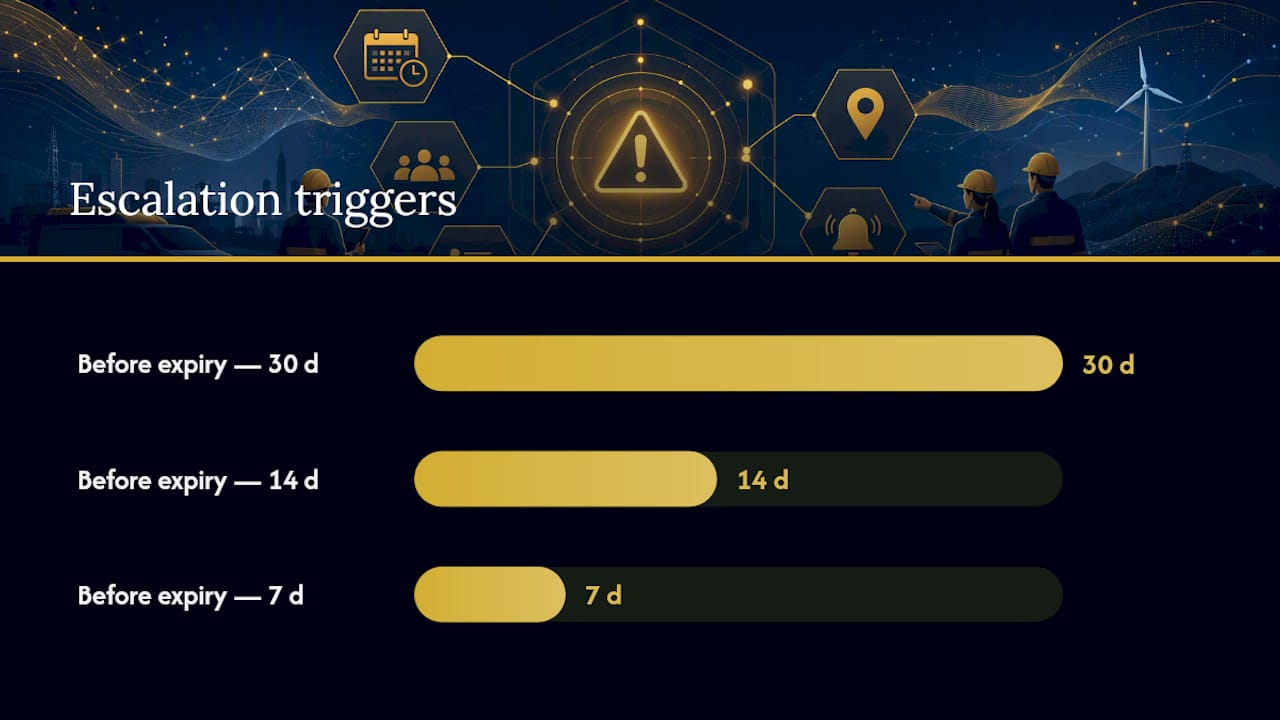
- SLA compliance targets should be set at 95% or higher, with automated alerts triggered 7, 14, and 30 days before expiry to prevent breaches.
- Most audit findings originate from small, overlooked gaps such as unrecorded serial numbers or calibration entries labeled "OK" without data, not from major failures.
- Implementing strict, consistent KPI definitions and real-time evidence capture during work ensures trustworthy compliance measurements and effective audits.
Table of Contents
- Core compliance KPIs and what each one measures
- How do you measure each compliance KPI accurately?
- Building dashboards and reporting that people actually use
- How do you roll out compliance KPI tracking without disrupting operations?
- What causes most compliance audit findings?
- What I've learned building compliance tools inside a real service business
- See how Curcle turns job data into KPI dashboards
- Sources
Core compliance KPIs and what each one measures
Most operations teams already collect the raw data behind good compliance KPIs. The problem is usually that it sits in three different systems and nobody has agreed what "on time" or "complete" actually means. Fix the definitions first, and the numbers start doing real work.
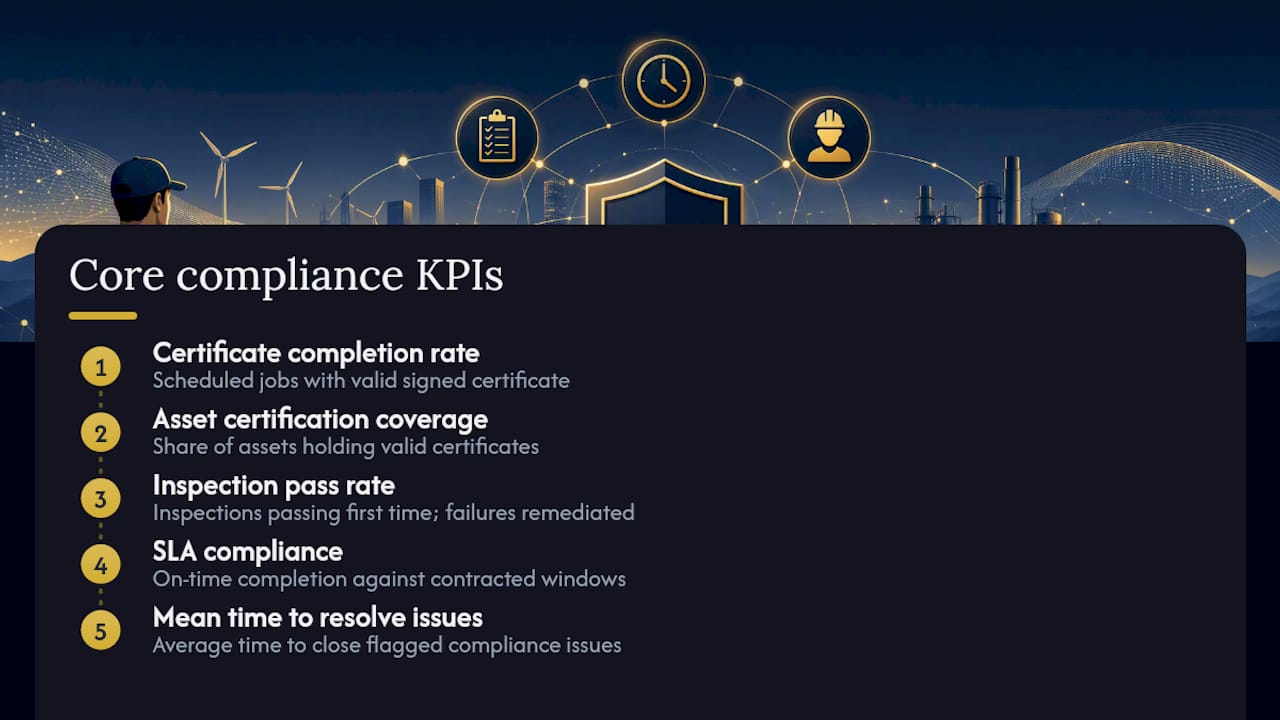
Certificate completion rate measures the percentage of scheduled jobs that end with a valid, signed certificate attached, not just a job marked "complete" in the system. A CP12 gas safety check or EICR that gets carried out but never has its paperwork filed is functionally the same as a missed visit if an auditor asks for it later. This is the metric that catches engineers who do the work but skip the admin.
Asset certification coverage tracks the share of assets on your register that currently hold a valid, in-date certificate. This one matters most for contract compliance. Facilities and multi-site clients increasingly expect a live coverage figure, not a retrospective audit trail assembled after the fact.
Inspection pass rate shows what proportion of inspections pass first time, with a separate remediation tracker for anything that fails. A dropping pass rate on a specific asset class, say lifting equipment under LOLER, is usually an early warning of ageing stock or a training gap, long before it becomes a safety incident.
SLA compliance (on-time completion against contracted response and fix windows) has direct commercial teeth: miss it repeatedly and you're looking at penalty clauses or a lost contract at renewal. Inspection-heavy operations commonly set an SLA compliance target around 95% or higher, which is a sensible baseline to adopt unless your contracts specify otherwise.
Mean time to resolve compliance issues measures how long a flagged fault, failed inspection, or expired certificate sits open before it's closed out. A short MTTR is what actually reduces operational risk, because most compliance failures aren't caused by one missed job. They're caused by a known issue that lingered for weeks.
How do you measure each compliance KPI accurately?
A KPI is only as trustworthy as its definition. Vague rules produce numbers that different sites calculate differently, which makes them useless for comparison. Set these definitions once, document them centrally, and apply them everywhere.
- Certificate completion rate: numerator is jobs closed with a valid certificate attached; denominator is all jobs scheduled for that certificate type in the period. Source it from the job record, not the certificate file alone, so cancelled or rescheduled jobs can be excluded correctly.
- Asset certification coverage: numerator is assets with an in-date certificate on the register right now; denominator is total active assets. Pull this from the asset register at a fixed point in time, ideally daily, since it's a snapshot metric rather than a period total.
- Inspection pass rate: numerator is inspections passed without remediation required; denominator is total inspections completed. Partial passes with minor remediation should be flagged separately rather than folded into either bucket.
- SLA compliance: numerator is jobs completed within the contracted window; denominator is all jobs with an SLA attached. Decide up front how you treat customer-caused delays, because that single rule can swing the figure by several points.
- Mean time to resolve: measured from the moment an issue is flagged (failed inspection, expired certificate, open fault) to the moment it's formally closed with evidence.
Pro Tip: Make checklist fields non-skippable in the field app and require a photo or signed certificate attachment before a job can close. This single change removes most of the missing-evidence problems that surface later during audits.
Building dashboards and reporting that people actually use
A dashboard only earns its place if it changes what someone does that day. Match the visual to the decision it needs to drive, not to what looks impressive in a screenshot.
- Asset certification coverage works best as a simple gauge or percentage bar, refreshed daily.
- Certificate and inspection expiries belong on a calendar view, colour-coded by urgency.
- Mean time to resolve reads best as a trend line, since a single figure tells you nothing about direction.
- SLA compliance suits a rolling percentage against target, broken down by contract or site.
Cadence matters as much as the visual. Operations staff need daily alerts on exceptions, not a monthly report. Managers should get a weekly review that surfaces trends by site and engineer. Leadership needs a monthly summary that rolls everything up to a handful of headline figures.
Role-based drill-downs keep the same data useful at every level: an engineer sees their own task queue and outstanding certificates, a site manager sees the full asset list for their location, and a contract manager sees an SLA summary across every site under that agreement. A focused dashboard built around compliance rate, backlog, and MTTR moves teams from reacting to problems to spotting them coming. Set escalation triggers at 30, 14, and 7 days before certificate expiry, plus an immediate alert the moment an SLA breach occurs.
How do you roll out compliance KPI tracking without disrupting operations?
Don't try to instrument every KPI across every site simultaneously. Most rollouts stall because the definitions weren't tested before they went wide.
- Assign a named owner for assets, certificates, and job compliance data. Without ownership, nobody notices when a definition drifts.
- Pilot the KPI set on one or two sites first, checking that the numerator and denominator rules actually hold up against messy real-world job data.
- Build mandatory checklist items and automated expiry alerts into structured job templates, so compliance capture happens as part of the job, not as a separate admin task afterwards.
- Feed certificate capture directly into job closure, and route completed service reports into a triage workflow rather than a filing cabinet.
Keeping the KPI list tight also matters. A compact set of five to seven KPIs mapped to your current operational maturity beats a dashboard crammed with thirty measures nobody reviews.
Pro Tip: Run your pilot sites for a full billing or inspection cycle before rolling out further. A two-week pilot won't surface the exceptions (cancelled jobs, part-way completions) that break a KPI definition in practice.
What causes most compliance audit findings?
Audit findings rarely come from one dramatic failure. They come from small gaps that compound: a part swapped without a recorded serial number, a calibration entry that just says "OK" instead of a measured value, or a service report that never reached anyone who could act on it.
- Traceability gaps between parts, serial numbers and device records are among the most common audit findings in regulated field service.
- Non-specific calibration entries hide drift that a measured value would have caught immediately.
- Service reports that don't feed into a triage or complaint process leave known issues open indefinitely.
- Inconsistent KPI definitions across sites make period-on-period comparisons meaningless. Fix this by documenting the numerator, denominator, and exceptions in one central place, not in each site manager's head.
What I've learned building compliance tools inside a real service business
Curcle wasn't designed on a whiteboard. It grew out of a working UK engineering and service business that lived with exactly the problems this article describes: certificates filed but not linked to the job, calibration values recorded as "pass" with no number behind them, and MTTR nobody could actually calculate because the data lived in three places.
The lesson that stuck: a KPI is only trustworthy when the evidence behind it is captured at the point of work, not reconstructed afterwards. That's why we built free CP12, EICR and LOLER templates and short demo walkthroughs, so teams can test a measurement definition against real jobs before committing to a full rollout.
— Luke Herridge
See how Curcle turns job data into KPI dashboards
Curcle gives you one place where jobs, assets and certificates connect automatically, so certificate completion rate, asset coverage and MTTR calculate themselves instead of being chased down at month end. Every certificate captured on a job attaches straight to the asset record, which is what makes an audit trail genuinely traceable rather than reconstructed under pressure.

If you're currently pulling these numbers from spreadsheets or three separate systems, watch how the workflow actually connects on the product demo, or start with the free compliance templates to pilot your own KPI definitions before rolling out further. For a full view of how job scheduling, asset registers and compliance tracking sit together, the field service management platform page walks through the whole system, and the trust and security page covers how certificate and customer data are protected. Book a demo when you're ready to see your own data structured this way.
Sources
- Field Service Engineering for Medical Devices: MDR Compliance
- How to Build a Maintenance Department KPI Dashboard in 2026 (With Examples)
- Field service KPI framework: metrics that drive performance & growth