

Automated compliance reporting automatically consolidates evidence, validates controls and produces audit-ready reports, so compliance teams can demonstrate continuous adherence with less manual work. Instead of chasing screenshots and spreadsheets before every audit, the system pulls from live data sources, checks them against widely used frameworks such as GDPR, ISO 27001, SOC 2 and PCI DSS, and generates reports on a schedule or on demand. For teams still stitching evidence together by hand, the case for switching is straightforward.
- Continuous control monitoring replaces the pre-audit scramble with a permanent state of readiness.
- Evidence packs are generated and hashed automatically, cutting the manual verification work auditors usually demand.
- Fewer people touch the data, which means fewer transcription errors and fewer gaps discovered too late.
Vendors and platforms like Curcle build these capabilities specifically for compliance-heavy operations, where a missed certificate or an expired inspection carries real financial and legal consequences. Fortinet's glossary on compliance automation describes the same core idea: continuous monitoring, automated evidence collection, and streamlined audit preparation, working together rather than as separate tools bolted on afterwards.
Key takeaways
Automated compliance reporting works because it replaces periodic, manual evidence gathering with continuous monitoring, validated data pipelines, and audit-ready exports that hold up under scrutiny.
| Point | Details |
|---|---|
| Definition matters | Automated compliance reporting means continuous control monitoring, evidence collection, and validated report generation, not just faster spreadsheets. |
| Architecture drives reliability | Connectors, an evidence engine, templates, dashboards, and exports must work together, or the output is only as good as the weakest component. |
| Automation has real limits | Judgement, remediation strategy, and contextual narrative for auditors still require human compliance expertise. |
| Integrity measures build trust | Cryptographic hashing and version control let auditors verify a chain of custody far faster than manually assembled folders. |
| Curcle applies this to field service | Curcle generates certificates like LOLER and F-Gas directly from mobile-captured field evidence, supporting recurring inspections and centralised reporting. |
Table of Contents
- What automated compliance reporting actually does behind the scenes
- What automation actually improves, and where it stops
- A six-step roadmap for automating compliance reporting
- Building an evidence pack an auditor will actually trust
- Getting the integration and security architecture right
- What to show executives, auditors, and operations teams
- How Curcle handles this in real field service operations
- Why the roadmap matters more than the software
- Curcle: built for compliance-heavy field service teams
- Sources
What automated compliance reporting actually does behind the scenes
Automated compliance reporting is not one feature. It is a chain of components that has to work end to end, or the output is only as trustworthy as its weakest link.
- Connectors pull data from source systems, job management platforms, HR tools, payment processors, asset registers, and identity providers.
- An evidence engine timestamps, tags, and stores what those connectors retrieve, so every data point has a traceable origin.
- Templates and validators map raw evidence against the specific clauses of a framework, flagging anything that doesn't fit the expected schema.
- Dashboards surface what's current, what's missing, and what's overdue, giving teams a single view instead of five browser tabs.
- Export functions package the validated evidence into the format an auditor, regulator, or board actually wants.
Continuous control monitoring sits underneath all of this. Rather than checking a control once a quarter, the system polls it constantly, so a lapsed certificate or a misconfigured permission gets flagged the day it happens, not the week before the audit. Scheduled reports then run automatically, weekly compliance summaries to a manager, monthly board packs, quarterly regulator submissions, while ad-hoc exports handle the unplanned request that lands on a Tuesday afternoon.
Export formats matter more than people expect. PDF still dominates for board and regulator submissions because it's static and easy to sign off. XLSX suits internal reconciliation work where someone needs to filter or pivot the data. API and SFTP exports matter for organisations feeding compliance data into a governance, risk, and compliance platform or a parent company's reporting system. Insightsoftware's compliance reporting automation overview notes that automated solutions typically span multiple frameworks at once, which means schema validation has to check a data point against several rulesets simultaneously, not just one. A field engineer's LOLER inspection record, for instance, might need to validate against an internal SLA and a statutory format at the same time. Get the schema wrong and the export looks fine until an auditor tries to reconcile it against their own checklist.
What automation actually improves, and where it stops
The efficiency gains are real, but they're specific. Automated reporting doesn't make an organisation compliant on its own. It makes the process of proving compliance faster and less error-prone.
- Accuracy improves because data is pulled directly from source systems rather than retyped into a spreadsheet by someone working from memory.
- Speed improves because reports that once took days of collating now generate in minutes.
- Fewer missed items result from continuous monitoring catching a lapsed certificate the day it lapses, not the day before an audit.
- Less evidence chasing happens because the system already knows who owns what, so nobody's emailing five people asking for the same PDF.
- Ownership becomes clearer because every control has an assigned owner visible on the dashboard, rather than living in someone's head.
What automation can't do is replace judgement. A dashboard can tell you that a control has failed three times this quarter. It cannot tell you whether that pattern reflects a training gap, a process flaw, or a one-off supplier error, and it certainly can't decide the right remediation strategy. Automated systems are also poor at writing the contextual narrative auditors and boards actually want: why a deviation happened, what changed as a result, and what risk remains. That's still a human task.
Pro Tip: Treat the automated report as the evidence base, not the finished submission. Budget time for a compliance lead to add two or three sentences of narrative context before anything goes to a board or regulator.
A six-step roadmap for automating compliance reporting
Moving from manual reporting to an automated system rarely fails because the technology doesn't work. It fails because teams skip the groundwork. Here's the sequence that holds up in practice.
- Map obligations and required outputs. List every regulation, standard, and contractual clause your organisation must report against, GDPR data subject rights, ISO 27001 Annex A controls, SOC 2 trust criteria, PCI DSS requirements, and note exactly what output each one demands and how often.
- Catalogue data owners. Every control needs a named person accountable for its evidence, not a department. Ambiguous ownership is the single most common reason automated systems drift out of date within a year.
- Choose integration patterns. Decide whether each data source needs a live API connection, a scheduled batch pull, an event stream, or manual capture through a mobile app for field-based evidence like photos and signatures.
- Build and validate templates. Configure report templates against the mapped requirements from step one, then run them against historical data to check the schema actually produces something an auditor would recognize.
- Pilot with reviewers. Run the automated reports alongside your existing manual process for one full reporting cycle. Adjust service-level agreements for review turnaround, and train reviewers on where the system's judgement stops and theirs begins.
- Scale and maintain version control. Once the pilot proves reliable, extend it across the organisation, and keep every template, mapping, and evidence bundle under version control so you can show exactly what changed and when.
A few things trip teams up consistently at each stage:
- Skipping the obligations map and buying a tool before knowing what it needs to produce.
- Assuming a connector exists for every legacy system, when older asset registers and paper-based logs often need a manual bridge.
- Under-resourcing the pilot phase, which is where template errors surface before they reach a real auditor.
- Forgetting that training isn't a one-off session, new starters need it too, and frameworks change annually.
Quality frameworks reinforce why the sequencing matters. ASQ's guidance on quality management systems stresses documented processes and traceability as the foundation of continual improvement, and that principle applies directly here: an automated report is only as credible as the documented process behind it.
Building an evidence pack an auditor will actually trust
An audit-ready evidence pack is not just a folder of exported PDFs. Auditors want to see the full trail behind each claim, not just the claim itself.
A properly assembled pack typically includes:
- Raw logs from the source systems, unedited, showing exactly what was recorded and when.
- Reviewer annotations explaining any manual override or judgement call made along the way.
- Timestamps on every entry, so the sequence of events is never in question.
- Approver identities attached to sign-offs, so accountability is traceable to a named person.
- Snapshots of the relevant system configuration at the time evidence was captured, since a control's status often depends on settings that change later.
The integrity layer is where automated systems earn their keep over manual ones. Applying a cryptographic hash or digital signature to a finished evidence bundle means any later alteration is instantly detectable, because the hash won't match if a single character changes. Auditors generally accept cryptographically hashed bundles far faster than manually assembled folders, since the hash itself proves the chain of custody rather than relying on someone's word that nothing was edited. Version control matters just as much: every template update and remapped control needs a record of what it replaced and why.
For speed, the practical tactic is pre-building export profiles for the requests that come up repeatedly, a standard regulator submission format, a board pack format, an insurer's format. Commercial reporting platforms increasingly advertise exactly this: pre-built templates and scheduled exports to SFTP or email that compress audit preparation from days to minutes. When a regulator emails asking for evidence within 48 hours, having that export profile ready is the difference between a calm afternoon and a scramble.
Getting the integration and security architecture right
The reliability of an automated compliance report depends entirely on how well the underlying systems talk to each other. Get the architecture wrong and the dashboard looks confident while quietly reporting stale or incomplete data.
Four integration patterns cover most situations:
- API connectors for systems that support live, structured data pulls, the most reliable option where available.
- Event streams for high-frequency data like access logs or transaction records, where you need near real-time flagging rather than a daily snapshot.
- SFTP transfers for legacy systems or third-party partners who can only export on a schedule.
- Mobile agents or field apps for evidence that starts as a physical action, a completed inspection, a signed certificate, a photo of a repaired asset.
Schema validation has to happen at the point of ingestion, not after a report is already built. Mapping incoming data to the exact fields a framework requires, PCI DSS's cardholder data handling requirements are a good example of a standard with unusually strict field-level expectations, as PCI Security Standards Council guidance sets out, catches malformed or mismatched entries before they corrupt a report rather than after.
Security controls need to match the sensitivity of what's being reported. Encryption in transit and at rest is the baseline. Role-based access control ensures a field engineer can submit evidence without being able to alter a completed audit trail, while a compliance manager can approve without needing raw system access. Logging every access and change, and setting retention policies that match your regulatory obligations rather than a default database setting, closes the loop. Curcle's approach to trust and security reflects this layered model: access, encryption, and audit logging treated as inseparable from the reporting function itself, not bolted on afterwards.

What to show executives, auditors, and operations teams
The same underlying data needs three different presentations, because a board member and a field operations manager are asking different questions of it.
Executive summaries should stay high-level: overall compliance posture, trend direction, and the two or three items that carry genuine business risk. Nobody at board level needs to see every individual control. Operations dashboards need the opposite: specific evidence gaps, which SLAs are at risk, and who owns the fix. Practical dashboards work best when they answer "what needs attention" rather than displaying dense raw tables, a point ZoTracker's compliance dashboard guidance makes clearly: the value is in converting scattered records into an answer, not just a display.
Four KPIs tend to matter most across all three audiences, just weighted differently:
- Controls monitored as a proportion of controls required by the frameworks in scope.
- Evidence coverage, the percentage of controls with current, validated evidence attached.
- Time-to-evidence, how long it takes to produce a requested piece of evidence on demand.
- Outstanding remediation, items flagged as non-compliant and not yet resolved, aged by how long they've been open.
Delivery cadence should match the audience's decision cycle. Boards typically want monthly or quarterly summaries timed to board meetings. Regulators want whatever cadence their own reporting calendar demands, often annually with the option of ad-hoc requests. Operations teams benefit from weekly or even daily dashboard refreshes, since that's the timeframe in which a missed certificate can still be fixed before it becomes a finding.
How Curcle handles this in real field service operations
Curcle was built inside a working UK service and engineering business, not designed on a whiteboard for a generic market. That distinction shows up directly in how compliance reporting works inside the platform.
Field engineers capture evidence, photos, signatures, meter readings, on a mobile app that works offline and syncs once connectivity returns, so a site with no signal doesn't become a compliance gap. Certificates for Gas Safe, EICR, PAT, LOLER, and F-Gas work generate directly from that captured evidence rather than being typed up separately afterwards, which removes an entire layer of transcription risk. Recurring inspections and renewals run on their own schedule inside Curcle's compliance inspection tools, so a LOLER examination due in eleven months doesn't rely on someone remembering to check a spreadsheet.
Everything then rolls up into centralised reporting, visible to office teams and field teams from the same source of truth, which is the specific problem Curcle was built to solve: disconnected information between people doing the same job from different systems.
- Certificate generation ties directly to captured field evidence, not a separate admin step.
- Recurring inspection schedules run automatically rather than depending on manual tracking.
- Office and field teams see the same live data, closing the gap that causes most compliance surprises.
Pro Tip: If you're piloting automated reporting for the first time, start with your highest-risk recurring inspection, LOLER or F-Gas are common choices, and use Curcle's free compliance templates to see what a structured, audit-ready record actually looks like before building your own.
Why the roadmap matters more than the software
Most advice on this subject leads with the tool, which vendor, which dashboard, which integration. That's backwards. The organisations that get automated compliance reporting right are the ones that do the unglamorous mapping work first, naming every obligation, assigning every control to a person, before they touch a platform.
The conventional wisdom oversells what automation replaces. It doesn't replace a compliance manager's judgement about whether a deviation is serious or explainable. It replaces the hours spent proving that judgement was applied correctly, chasing screenshots, retyping figures, hunting for the one email that confirms an approval happened. That's the actual return on investment, and it's bigger than most teams expect once evidence stops living in inboxes.
If you're prioritising one thing first, make it ownership. A brilliant dashboard connected to a control nobody's accountable for will quietly drift out of date within two quarters. Get the human accountability right, then let the system do what it's actually good at: watching continuously, flagging early, and keeping a record nobody has to reconstruct from memory later.
— Luke Herridge
Curcle: built for compliance-heavy field service teams
Curcle is the practical route to automated compliance reporting for engineering and field service businesses that can't afford a lapsed certificate or a missing inspection record. Where generic compliance software treats field evidence as an afterthought, Curcle was built around it from day one, because it grew out of a real UK service business dealing with exactly these problems.
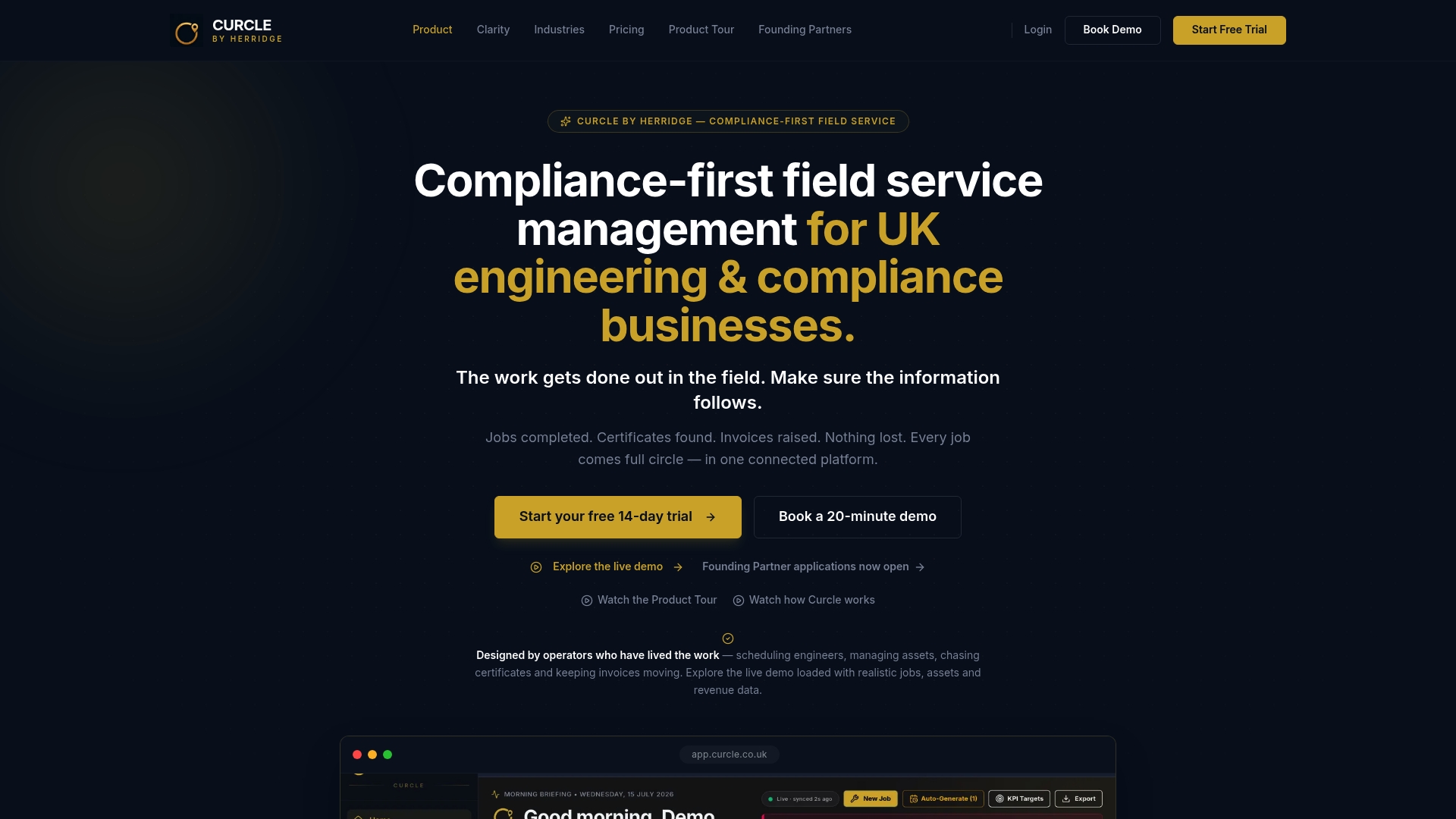
Jobs, engineers, assets, and compliance records all sit in one connected system, so a completed inspection automatically feeds the certificate, the audit trail, and the dashboard your office team already relies on. That means less time reconciling three separate spreadsheets and more time acting on what the data actually shows. Explore how Curcle's feature set brings compliance, scheduling, and reporting together, or look at Curcle's field service management software to see how it fits engineering and multi-trade operations specifically. If you're ready to move past manual evidence chasing, book a demo and see your own compliance data structured this way within a week.
Sources
Automated compliance reporting draws on established standards bodies and a growing set of specialist tools worth knowing.
- PCI Security Standards Council
- ASQ — Quality management system resources
- Reporting & Audit | ComplianceSuite
- Compliance Reporting Dashboard and Audit-Ready Reports | ZoTracker