
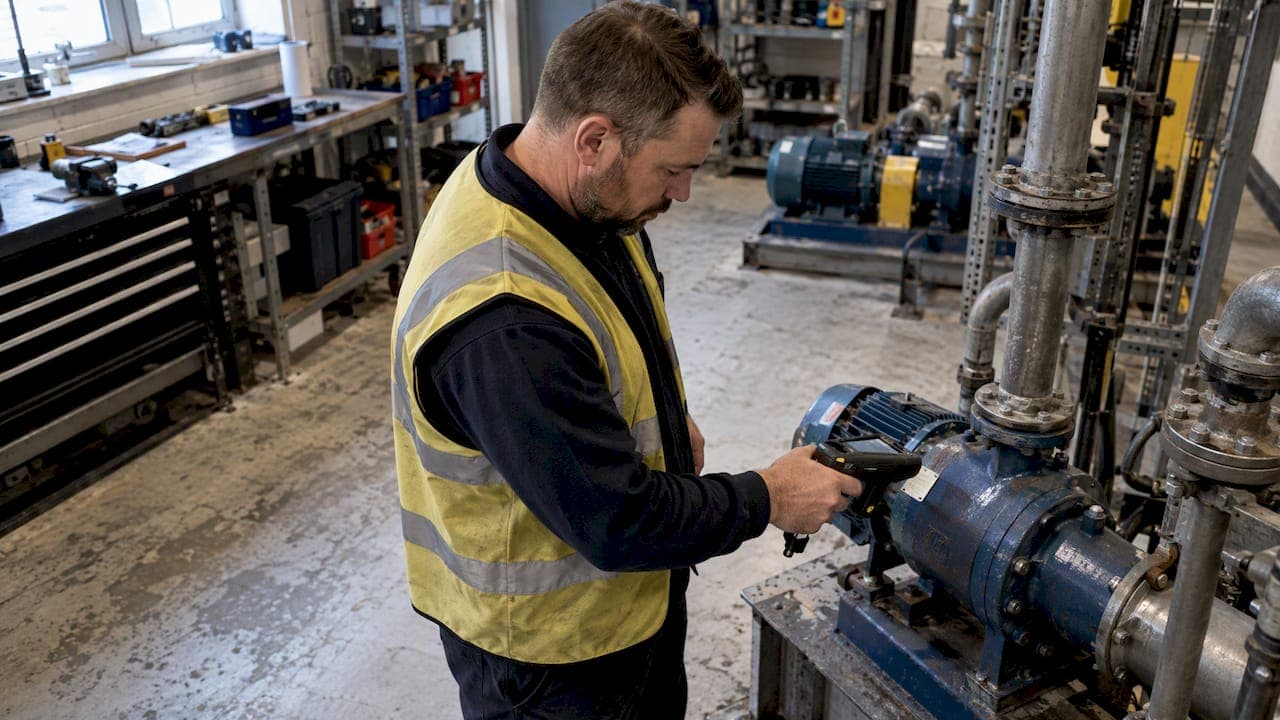
Asset lifecycle tracking is the practice of maintaining a live asset register linked to the right tracking technology and maintenance records, so that assets are used, maintained and retired on a schedule that reduces downtime and proves compliance. The practical approach combines a single source of truth for every asset, tagging or telemetry suited to the environment, and maintenance records that answer the questions a regulator or auditor will actually ask. Frameworks such as ISO 55001 and HSE guidance give the structure; the rest comes down to discipline in how you capture and use the data.
TL;DR:
- Proper asset lifecycle tracking requires consistent data capture at each stage to prevent later gaps in downtime or audits.
- Standardizing tag placement and using mixed RFID and barcode systems improves read accuracy and reduces ghost assets in complex environments.
- Maintaining a secure, role-based asset register with unique IDs, version history, and reconciliation prevents data degradation and conflicting records.
- Compliance records must demonstrate that assets remain fit for use, including location, test results, calibration dates, and supporting photo evidence.
- Most lifecycle tracking failures stem from poor data governance and ownership, not hardware limitations, emphasizing the importance of disciplined data management.
Table of Contents
- The five stages of the asset lifecycle and what each one needs
- Choosing between barcode, RFID and IoT tracking
- Building an asset register that works as your single source of truth
- What inspectors expect from your maintenance records
- The KPIs that tell you whether your lifecycle approach is working
- Rolling out lifecycle tracking without disrupting operations
- Quick wins to start this month
- Building this from inside a real service business
- Risk and compliance beyond maintenance schedules
- Keeping tracking data secure as sensors multiply
- Making continuous improvement part of the routine, not a project
- What successful implementations tend to look like
- Why most lifecycle advice underweights the register itself
- Where Curcle fits once your register is ready
- FAQ
- Sources
The five stages of the asset lifecycle and what each one needs
Every physical asset moves through five broad stages, and each one has a distinct data job to do. Skipping the data at any stage tends to show up later as unplanned downtime or an audit gap.
- Planning: define the need, expected duty cycle and budget, and record the business case against which performance will later be judged.
- Acquisition: capture serial number, purchase date, supplier, warranty terms and installation condition at the point of handover.
- Operation and utilisation: log usage hours, duty cycle, location and condition checks so you know how hard the asset is actually working.
- Maintenance: record every inspection, repair, part replacement and test result against a fixed schedule, not an ad hoc one.
- Disposal and renewal: document the end-of-life decision, condition at retirement and disposal method, including any compliance sign-off required.
Capturing these fields consistently at each stage is what keeps total cost of ownership visible rather than guessed at. It also means a maintenance planner or finance lead can pull a single asset's full history without chasing five different spreadsheets.
Choosing between barcode, RFID and IoT tracking
The right tracking technology depends on scale, environment and how often you need a status update rather than a technical preference. Barcodes are cheap and simple: a technician scans a label during a visit, and the system updates. They work well for low-volume estates but depend entirely on someone remembering to scan.
RFID removes some of that manual step. Passive tags can be read in bulk without line of sight, which suits stock rooms and fleets; active tags add their own power source for longer range and real-time localisation. Research into RFID and IoT integration shows that richer lifecycle records follow when tag orientation and placement are standardised, because misalignment increases read errors and can create ghost assets that were never actually scanned.
- Barcode: lowest cost, manual scan, best for low-frequency checks.
- Passive RFID: bulk reads without line of sight, good for inventory and stock rooms.
- Active RFID or IoT sensors: live location and condition telemetry, higher cost and connectivity needs.
Pro Tip: Standardise tag placement and orientation across every site before you scale a pilot, since inconsistent mounting is the most common cause of missed reads.
Mixed-topology setups, fixed readers at choke points combined with handheld scanners for inspections, tend to outperform any single method in complex industrial sites. The result, stored centrally, functions as a digital twin of the physical estate.
Building an asset register that works as your single source of truth
The register is only useful if every asset has the right fields and nobody can quietly edit them without a trace. At minimum, each record needs a unique ID, serial number, owner or responsible team, current status, safety-critical flags, maintenance schedule and linked documents such as certificates or warranty terms.
- Assign one unique ID per asset and link every tag, barcode or sensor reading directly to that ID, never to a description alone.
- Apply role-based edit permissions so only the register custodian can change safety-critical fields.
- Keep a version history of every change, who made it and when, to support audit trails.
- Reconcile tag reads against the register on a fixed schedule to catch ghost assets before they distort your data.
Without an accountable custodian, registers tend to degrade: duplicate entries creep in, statuses go stale, and the "single source of truth" becomes two or three conflicting ones.
What inspectors expect from your maintenance records
HSE guidance on safety-critical elements expects a live asset register and records that demonstrate equipment remains in good repair and condition, including components identified by location and ID, test details, results and actions taken, as set out in SPC/Enforcement/175. A planned maintenance system does not automatically satisfy this; many routines record that a task was done without capturing whether the asset remains fit for continued use.
The record should show not just that an inspection happened, but that the result proves the asset is still suitable for its purpose.
Designing your maintenance forms around the questions an inspector will ask closes that gap.
- Record the component's location and unique ID alongside every test result, not just a pass or fail.
- Keep photo evidence for safety-critical work, stored against the asset record rather than in a separate folder.
- Log calibration dates for test equipment used, since an inspection is only as credible as the tool that performed it.
- Retain records for the period your sector requires, with a clear chain from inspection to corrective action.
The KPIs that tell you whether your lifecycle approach is working
A small set of metrics does most of the work: preventive versus corrective maintenance ratio, mean time between failures, uptime or availability, maintenance backlog, and cost per asset. Surface uptime, backlog and any sudden rise in "unknown location" counts on daily dashboards, since those signal operational issues that need attention now.
Preventive maintenance performed under a standards-aligned system supports the lifecycle objectives set out in ISO 55001, which frames asset management as balancing performance, risk and cost rather than reacting to failures. Push cost per asset and the preventive-to-corrective ratio into monthly reviews, where trends matter more than daily noise.
Rolling out lifecycle tracking without disrupting operations
A phased rollout avoids the common failure mode of buying tagging hardware before the register is trustworthy.
- Audit your current estate and identify every asset that exists but is not yet recorded anywhere.
- Clean and standardise the register, assigning one ID format and closing duplicate entries.
- Pilot tags or telemetry on a single site or fleet before committing to an estate-wide rollout.
- Integrate the register with your CMMS or operations platform so maintenance tasks update the same record.
- Scale once read accuracy and data entry habits are proven at pilot stage.
Assign clear roles early: an asset owner accountable for the equipment, a register custodian who controls edits, a maintenance planner who schedules work, and field engineers who capture data on site. Pro Tip: Choose a mobile app that works offline before committing to a rollout, since engineers working in plant rooms or basements often lose signal at the exact point they need to log a reading.
Integration should include API sync with accounting or CMMS systems and export formats that match what an auditor expects to receive, usually a PDF or CSV with timestamps intact.
Quick wins to start this month
- Stand up a live register for your most critical assets first, even if the rest of the estate follows later.
- Tag and label safety-critical equipment before anything else, since that is where enforcement risk concentrates.
- Pilot barcode or RFID scanning on one building or fleet and validate read accuracy before expanding.
- Capture baseline KPIs now, even imperfect ones, so future improvement has something to measure against.
Avoid the predictable pitfalls: nobody owning the register, skipping validation of early tag reads, and promising full automation before the data is clean enough to support it.
Building this from inside a real service business
I have spent time inside UK field service and engineering operations where the asset register was a spreadsheet nobody trusted. That experience shaped how Curcle approaches asset tracking: fewer duplicate entries, fields that match what inspectors actually ask for, and audit exports that do not need rebuilding under deadline pressure.
— Luke Herridge
Risk and compliance beyond maintenance schedules
Maintenance compliance is only part of the risk picture. Asset lifecycle tracking also needs to account for financial risk, operational risk and contractual exposure that sit outside a simple inspection calendar.
Financial risk shows up when depreciation schedules and actual asset condition drift apart. An asset written off on the books but still running, or one carried at full value despite heavy wear, distorts budgeting and capital planning. Linking depreciation method, whether straight-line or reducing balance, to the same register that tracks condition keeps finance and operations looking at the same picture rather than two separate ones.
Contractual risk matters for leased or warrantied equipment, where using an asset outside its approved duty cycle can void cover or breach a service level agreement. Recording duty cycle and usage hours against the warranty terms captured at acquisition closes that gap before it becomes an expensive surprise.
Operational risk includes business continuity: knowing which assets are single points of failure and which have no backup if they fail unexpectedly. A register that flags criticality, not just location and status, lets planners prioritise spares and contingency cover where it actually matters.

None of this replaces sector-specific legal advice. Where a compliance question touches on PUWER, LOLER or another statutory duty, the register should point to the primary guidance and a qualified professional rather than attempt to answer it generically.
Keeping tracking data secure as sensors multiply
Adding IoT sensors and RFID infrastructure to an asset register increases the amount of data worth protecting, and widens the number of devices that could become an entry point. Each sensor that reports location or condition is also a potential weak link if it is not managed with the same care as the core system.
Role-based access control is the first line of defence: field engineers need to update records, but only a register custodian should be able to alter safety-critical fields or delete history. Pairing that with a full audit trail, who changed what and when, makes it possible to spot tampering or error quickly rather than discovering it during an incident review.
Network segmentation matters for IoT deployments specifically. Sensors reporting telemetry should sit on a separate network segment from core business systems, so a compromised sensor cannot become a route into financial or customer data. Encrypting data in transit and at rest, and rotating device credentials rather than relying on factory defaults, closes two of the most common gaps in sensor fleets.
Data minimisation is worth applying deliberately: collect the location and condition data a maintenance decision actually needs, not everything a sensor happens to be capable of reporting. Retention policies should mirror the record-keeping periods your sector requires, no longer, since data kept beyond its useful life is a liability with no operational benefit.

Making continuous improvement part of the routine, not a project
Lifecycle tracking delivers the most value when it is treated as an ongoing discipline rather than a one-off rollout. The organisations that keep improving tend to review the same small set of KPIs on a fixed cadence and act on what the trend shows, rather than reacting only when something breaks.
Root cause analysis on recurring failures is one of the more underused habits. When the same asset type keeps failing early, the fix is rarely another repair, it is revisiting the maintenance schedule, the operating environment or the original specification. Feeding that insight back into the planning stage for the next purchase closes the loop between operation and acquisition.
Benchmarking cost per asset and backlog against your own historical trend, rather than an external average that may not reflect your environment, gives a more honest read on whether changes are working. Standardising maintenance forms across sites, so every technician records the same fields in the same format, also makes that comparison meaningful instead of noisy.
Treating the register custodian role as permanent, with the authority to lock fields and reject incomplete entries, is what keeps data quality from sliding back after the initial clean-up effort fades.
What successful implementations tend to look like
The pattern across well-run lifecycle tracking programmes is consistent, even across different sectors: a clean register comes first, technology choice comes second, and integration with day-to-day workflows comes last but is what makes the whole system stick.
A facilities team managing safety-critical plant across multiple sites typically starts by tagging and registering the equipment HSE guidance treats as safety-critical, since that is where enforcement risk is highest and the record-keeping bar is clearest. Mechanical services contractors running recurring planned maintenance contracts tend to see the fastest payback from integrating the register directly with scheduling, since it removes the duplicate entry between a job sheet and an asset history that previously lived in different systems.
Warehouse and stock-heavy operations that adopt passive UHF RFID for inventory report that automated reads can support near-automated stock counts, though the same research emphasises in-situ validation and interference testing before trusting the numbers at scale. That caveat matters more than the headline accuracy figure: a pilot that skips validation tends to produce a register that looks complete and is quietly wrong.
What ties these examples together is sequencing: the technology never leads, the data model does.
Why most lifecycle advice underweights the register itself
The received wisdom on asset lifecycle tracking spends most of its attention on technology choice: barcode versus RFID versus IoT, which sensor, which range. That conversation matters less than it is given credit for. A business with a clean, disciplined register and nothing but barcodes will outperform one with expensive IoT sensors feeding a register nobody maintains.
The gap between what tracking technology promises and what it delivers is almost always a data governance gap, not a hardware one. Ghost assets, ambiguous ownership and inconsistent tag placement cause more lost time than the absence of real-time telemetry ever does. If you can only fix one thing this quarter, fix who owns the register and what "done" means for a data entry, before spending a budget on sensors.
The second underrated point is that compliance and performance tracking are the same exercise, not two separate ones. A maintenance record built to answer an inspector's question about safety-critical condition is, by construction, also the record that tells you whether an asset is running well. Teams that build two separate systems for these purposes end up maintaining twice the data for half the insight.
— Luke Herridge
Where Curcle fits once your register is ready
Once the register and process discipline are in place, the remaining friction is usually having jobs, assets, compliance and reporting live in separate systems that do not talk to each other. We built Curcle around that specific problem, bringing asset registers, recurring inspections, compliance templates and reporting into one connected platform rather than a patchwork of spreadsheets and point tools.

- Import an existing asset register directly rather than rebuilding it from scratch.
- Run recurring inspections and PPM schedules from the same record that holds warranty and compliance history.
- Generate audit-ready exports for certificates such as Gas Safe, EICR, PAT and LOLER without reformatting data under deadline pressure.
- Work from a mobile app built for engineers on site, including offline capability where signal drops out.
If that matches where your operation is heading, you can start by exploring our pricing plans, which start at £99 a month for the Starter plan, or book a platform walkthrough to see how an asset register and compliance workflow sit together in practice.
FAQ
What are the 5 stages of the asset lifecycle?
The five stages are planning, acquisition, operation and utilisation, maintenance, and disposal or renewal. Each stage has its own data requirements, from the initial business case through to the end-of-life decision, and tracking them consistently is what keeps total cost of ownership visible.
What is the process of asset tracking?
Asset tracking is the process of assigning a unique identifier, such as a barcode, RFID tag or IoT sensor, to a physical asset and linking its reads or telemetry back to a central register. That register then holds the asset's status, location, maintenance history and compliance documents as a single, auditable record.
What are the 5 main stages of the data lifecycle?
Definitions vary slightly by source, but a common version covers data collection, storage, processing or use, sharing, and archiving or deletion. In an asset tracking context, this means capturing readings, storing them against the correct asset ID, acting on them through maintenance or reporting, and retaining them for the period your sector requires.
Is SAP an EAM system?
SAP offers enterprise asset management functionality as part of its broader software suite, typically aimed at large organisations with complex, multi-site operations. Smaller or mid-sized service and engineering businesses often choose a more focused asset and compliance platform instead, depending on the scale and complexity of their estate.
Sources
- ISO 55001:2024 - Asset management — Asset management system — Requirements
- RFID and wireless IoT technologies for transportation maintenance operations and asset management (BS Lee et al.)
- Passive UHF RFID for automatic inventory in component warehouses (MDPI, 2026)